
Full spoilers for Sly 3: Honour Among Thieves follow.
“You’re an ignorant child playing dress-up in his father’s legacy.”
– Sly 2: Band of Thieves (2004)
I can unequivocally recommend Sly Raccoon and Sly 2: Band of Thieves. Both games fill a decided niche in the 3D platformer space, creating a compelling narrative out of what appears to be, on its surface, just another 3D platformer with cutesy mascot animals. It focuses on just a few characters, creating something that transcends time and remains eminently playable. It is an understatement to say that I love these games. They founded a part of me, alongside Ratchet, Jak, and Crash, the other PlayStation platforming mascots.
Sly 3, on the other hand, is slightly different. While it’s still a good game, there are a large number of gameplay moments that weren’t as enjoyable as its predecessors. I didn’t quite understand it when I was small. I still loved the game, but it’s the one I’ve replayed the least out of the original trilogy. I spent a lot of time playing it – but that was messing around with the game’s systems in a way that only a kid can do. You might know the feeling. The feeling of messing around for countless hours with how a character moves, and learning how to exploit the stupid AI. Grinding for countless hours getting coins that have no real purpose, because you’ve already bought everything. But it’s fun. It’s fun to inhabit a world that means a lot to you, and to do it with characters that mean a lot.
Sly 3, however, unlike the previous two games, can feel a bit more muddled. It is short – shorter than I remembered. Playing it through again this year, for the first time in (yuck) thirteen years, I found myself surprised by its brevity. But also by my reluctance to finish it. Whereas I can pick up Sly 1 and Sly 2 and just play and play until it’s finished, Sly 3 doesn’t seem to flow quite so smoothly. Part of that problem is that we just don’t get to play as Sly so much anymore. A lot of the time, we are playing minigames or with new toys, that, while fun, just don’t measure up to just doing platforming.
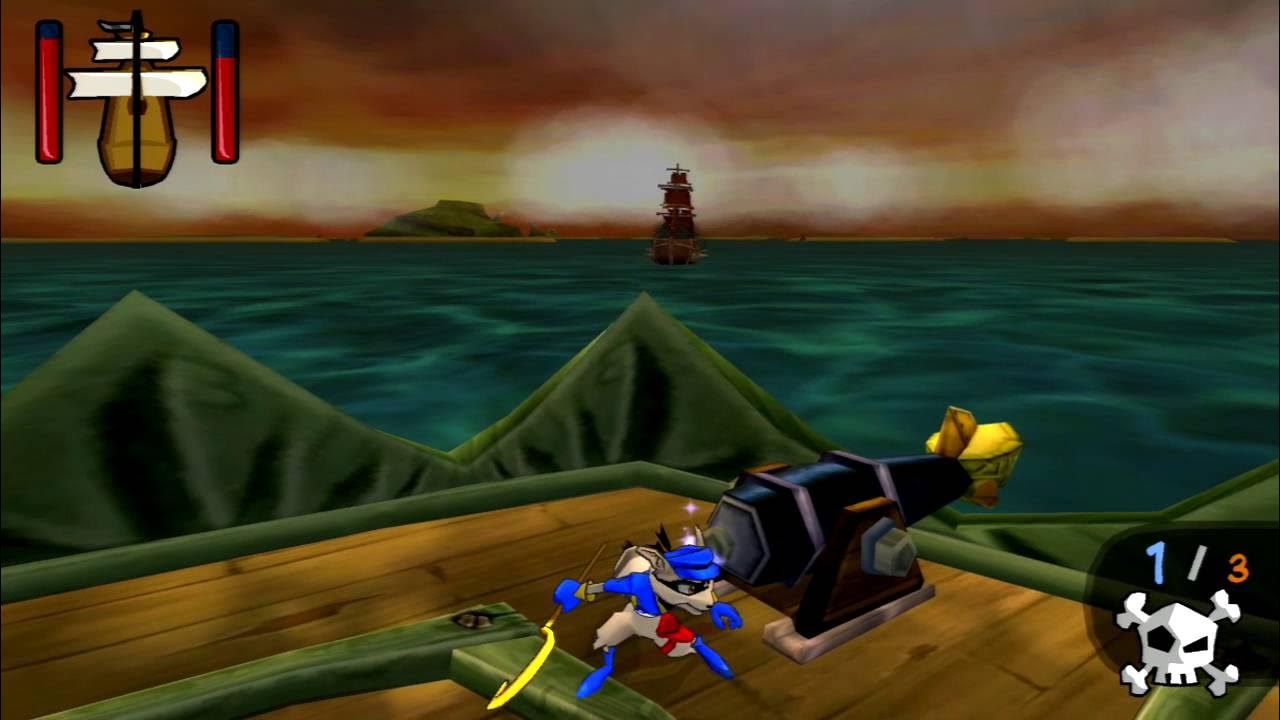
Some of these minigames are actually pretty fun. I like rowing the boat as Murray, for instance, and piloting the pirate ship is a particular joy of mine. I spent countless hours doing the ship battles in that mode when I was a child, and even when replaying it this year, I found myself drawn to it yet again. The mechanics are simple but effective – as representative as it needs to be of being a pirate in a fairly liminal set of islands. Nothing but pirates and jungle islands – some kind of video game dream, I suppose. It’s no Sid Meier’s Pirates, but it really does the job. The soundtrack is fantastic, too – I have had several tracks from the game rattle round in my head unbidden, even ten years or so since properly replaying the game. When I came to certain areas or certain missions, I found the music was already playing in my head, anticipating its presence in the game. That’s how you know a game is, at the very least, formative. The rush of nostalgia was nice, but it was also nice to discover that most of the game really did hold up.
As usual as well, the game does a really good job with (most) of its villains. It is the first game with a truly dud villain (the Mask of Dark Earth has zero personality and doesn’t even get a backstory), and it is also the first game where the villains in each episode aren’t connected to each other. The first villain of the game, Don Octavio, is fantastic. An aged opera singer turned into a mob boss, Octavio conspires to get everyone to like opera again. And he’s a legitimately great boss fight, a two phase boss that spans the entirety of the level as you have to use the environment against him. He acts as a turning point, though – he’s the last villain we confront with just the three original members of the Cooper Gang. From there on, we add new members every episode. The Australian episode (the second one) is easily the worst episode in the original trilogy. It has a dull environment, a dull villain (the aforementioned Mask of Dark Earth), and while I like the playable character of the Guru, he has no substantive character. In fact, he’s a bit of a reductive Aboriginal stereotype, who only speaks in gibberish but everyone can understand him. Given he’s the only Aboriginal character in the game, it comes off a bit weirdly.
Sly 3, as well as being the first game with a bad episode, is the first game where we have really noticeable missteps that detract from the game’s flow. Sure, Sly 1 had some weird minigame missions, and Sly 2 had a few turret missions that weren’t as much fun as the other ones. But Sly 3 has a lot less platforming missions to actually rely on. It feels like every second mission is a diversion from the core platforming gameplay. And, given that this was the era of sequels trying everything new under the sun, I can hardly blame them. But it’s frustrating to watch sometimes as control is wrested away from the core three, and we have to play yet another RC car mission.
It’s not that the new characters are bad – no, not at all. They are consistently good additions to the team, and ones that challenge both Sly and Bentley as characters. Loyalty and legacy are the game’s two big thematic questions, and it does mean that Sly 3 should have the best story in the series.
However, there are a number of noticeable missteps on a gameplay front that make the game harder to connect with than its predecessors. The dialogue remains strong, but the gameplay can really drag in places. The frustrating thing is, the gameplay is often thematically connected to the story – at one point we control the Panda King behind the crosshairs of a turret, who must defend Murray. In the first game, we controlled Sly, who had to defend Murray from the henchmen of the Panda King. Moments like this convinced me time and again that Sly must be one of the smartest platformers out there, at least from a narrative perspective.
But there are just too many moments where the platforming is lost in the weeds. Side characters are given chances to shine but often too few. Panda King’s presence in the gameplay as an actual character, not just a turret, is one and a half missions. This is frustratingly small, especially given we do not get to utilize any of his boss fight moveset. His “Flame Fu” is not useful in either of the missions he features in, and his fireworks aren’t great to use.
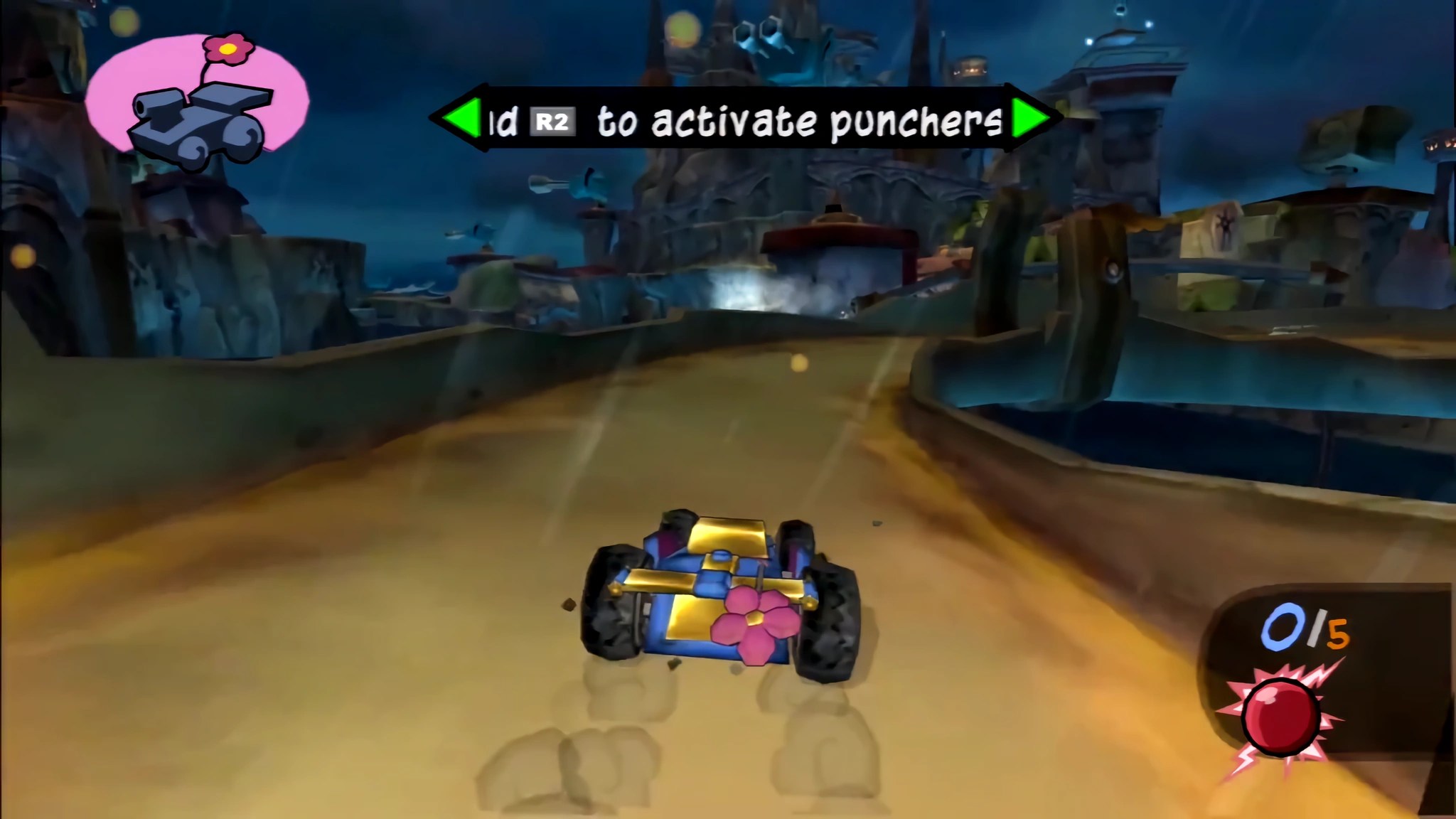
Penelope, the RC expert, is playable in too many missions. She’s a good character (in this game), but her RC car is just not that fun to play as – given that we’ve come to expect the freedom of movement that comes with a 3D platformer, driving a small RC car along rough terrain is not fun. The car flips often and is slow to turn, making playing it an exercise in frustration. Her car appears in quite a few missions too, and only one or two of those are any good.
The game’s not hard – at least, not as hard as young me claimed it was – but it’s certainly less consistent. I wished time and again that it would just let me get back to the core gameplay, but often, we’d just get another minigame, another diversion. The last chapter of the game – the chapter that finishes off the story of Sly – is both a masterwork, and a dramatic missed opportunity.
Over the course of the game, we are recruiting members for one big heist – to break into the Cooper Vault. Interestingly, none of the villains are connected to the final villain, Dr M. Each villain encountered in each chapter instead opposes the recruitable gang member – another part of the story that makes it feel less focused than previous entries. So, when the time comes for this dramatic final chapter, we play missions as almost everyone newly recruited to the gang (sorry Panda King, you don’t get one). Murray and Bentley get half a mission each.
This was a bit of a frustrating let-down. Playing it now, I can’t help but feel a bit deflated. There’s not even a hub area to run around in. It’s just a series of minigames, testing the skills you learned playing the game previously. It’s not bad, it’s just… it doesn’t sit right with me, the sheer number of minigames you play, and the lack of closure you get as Murray and Bentley gameplay-wise that irks me. Murray beats up a bunch of guys, and Bentley uses a single gadget a few times. That’s it – that’s their grand finale. From a narrative perspective, the level where you play as the both of them works really well. But I just can’t help but feel let down from a gameplay perspective.
—
“I wanted to show the world that without your precious book, the Cooper line was nothing.”
“Ah, well, there’s where you’re wrong. The Thievius Raccoonus doesn’t create great thieves. It takes great thieves to create the Thievius Raccoonus.”
“Enough, Sly Cooper! It ends here! I’ll finish you like I finished your father.”
– Sly Raccoon (2002)
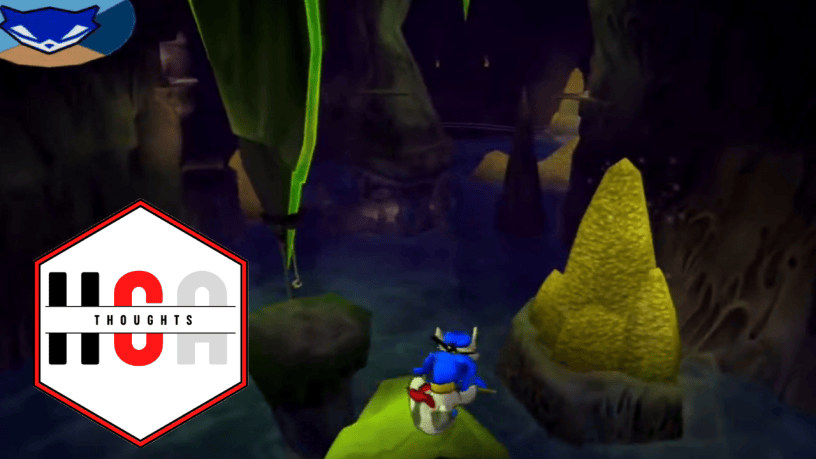
Despite all the shortcomings the game has, the wobbliness of the game is almost all made up for in the final gauntlet. The Ancestor’s Gauntlet pits Sly – and Sly alone – against the enormity of his ancestor’s accomplishments, rendered within the gameworld by enormous mountains of gold, rising up out of a flooded cavern. In order to progress through the level, you must essentially pay homage to the ancestors that came before Sly, going up to their dusty portraits and pressing circle in front of them. Then, that triggers the next part of the gauntlet to begin.
Each part of the gauntlet tests a specific thief skill that you’ve learned over the course of the three games, and feels like a truly epic climax. If the game hadn’t had a final boss, and had just had this, I would have been just as happy. Riochi Cooper’s section of the gauntlet features swords that shoot out of the wall and must be Ninja Spire Jumped onto. Given the Spire Jump was Riochi’s speciality, as illustrated by his section of the Thievius Raccoonus in the first game… well, it just works for me. It’s a narrative marvel, but one that, finally, connects the dots from a gameplay perspective.
Sly is literally dwarfed by the things he sees, the enormity of his ancestors’ accomplishments. The game has been quietly asking about legacy – hell, the series has been – and now, everything comes to a head. How far does one go for legacy? Is your name an honour, or a burden? Climbing past the deadly traps set by your ancestors, proving yourself worthy of the Cooper name – it is no wonder that I had truly sublime memories from when I was a kid playing this. From a gameplay and narrative perspective, it works beautifully. Everything combines, working to complete Sly’s character arc.
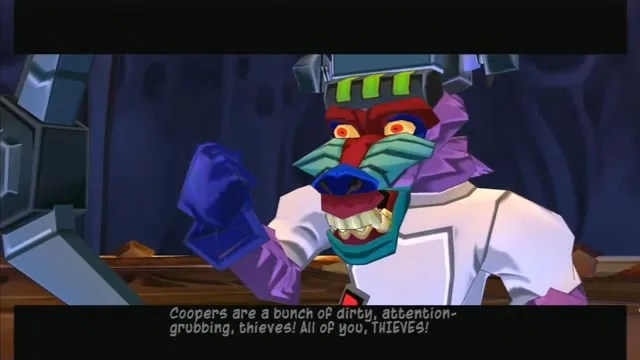
It comes to a head when you confront Dr M, the owner of the island that the Cooper Vault is on. It turns out that Dr M was the technical genius in Sly’s father’s gang – the Bentley of the gang. He felt mistreated and undervalued by Sly’s father, and time slowly drove him insane, until his one fixation was destroying the Cooper legacy. As much as I enjoy Clockwerk as a villain, there’s something to be said for Dr M. He deserves just as much respect as Clockwerk does, perhaps more, given how well he is built up. Him rebutting Sly’s attempt at apology cements him as a villain, certainly – but a villain who feels justified in that hatred. Sly discovers that, much like Clockwerk, the Cooper name has created a bitter enemy. In that realization, Sly can let go of the legacy he strove after so dearly. He can let go, and become someone else. What is it he says?
“We’re all individuals. I might be a part of all this, a member of the Cooper line, but in the end… I’m just me. Not Henriette, Thaddeus, Slytunkhamen, Rioichi or my father… just Sly.”
Dr M responds with “Please! Keep your touchy-feely rhetoric to yourself, I can’t stomach it! You Coopers are a bunch of dirty, attention-grubbing thieves! All of you, thieves!” In these two sentences, Sly casts himself as more than the Cooper legacy, and Dr M proves he cannot escape it. For a children’s game about anthropomorphic animals, Sly’s thematic throughline is incredibly strong. It resonates emotionally to this day, and continues to ask me big questions about where I come from, and the legacy we each have to live up to on a day to day basis.
When Dr M attempts to shoot Carmelita, Sly throws himself in front of the blast. And, perfectly, just like in the other games, Carmelita is the one to defeat the villain once and for all. Sly gives up his life of thievery to be with the woman he loves. At the end of it all, Sly 3 is a love story, just as it is a game about legacy. Sly 3 reveals it is has been a series about legacy. About living up to the idealized versions of your parents, or your ancestors. Sly 3 also showcases that both of the strongest villains in the series – Clockwerk and Dr M – are demonstrative examples of obsession, but also twisted reflections of Sly himself in some ways. The games showcase the lengths people go through to prove themselves “worthy”, or the lengths they will go through to change “legacy”. Sly 3 is a cap on a series that should be preserved much better than it has. It’s trapped on the PS2 and PS3 in regions that don’t have PSNow, the PlayStation streaming service, and emulation hardly helps when no-one really knows the game exists these days. What kid has heard of Sly Cooper? It’s not a question of nostalgic whining – my video games were better than yours – no, not at all.
But children should be able to experience a series like this, with storytelling that didn’t talk down to you at all. It’s funny, sure, and can be juvenile in its humor sometimes, but that’s part of the fun. When it all gets serious, it gets serious – and never once did I feel like it was pulling punches, even as an adult. It is a character-driven narrative about legacy, and, as Sly 3 reveals, it always has been.
A game doesn’t need violence or crude language to tell a compelling, adult story, with rich thematic qualities. A shame that many games made for adults didn’t learn from Sly – it uses the Assassin’s Creed formula better than basically every Assassin’s Creed game ever made, and it came up with the open-world stealth-em-up years before Assassin’s Creed tried it. In a just world, Sly would have had the popularity Assassin’s Creed enjoys (or enjoyed?). But, in another sense, it is good that Sly had the sense to end when it did – on such a strong moment.
As the Cooper Vault collapses around Dr M.’s ears, he beats his chest defiantly and lets the cave crush him. The weight of legacy – the pain he carried – was too much to bear. The villain of the story can’t let go. But Sly can. We can. The story of Sly Cooper ends with us reflecting on what we’ve been through – and knowing that we can go through it again together, when the time is right. It is a story about strength coming from uncertainty, and I am disappointed I went so long without playing it through again.
Hopefully I’ll be able to stream both games this year. See you there.
 Horrorgameanalysis