
Rarely do I play a game that becomes an obsession. I mean, to a point of daydreaming and strategizing, conjuring ideas about game systems melting against the game’s fiction. Constantly thinking about how the intoxicating lore of the game lends itself perfectly to the tough-as-nails brutality of the game’s rules. The last game that truly did that to me was the original Pathologic. Then, there was Termina.
Fear & Hunger 2: Termina is, on its face, a survival horror JRPG. But it reveals itself to be smarter than that by being cruel. It is not a game where you assemble a party of heroes and march triumphantly to the end, powered merely by the power of friendship (or level grinding). It is also not merely a survival horror game about fighting enemies with increasingly large firepower. In fact, it is a game built around the core concept of disempowerment. Even when you play as a chiseled boxer, a veteran of life’s woes from his time in the underworld, the monsters in the game are savage, and pull no punches. Death is frequent, merciless, and can often set you back a significant amount of time.
So, put simply, Fear & Hunger 2: Termina is not for everyone, even if the game did not have a multitude of particularly heavy themes. It is a game that doesn’t pull any punches on that front either – full nudity, sexual assault, rape, gore, cannibalism, child abuse, drug addiction – the list goes on. At times, these themes can become overwhelming and distressing. I can think of several moments of just jaw-dropping debauchery, wherein the villains of the game show their moral vacuity. Yet, to its credit, it consistently uses these themes for a higher purpose. That purpose is character and theme.
The game has a few weird word choices here and there (why use the word chad when the game is meant to be set in the 1940s?) but the longer you play, the more these odd word choices and occasional typos begin to cohere. They become part of the text of the game, informing us of the style of the author, Miro Haverinen. It gives the game a unique voice. Termina is a love letter to video games and, in odd moments, a variety of internet subcultures. It is clear how much Haverinen enjoys toying with expectation, creating a world that feels wholly his own.
This is a game about the brutality of war, reflected in the game’s actual rules. Games need good game systems, and even if Termina feels unfair at times, the underlying logic helps the player understand that the world is not made to be fought through. It is a game where combat is a final, desperate scramble to not be instantly decapitated by an enormous ghostly owl, or trampled by a truly disgusting creature. Limb loss reduces a character’s capacity to do things or hold certain weapons, and it is frighteningly easy to have that happen to you. Infection happens commonly if you get bitten by the various enemies that carry disease. Given you’re wandering into a city ravaged by war and devoid of most of its supplies – and most of the inhabitants have been driven insane by either natural or supernatural phenomena – this makes sense.
You must guide your character through moral conundrum after moral conundrum. Each and every character is rendered with thought and care. The character writing is better than it has any right to be, and it feels as though the world would not be the same without the great characters that inhabit it. That is the sign of a good set of characters, and great worldbuilding. The game’s end states are complicated by the fact that those same party members you can recruit to help you are explicitly expendable. Worse, those expendable characters – who have considerable dimension to them, becoming likeable people – are people you can murder in cold blood. People whose deaths benefit you, as you can take their abilities. You can also chop off and sell their heads for other rewards. There is a sick satisfaction in the way the game’s morality erodes you. Much like the original Pathologic, Fear & Hunger 2: Termina dissolves the barrier between what you will and won’t do. Oh, I won’t chop off the heads of defeated enemies. I won’t stomp on their corpses. I won’t kill others just because the opportunity presents itself. I won’t.
Except, of course, you will. It might take hours upon hours, but you will. You’ll do these horrible things, just to get an edge on the game. The game plays dirty – or so it seems. It slings mud into your eyes, hacks at your shins, and all kinds of other underhanded things. But, slowly, as you are beaten down again and again, you start to notice things about your surroundings. You notice how an enemy reacts poorly to a certain item being hurled at them. You figure out that you can use certain items for things in combat (or out of combat). You discover crafting recipes, combat strategies, pathways through the city…
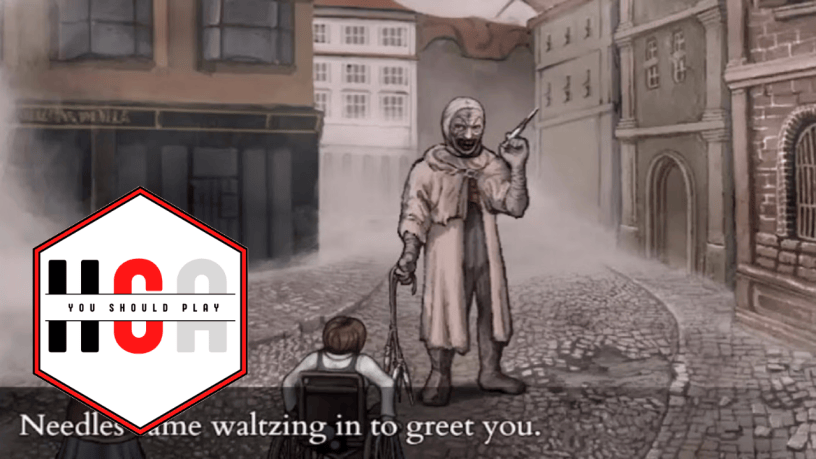
The city. I am obsessed with video game spaces that can come alive in the mind. And what is Prehevil but a space that can come alive? It is a space warped by old gods and modern warfare, and it creates this repugnant melting pot of horrors. Different parts of the city are dangerous for different reasons, but it’s not like Prehevil is ever not cohesive. The sewers have hideous old women, shunned for their connection to rats; the streets are patrolled by inquisitorial staff, warped by their own wretched beliefs. The game’s world is coherently built, and a joy to explore and re-explore, with each space recontextualizing itself based on who inhabits it. Space is subjective; Prehevil is one of the finest ever developed in video games, in my humble opinion. It is a real achievement, an immersive place that facilitates immersive play. Everything connects – it is, in a sense, a survival immersive sim placed in the guise of an RPGMaker game. I could ramble about it for hours, and I might later this year in a video essay.
But, for now, the most majestic thing the game manages are the genuine, stirring human emotions. It is amazing that it achieves that, a game so seemingly simple on the face of it – built from the bones of RPGMaker, which, by all previous judgment of mine, should not have been able to build a game so complex. I know I keep sounding surprised or shocked that the game works, but, on a certain level, I am. I enjoyed the first game, but this one shocked me time and again with just how considered everything is. Unlike the first game, the answers to the puzzles or the route forward always felt more natural. I knew where to go, or what to do, just not how to get there. That’s how the game beats you down, and absorbs you into it.
There’s a boss fight or two that are just so sublime (in all senses of the word) that I just couldn’t help but absorb the art and the music, both of which are just at the top of their field. The soundtrack ranges from genuinely really disturbing (Relentless) to hauntingly beautiful (Wayward Souls) to heartwrenching and desperate (Denied the Light). Every track has a standout moment, and would be worth discussing. But my favourite tracks are either the regular combat song, “Breath of the Moon”, or one of the final boss songs, “Full Moon”. The final battle in one route is so surreal, so mindblowing, that it seemed to punch through the screen and demand that I too succumb to the madness.
The surreal horror of the game fuses with down-to-earth body horror. The game has practical moments of fear that will twist your guts or disturb you. Early on, you wander through a foggy forest, and from your birds-eye-view vantage point you can see a single naked corpse nailed to the back of a power pole. But your character doesn’t see it, cannot see it. You are privy to the suffering in a way that the best horror games encourage. You are the voyeur again, as well as the potential enforcer of cruelty. But it also has moments of out-there occultism that sincerely fascinate me. We are told by Douglas Cowan in his book The Forbidden Body: Sex, Horror and the Religious Imagination that “[a]s much as the horror mode reveals our fear of what others may do to us, the ways in which they may violate our bodies, it also shows us the power of our own bodies— either our inability to control them and resist their urges, or our willingness to give in to what many consider their basest desires” (2022, 36). Religion and horror remain entwined, our curiosity as to what happens after death swinging between the hope of enlightenment and the bleak terror of nonexistence.
Termina is that rare kind of horror game that raises these questions without making the player feel tired of the game’s theming. It is a well-designed, well-structured game that demands a player invest time into understanding its complex systems and dark mysteries. Highly, highly recommended. And there’ll be more to come from me on the subject of Termina later. Stay tuned.
You Should Play: Fear & Hunger 2: Termina
 Horrorgameanalysis