
There’s a lot of good, general info on dragons to start us off, but you can read that for yourself here. Let’s jump straight into the specific monsters as they are presented.
Dragon, Cloud
★★☆☆☆
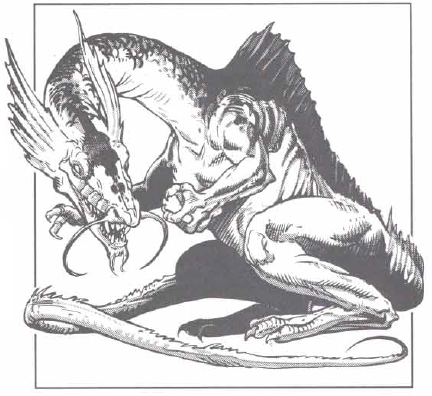
The Cloud Dragon is a bit of an interesting one. It has a fifty-fifty chance of either wanting to fight or just turning into a cloud and running away. I love the mustache it seems to have, which adds to their snooty, condescending vibe. Apparently “[t]hey have no respect whatsoever for creatures that cannot fly without assistance from spells or devices”, so I guess they just collectively banded together and agreed that anyone without wings kind of sucks.
Cloud Dragons have the “cloud” theming and nothing else really going for them. They can turn into mist which gives them -3 AC (a good thing in this version of D&D) and a magical resistance bonus. They are also 75% indistinguishable from a regular cloud. Much like the Quickling from the last post being 90% invisible while moving, I am unsure how one distinguishes 25% of a cloud as a dragon. Is it just like an opacity slider?
I’m kind of torn regarding the sheer variety of dragons that Dungeons and Dragons has decided to make over the years. I get it, it’s in the name – but at a certain point, the repetition of monster types kind of blurs together. I get that they were just making blueprints for dragons, and trying to mix things up for the players so dragons feel fresh and new – but a lot of the dragons just end up not having a distinguishable personality compared to each other. You will see this very shortly, and it’s why I rated the Cloud Dragon a mere two stars. It just doesn’t do anything particularly well that would make me want to use it ahead of other dragons. Maybe I just need to set more adventures in the clouds?
Dragon, Greyhawk
★★★★☆
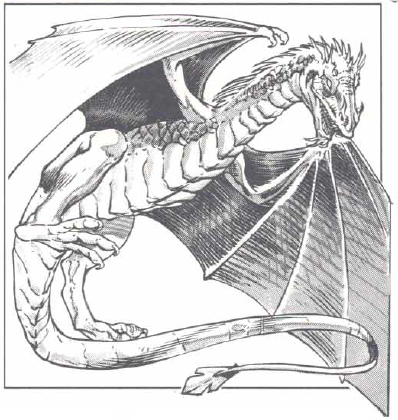
A special Greyhawk dragon, the Greyhawk Dragon is an honest-to-goodness urban dragon, that loves the company of humanoids. It hangs around crowded cities and acts as a philosopher, a debater, a scholar, a mage, or an academic. This is supremely awesome at first, but then you realize they are changing into humanoids to do this. This is far more formulaic and less awesome. I was imagining attending classes with a dragon professor that smashes their head in through the window for every class.
Greyhawk Dragons can’t be poisoned and are immune to a lot of magic spells. Greyhawk Dragons have a breath attack that manifests as a cube of poisonous gas, which is probably one of the weirdest dragon breaths I have ever read about, anywhere. For some reason coating yourself in lard or grease deflects Greyhawk Dragon gas breath? Is that a thing? Does grease repel gas? I don’t know.
The fact that Greyhawk Dragons prefer human form to their own is both kind of interesting and also deflates the purpose of them being a dragon for me. I do like the idea of one or two NPCs in a city being benign, secret dragons – but I am still attached to the idea of a university city that just has dragon scholars attending it. Also they love snitching on people according to the book, whereas if they are in nature “they prefer a swifter form of justice”. Hmm.
I think for the sheer weirdness of the idea, this has to be a four out of five creature. But they could have been even more daring.
Dragon, Mist
★★★☆☆
A mist dragon! Wow! It’s a good thing there isn’t another water vapour dragon, otherwise who knows what I’d do?!?!
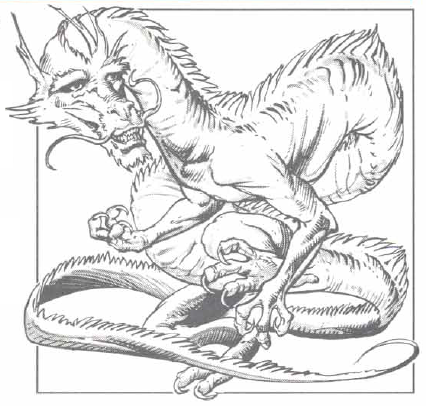
Mist Dragons are kinda just like Cloud Dragons but lower to the ground. …No, that’s not fair. Mist Dragons are clearly inspired by eastern dragons, and have a more “philosophical” attitude to life rather than the Cloud Dragon, which is mostly a jerk. There’s a 15% chance Mist Dragons can talk to anyone they like because sometimes they are just born with knowledge of every language. Which is certainly a talent.
Mist Dragons tend to avoid combat, preferring to turn into Mist and just run away or even watch what’s going on from a safe distance. If they do attack, Mist Dragons can breathe scalding vapour (so steam?) which can deal some nasty damage. My favourite detail is that Mist Dragon breathe can linger on the battlefield, transforming into a dangerous fog that obscures the vision of everyone trapped within it. This feels like it could create an actual dynamic combat scenario, where characters are constantly trying to escape the fog the dragon is creating, moving around the battlefield and making it an encounter worth remembering. They love living near waterfalls, since they mainly subsist by a combination of sunbathing and regular waterbathing, being sustained by the misty spray that occurs when water splashes off of a surface. This is a cool visual – wandering through an ancient forest to see a dragon languidly lying beside a gorgeous brook, basking in the sun and the water.
I definitely think they are better than the Cloud Dragon, and I would probably be inclined to use a Mist Dragon at some point, even if just as a passing sight that players can see in the deep forests. But they’re still just more dragons in a setting stuffed with them.
Dragon, Shadow
★★★☆☆
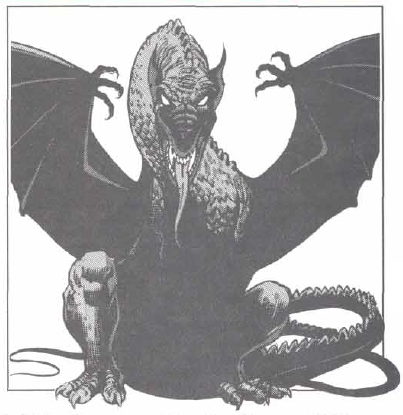
The idea is accompanied by a pretty cool illustration, the Shadow Dragon breathes literal darkness onto its foes. It is a primordial chaotic evil being, which I’m a sucker for. They’re “sly and devious” and not prone to taking risks, and are also highly intelligent – all great qualities for a campaign villain, creatures who I am always on the lookout for. And, I mean: “a shadow dragon’s scales and body are translucent, so that when viewed from a distance it appears to be a mass of shadows” – how cool is that??
The main reason I don’t like these creatures as much as I should is how the rules write their breath. Their breath actually takes away either levels or entire hit dice, with the time it occurs depending on how old the Shadow Dragon is. This is, suffice it to say, pretty rough. I can imagine a meat-grinder dungeon (or just an evil Dungeon Master) using one of these to decimate an entire party. Not going to do you much good if you have half the hitpoints and access to none of your spells when it comes time to fight a hugely difficult dragon.
Aside from this, I really like the Shadow Dragon stylistically and I think it offers something a bit different than the other dragons in this compendium. I also like the detail that “[s]hadow dragons hate both bright light and total darkness, preferring variegated lighting with patches of diffuse light and deep, inky shadows” – given they are shadow dragons, this makes sense. But, I’m a sucker for ancient evil creatures, so maybe I’m just biased.
Dragonfly, Giant
★☆☆☆☆
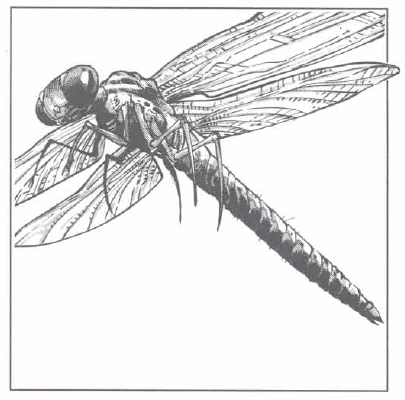
This is just a giant bug (bigger than a human), without any of the flavour that made even the Death Beetle stand out to me. It just… flies around really fast and is a big version of a small insect. I can’t say I’d ever use this, as it’s strikingly generic and not what I like to include in my fantasy stories. Imagine animal, but big! The first one-star entry in this book so far.
Dragonnel
★★★★☆
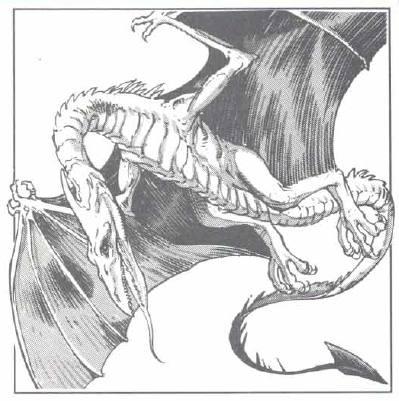
Weirdly I really like this creature. The dragonnel is a mix of dragon and pterodactyl, but done in such a way that it feels pretty cool. Dragonnels aren’t actually dragons or a dragon subspecies, which is a huge relief given all the dragons we’ve had. 4% of dragonnels can speak “evil dragon” which is the kind of meaningless fun stat that I wish more modern tabletop books would include. Why 4%? How did they come to that conclusion? Was rigorous scientific testing done? What if 96% of dragonnels are just shy? These are the questions that a good monster manual entry raises.
Also like that dragonnels are used by the evil humans of the Pomarj, which is a region dominated by Orcs. Kind of cool to envision humans as the legitimate underdogs in a region dominated by an Orcish superpower. Even cooler to imagine them flying around dragon-pterodactyl things. It is the kind of information about the setting that is just firing up my creativity. I can imagine players fighting as human freedom fighters against an oppressive Orc regime, using dragonnel mounts to ferry themselves to rebel outposts here and there. That’s what a good monster does – its design combines with storytelling opportunities to generate something awesome in your own head.
Elf, Grugach
★★☆☆☆
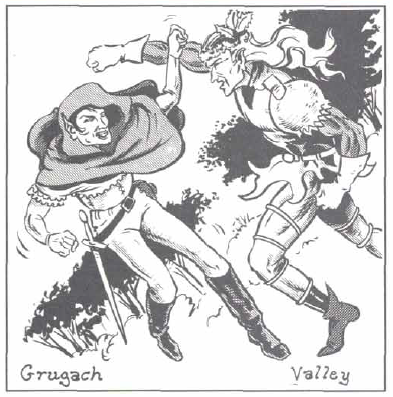
When a monster entry begins with how similar they are to other creatures – in this instance the “sylvan or wood elves” – it does not fill me with hope. I do enjoy the awful illustration of the elves brawling, and the indicator that the Grugach elf is the fella on the left. Initial impressions aren’t strong. The main things that the compendium would have us use to differentiate them from other elves are a) they are the strongest elves around, and b) they are incredibly reclusive. They hang out in the depths of forests, and lay traps for people who come too close to their beloved nature – even friendly folk like druids. When they’re trapped, they rob the friendly ones and dump them, unconscious, many kilometers away. If the person the elves captured is evil, they kill them.
If you’re getting a little deja vu, you’re not the only one. The Grugach Elves feel at first similar in concept to the Beastman, just with different flavouring – they’re elves, and they live in the woods instead of in the jungle. They like platinum, apparently. Their extremism technically makes them more interesting – unlike the Beastman, they’re Chaotic Neutral rather than Neutral. It’s still a small distinction, though. You could make them into extremist elves, kind of like some of the elves seen in The Witcher books, I suppose.
I dunno, I guess I’d use them, but their niche is technically already filled. I would have just made a band of more extreme sylvan or wood elves rather than concoct a whole new version of an elf. But that’s just me.
Elf, Valley
★★★☆☆
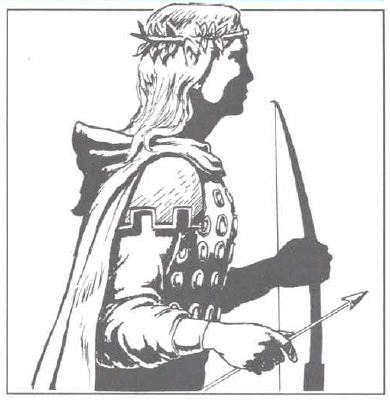
Then we come to the valley elf. The valley elf isn’t really a distinct kind of elf in one sense. Every valley elf comes from one valley, called the “Valley of the Mage”. They were created as slaves or servants rather than being a naturally occurring species. Valley Elves do look like regular elves – exactly the kind of thing you’d expect. Tall, eerily beautiful, like a good bow and arrow. Their hair changes colour during the seasons, which is another detail that I think is just kind of cool, but is also almost entirely useless. It could be kind of cool to have a campaign where a valley elf character is trying to go undetected, but that sells them out, and they have to confront their accuser or their attacker or something.
Valley Elves are quick to initiate combat and basically just stay as an army for the mysterious Mage that made them. They belong to the Mage and serve him, as well as the First Protector, a Drow commander, who they will always try to take newcomers to the valley to. I guess the First Protector decides whether or not the prisoners get to live. This hostile environment would make for a good set of adventures, where players have to infiltrate this manufactured civilization and steal something from the Valley of the Mage. Other elves hate Valley Elves because they have sold out to the Mage, but the book isn’t clear on why or how this arrangement occurred. I’m pretty sure they were made by the Mage, but the book doesn’t do a great job of explaining it. Nonetheless, they feel a bit more interesting to me than the Grugach Elf, but still aren’t so interesting I would drop everything and put them in a campaign right now.
Giant-kin, Voadkyn
★★★☆☆
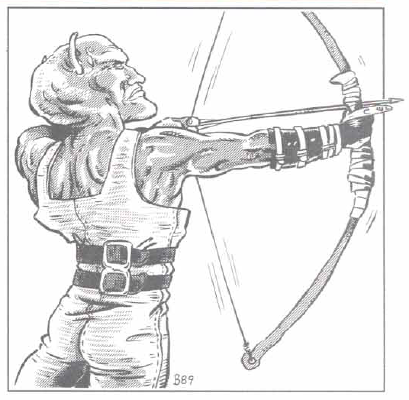
The Voadkyn are some of the smallest giants around. They are still pretty big: “[s]tanding 9½ feet tall, wood giants weigh around 700 pounds”, but have the proportions of humans. They’re pretty thin, and are “completely devoid of facial and body hair, including eyebrows”. So they’re these enormous, hairless humanoids that move through the forests of Greyhawk, prowling around. They can also move silently in forests, making it their natural territory. Voadkyn don’t like to fight either (there’s been a few of those so far in this monster manual, creatures that don’t prefer which is nice). Apparently they also “have no lairs, choosing to live under the stars or with the wood elves [who they are friends with] for a time. Wood giants encountered in the forest are mostly male (90%). Female wood giants usually remain at a makeshift camp or with the wood elves at their lair”. I do like these societal details – they can help characterize a species for use in campaigns in ways that spark the imagination, or even just fill in blanks a player might come up with. Maybe there are voadkyn who detest the women staying at home? Maybe there is a societal conflict in there to explore?
I do really like this paragraph about their behaviour: “Humans who have had contact with wood giants describe them as friendly enough, but flighty and frivolous, and never in a great hurry to do anything other than eat and drink large amounts of wine. Treants (with whom they occasionally converse) consider them irrational, foolish, and occasionally obnoxious, but enjoyable company”. It feels like they would make fun characters. I also love this detail that is included for seemingly no reason: “[t]he jaw of the voadkyn is large because of the over- sized grinding teeth in it”. What a marvelously useless detail – I guess they are all vegetarians, which actually does make a lot of sense.
I don’t know, I kind of like them. I don’t often use giants in my campaigns because my settings tend to have them as extinct civilizations or just distant from the goings-on of the rest of the world, but if I did have a setting like this, I would probably use them.
No five star monsters this time around, but maybe I’ll find some next time? Let me know if you agreed – or disagreed – with anything I wrote (or any of my incredibly objective scores)! See you next time, for some more giants and deliciously weird monsters!
 Horrorgameanalysis