
It is rare for a game to do any one of the following four things:
a) it is rare that a game can make me laugh out loud more than once
b) it is rare that a game can make cry more than once
c) it is rare that a game can make me despair
d) it is rare that a game can be a mirror to myself.
In Stars and Time (insertdisc5 2023) is one of those rare games that does all of these things.
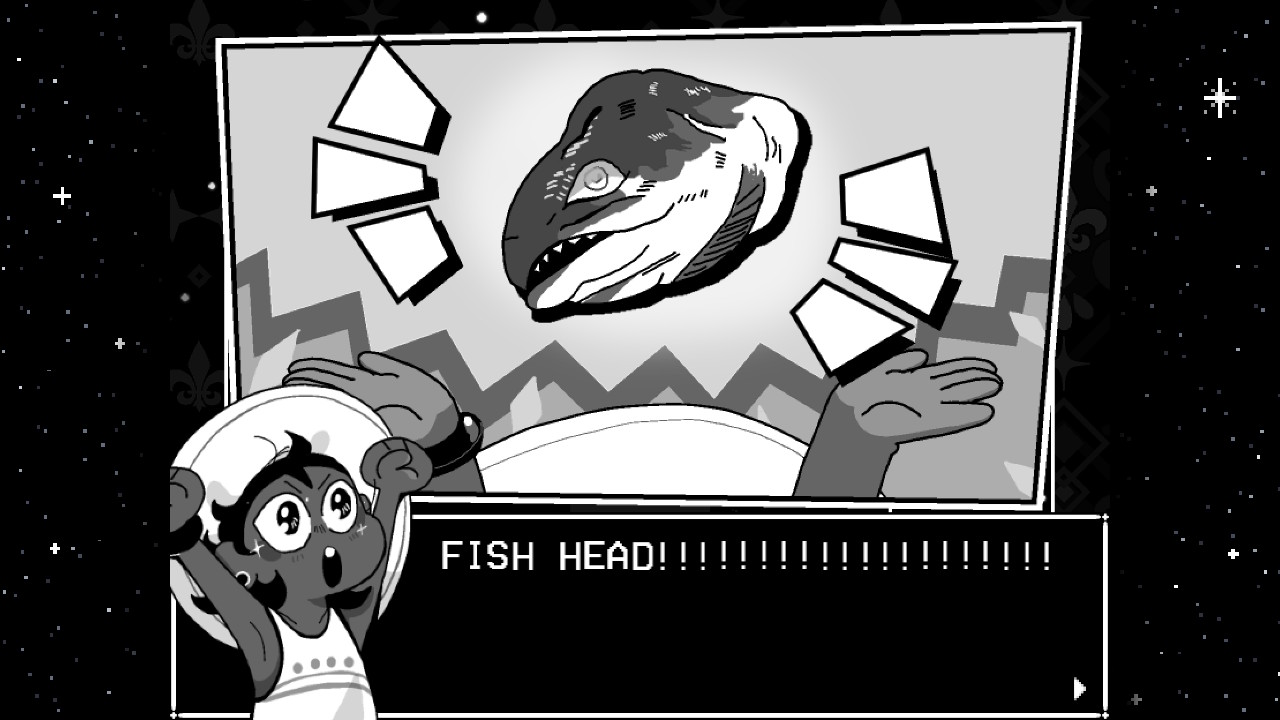
In Stars and Time is a top-down role-playing game made in RPGMaker, with all that entails. I find it so fascinating to play a game with such gorgeous stylistic flourishes, pushing the engine to its absolute limits – and yet it is still recognizably RPGMaker. The game is entirely in black and white (almost entirely) and has a clever score that reuses motifs from earlier songs, twisting the end-game tracks into something new and compelling, or even haunting.
The game’s combat is based around a literal rock-paper-scissors casting system, where certain enemies are weak to certain craft types. It’s easy enough to identify which is which (if an enemy has clenched fists, for example, it’s a rock-type enemy and is weak to paper), but it’s a satisfying and fun spin on traditional RPG combat. If there’s a problem with the game it’s that there is a bit too much fighting. I got a bit sick of it by the end – but then, of course, that’s the point. In Stars and Time is another time loop game – something I’ve been noticing more and more of lately – and it is one that thoroughly deconstructs the idea of what it means to be an agent trapped within a timeloop. Rather than the abstract observation of watching Groundhog Day (Ramis 1993), In Stars and Time foregrounds the player’s agential role, almost simply by being a video game, but it’s smarter than that.
In Stars and Time takes the joy of the time loop – the joy of discovery, of mastery, of knowing everything – and turns it against both the protagonist of the game and the player themselves. The more you discover, the faster you want to skip through over familiar dialogue. And slowly you forget the quips that made you laugh. You forget the tutorial. You forget anything that doesn’t help you win. And that’s a terrifying twist in a game all about love and family. The stuff that made me so happy became an obstacle towards beating the King. The King, the traditional “big bad” of an RPG world, with oddly sympathetic qualities, has been freezing the land of Vaugarde in time. The game is obsessed with time and temporality and how human beings experience it – and want to capture time. Our desire for mastery is constant throughout life and video games alike. We want to be good at stuff. We want to understand stuff! Yet time is a natural enemy to that. We have a limited amount of it – but in In Stars and Time, time is bountiful. Time, however, becomes an enemy in a new way. Stagnation becomes the enemy, dredging up negative emotions called “Sadnesses” that you must defeat throughout the “final dungeon” of an RPG campaign you never see the main chunk of.
And yes, again, the game is burdened with too much combat, but the frustration of that bleeds through into the narrative. I’m a sucker for ludonarrative harmony, and In Stars and Time perfectly angles its emotions into the gameplay. It is paced very well indeed, and the frustration at the game that you end up feeling is the same one that the protagonist Siffrin feels at his horrible predicament. So that’s the recommendation for In Stars and Time. It’s going to live in my heart for a very long time. It is one of those special games that resonates – and I think will resonate with a huge number of people in a very, very special way. It raises a lot of complex questions and also has an extremely queer-friendly set of characters, from aromantic / asexual representation that feels genuine, to a transmasculine character that is done so beautifully I just wanted to hug him. Each character has depth beyond their queerness, and the world itself is queer in a way that I wish I could just live in it, right now, dammit! Gender and sexuality is loose and relaxed in many ways throughout the game, and it’s just heartening to see and to experience. It’s a beautiful game that is a love letter to the RPG genre as a whole. It is well-crafted and is sure to just get better and better with time.
But I wanted to digress a bit and talk about the impact that In Stars and Time had on me, personally.
It has been, shall we say, a very long year. Or years, let’s include 2024 in that. I’m one to underplay it a little, I think, especially in retrospect. It feels like I successfully navigated some choppy waters and here I am, moved on, ready to move on. But it’s not so easy, and recognizing that difficult feelings will just keep resurfacing until I deal with them has been a large part of that. It’s also been a large part of why I’ve been sitting down and spending time away from the channel and the blog as a project (sadly), just to give myself some breathing room and to give myself some time to process my own emotions.
The relationship I have with my own body is different than it was even just a year ago, but perhaps it is the same relationship I had when I was a teenager. It feels as though I have wasted many years of my life, and I’ve come right back to the same damn conclusions. It makes me wonder what I’ve been doing all these years, and how I managed to dissociate so much from who I actually am as a transfeminine lady / person / scholar / horror-game-analyst. It’s a special kind of exhaustion I am coming to grips with, as I realize that I have indeed just gone around in one big circle. As I drew closer to the end of In Stars and Time, I realized with some alarm that it reflected my own slightly jaded, disaffected perspective on my own body and my own lived experience. If I already felt as though I had somehow wasted my childhood, somehow had the wrong childhood and adolescence – in language I was not able to use at the time, and can barely begin to use now – how can I even begin to comprehend spending my finite time in a way I didn’t want to? Well, I did… but I didn’t. It felt real, and it wasn’t, at the same time.
I have been reading a dissertation on gender and fascist impulses by Nathaniel Dickson. Dickson writes, passionately, powerfully, that “we must teach grief deeply, and work together to build a relationship to the world that acknowledges and honors loss without diminishing it or fetishizing it. The failure of gender signification is only of interest because of the torrent of trauma and grief that sits just below its surface. We need to become comfortable and help our students and other community members become comfortable with the impossibility of forever” (2023, 11). I think this idea, “the impossibility of forever”, speaks to the grief I feel for myself, but also the despair I feel for those that try hopelessly to clutch at immortality. I have brought up the idea that immortality is wrong a lot over the years. Perhaps it is a human impulse, but it is one that In Stars and Time pursues in order to interrogate with a feverish vigor. Why do we clutch onto things so damn hard – and what does it mean to let go?
In Stars and Time is not a relief from my emotions, persay, but is a way in which I can interface with them. I think that’s the remarkable thing about art and stories, right? Is that we can use them to look at ourselves in a more thoughtful light. We can recognize ourselves in characters, in ways that we might not be able to see ourselves in our day-to-day lives. I recognize myself in Siffrin, in some painful ways.
I recognize the fear I feel when I wake up every morning, still trapped in the same body. I recognize the feelings of anxiety that bubble up when I realize that the reality I want for myself is physically and temporally impossible. These things are feverish and cloying and horrifying, and nothing I’ve played before or since has managed to capture that despair so well. And yet it is also a joyous game. A game about connecting with people. About seeing them for who they truly are. About spending precious, finite time with those we love. About realizing that there are things to love about oneself, that self-loathing or self-deprecation is not a necessity.
The game is a psychological horror in the best sense – that it forges strong connections and then works to sever those connections, even as you desperately try to rebuild them. That’s what it is – it’s a desperate game, and there are so many crushing moments of realization and despair that it becomes almost impossible to go on. But then you find dialogue you’ve never seen before, you appreciate something someone said in a new way, you get one step closer to maybe breaking out – and you feel a little bit better about tomorrow, even if it’s the same tomorrow.
I’ll end this extremely personal “You Should Play” with a quote from the game.
“In this moment, you are loved.”
 Horrorgameanalysis