

I’ve never played a Project Zero (otherwise known more commonly as Fatal Frame) game before, and I figured, hey, 2025, why not make a start? So I broke out the old backwards compatible PS3, dusted it off, committed various blood sacrifice rituals in order to get it to work, and divined how long I could push the old machine by sorting through the entrails of my broken DualShock 3 controller (it was another three years, for anyone wondering).
There’s something deeply satisfying about watching a disc slide into an old machine, and watching that old machine begin to grapple with it. A deep, thrumming whirring. It fills the air of my living space and makes me reminisce about televisions as wide as they were deep. A controller that is barely clinging on to life, dreading being the next one to be dissected for parts to make my third and final controller work for another few years. This is hauntology in technology, the process of time transforming technology into something more mystical. This is also what Project Zero (aided by the passage of time) does to its space and its technologies.
Project Zero games are all about ghosts and photography, and I think this is a natural combination for a game. Ghost photography has a long and fascinating history, one centered more around technical prowess than finding any actual ghosts (as far as we can tell). It is particularly amusing to read statements like this one written back in 2021: “people associated photography with veracity in some contexts and the unexplained in others — a heady mix that made it challenging for viewers to know which pictures they could trust” (Mickevicius). In an era so firmly rooted in the digital that what we write can be spat back at us a thousand times, reworded in subtle ways, an era of anti-veracity, photographs do not feel very tangible at all.
Which is what makes the camera of the first Project Zero (Koei Tecmo 2001) seem so special, so far. These are weighty old things, given particular power and significance by their exorcistic powers. Aim one at a ghost and it’ll hurt it – but the genius move, of course, is that you have to let the ghost get close before you “squeeze the trigger”. You have to be willing to let it frighten you more, to invade your personal space, in order to make the most of your limited film. Melissa Bianchi observes that the way in which we use cameras in video games “operate using mechanics like those found in first-person shooters” (2024, 563). In some sense the power fantasy of the first person shooter is still baked into the gameplay. We’re still blasting ghosts with a gun – but the gun feels much less effective by virtue of the fact it’s a camera. We get to linger on the shots we take of them, look at their twisted faces, and broken limbs. It is a fabulously immersive experience that challenges the player’s conceptions about survival horror weapons – and that’s just a start.
I got a little ahead of myself there, but gosh, there’s so much to recommend about how the game unfolds. After a short prologue sequence where you explore the first few rooms of the house as the protagonist’s brother, you’re given control of the real main character, Miku, and you reexplore the first few rooms again. There’s a more profound sense of dread that comes when you realize the kiddie (tutorial) gloves have come off, and also when you realize your clunky old camera is all you have to defend yourself with. The Himuro Mansion – where the game takes place – has some of the most foreboding ambience I’ve ever heard in a video game, the kind of stuff that does feel legitimately haunted. It does a better job than Clock Tower 3 does at appearing like a venerable old horror game, anyway.
It’s funny that technology and its weightiness mingle together with hauntings in my mind. The more and more we entrench ourselves in the digital, the more and more we want to touch things, I think. To make them manifest in our hands. To have a sense of something tangible. Project Zero’s camera is one step towards this, with the controller rumbling to let me know there’s something nearby to take a photo of. But time is also part of that mystique. Himuro Mansion is old, decrepit, but with a sense of history. Rooms feel dusty. Some of them have been long-cleared out of stuff. Others have old boxes and scattered notes from several different people placed within them. There’s a real web of nonlinearity to Project Zero thus far, something that feels genuinely confronting as you try to work through the house itself, which obfuscates progress at every turn. Odd puzzles, looping hallways, and ghosts that return again and again, spouting the same twisted voice lines, all contribute to a feeling of surreality.
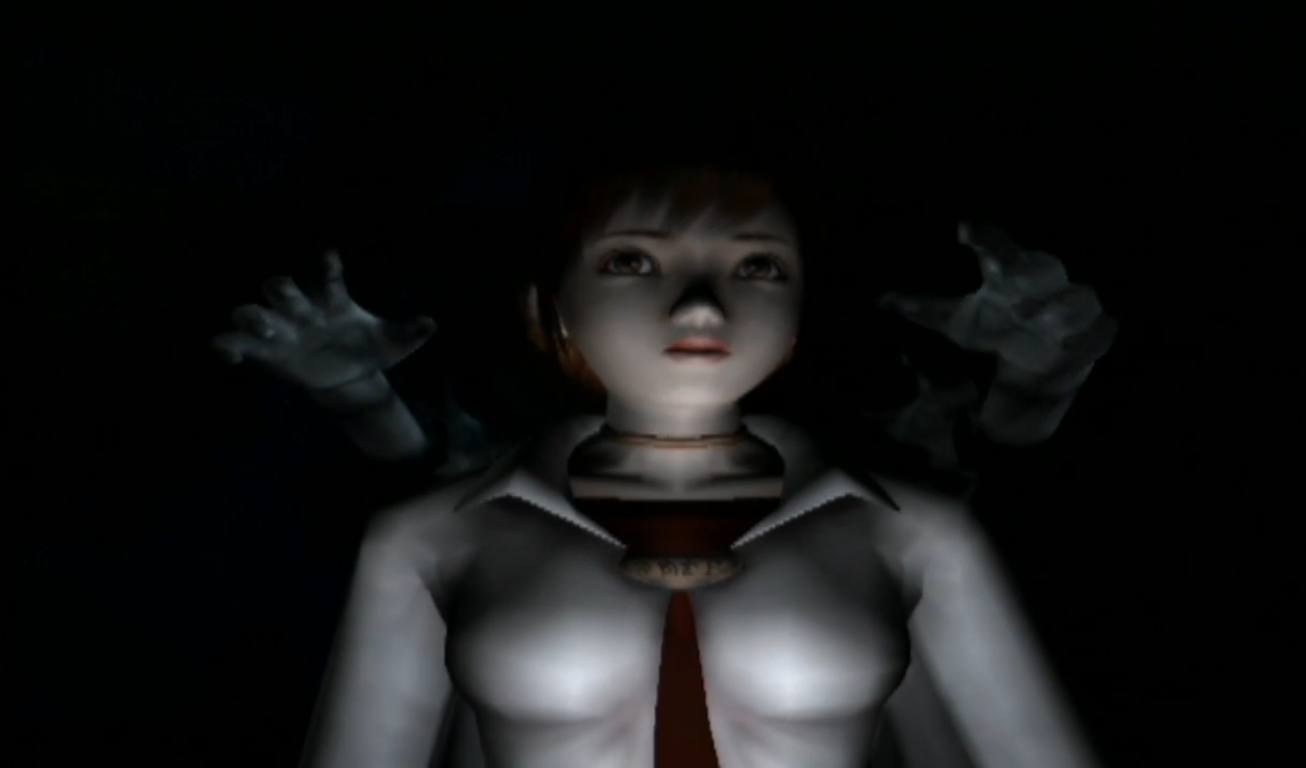
A ghost with long arms wails “give me back my child”. A blinded ghost screams “my eyes! My eyes!” Another wails about ropes. Each ghost is trapped in a moment, and they lash out at Miku, trying to drag her into their twisted, haunted existence as a spirit. The game is terrifying in unexpected ways, as ghosts appear in front of you in split-second flashes, blink-and-you-miss-them moments that can have you questioning reality. Is every spirit in this dark, foreboding home hostile? Or perhaps my instant reflexes as I use my exorcism film against these ghosts is harming spirits that otherwise might simply wish to observe me.
The terror begins to feel more and more genuine the deeper you get into the mansion. The ghosts not only become stronger, but reoccur more frequently. The worst offender thus far is easily “Blinded”, a woman with blood pouring from her eyesockets, her life (and death) destroyed by this awful ritual you must investigate. She shows up again and again, each time more powerful and aggressive. It’s in these moments that you must reckon with the same things you feel in something like Forbidden Siren (Project Siren), where enemies keep coming back, and you must keep putting them down. The violence restages itself time and again, and we ourselves become trapped in this terrible place. Repetition in video games is something that I’ve become more and more obsessed with. Obviously feelings of looping have a particular significance for me at the moment, but I think Project Zero approaches it from a particularly interesting angle. We are attempting to relieve the ghosts and to drive them away, to free their spirits from this physical place. But in order to do so the game asks us to commit acts of violence against them. While still in self-defence, there’s a feeling of torture alongside our documentation of this haunted space. We document these people (both in the journal entries and our camera, and in the various artefacts we can find scattered around), and demand that their story make sense to us. But can it? Should it?
These are the questions Project Zero raises, and I’m excited to finish the first game and move on to the later ones in the series to see if the feelings of claustrophobia and cloying darkness hold as much weight as they do for me right now. A sublime game, and I can’t wait to run away and play more as soon as I hit “post”… riiiiight…. now!
Reference List
Bianchi, Melissa. 2024. “A Field Guide to Monsters: Practices of Wildlife Watching in Video Games”. In Ecogames: Playful Perspectives on the Climate Crisis.
Mickevicius, Emilia. 2021. “Seeing Ghosts: A Brief Look at the Curious Business of Spirit Photography”. SFMOMA. https://www.sfmoma.org/read/seeing-ghosts-a-brief-look-at-the-curious-business-of-spirit-photography/
 Horrorgameanalysis