
The following contains some spoilers for Fear & Hunger (Haverinen 2018).
I’ve spent a while ranting and raving about just how good Fear & Hunger 2: Termina (Haverinen 2022) is, while mostly neglecting the original game in my writing. I think that’s because Termina is the more interesting and more complex game, in most regards. There’s a feeling of uniqueness to the sequel’s setting, and a robustness to the character dynamics and the gameplay, that has captured me and not let go. The original Fear & Hunger, however, is a game I still have a tremendous amount of respect for.
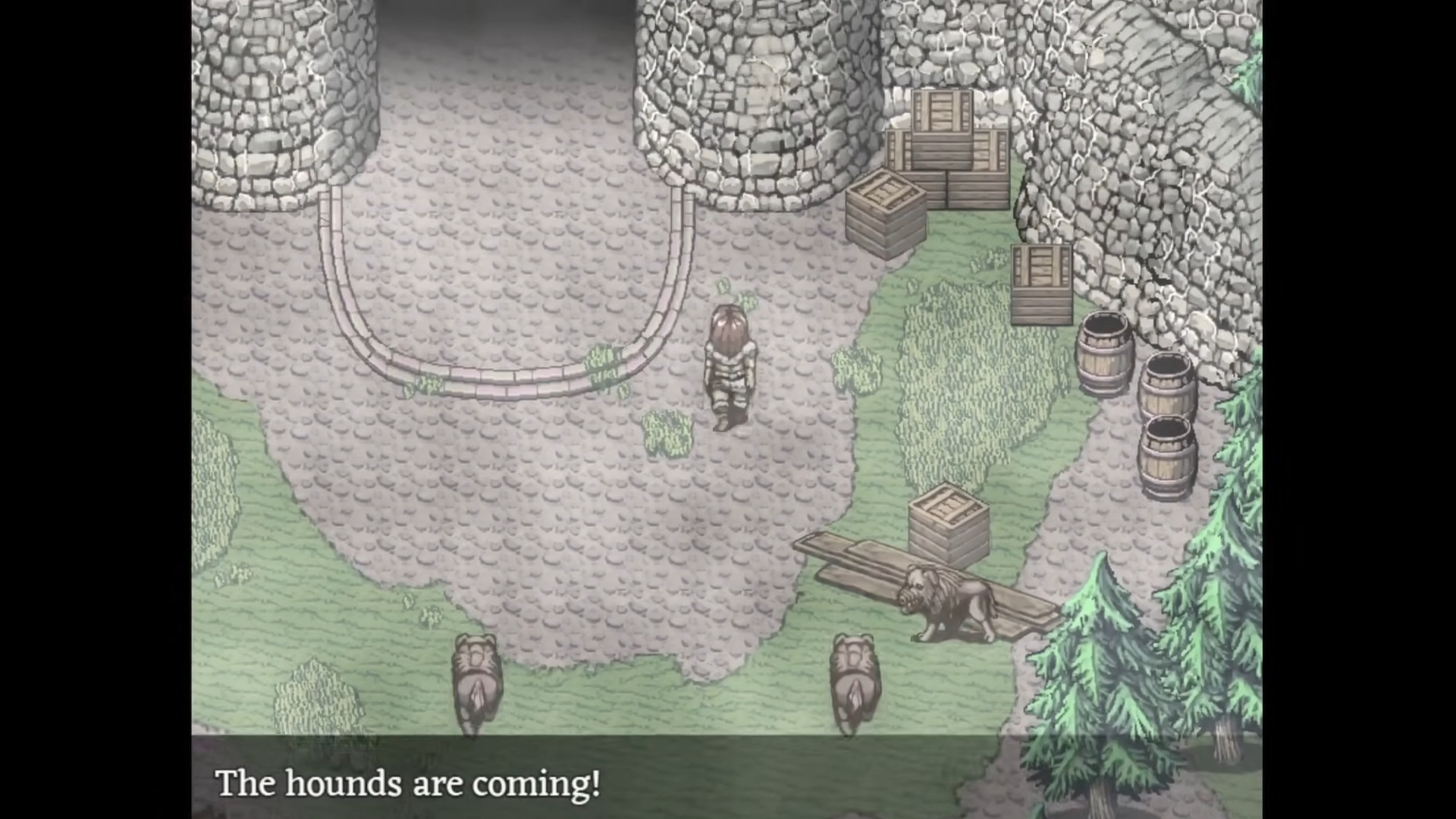
Fear & Hunger does not pull any punches. Or so it seems. There are a few short moments at the beginning of the game, during character creation and standing in the mist outside the Dungeons of Fear and Hunger, where you might think – okay, this is just like any other dark fantasy game. It seems at the outset to be a game about survival in a world both like and unlike our own. And I think this theme of survival is one that transforms throughout the game. If I could compare the game to anything, it is a rotten apple that appears shiny and normal on the outside. But the moment your teeth sink into its flesh, you know that something is wrong. Linger for a second too long in the outside area and enormous, slavering dogs burst onto the scene. There’s almost no way your character can take them at that time, and you’re ripped to shreds in moments. An inglorious end that signals how the game will go for the rest of its brutal runtime. Yet at the same time, this scene reveals a quiet ingenuity to the game’s combat. If you’ve picked up a stick, throw it, and the dogs will be distracted. As I’ve said before, Fear & Hunger designs combat like a puzzle to be solved, rather than a brute force wall to be damage-per-seconded into oblivion. Do the right moves at the right time and you’ll emerge victorious – or think outside the box.
The initial horrors of the dungeon are extreme, and so you might think that the game is showing its hand too early, as something like Outlast 2 (Red Barrel Studios 2017) does with a pit full of dead babies. But whereas Outlast 2 has nothing to say and nowhere beyond that to go, Fear & Hunger has the infamous guards, monstrous masculine lumps of muscle with enormous phallic stingers, used to rape and attack the player character. They are accompanied by Manebas, slow-moving mentally unreadable creatures that poddle along on their tentacles. They’re either a deadly threat that can poison you if you’re unlucky, or enemies that you’ll never even have to fight because they are so slow. If you don’t learn to avoid fighting enemies to start with, the game will eventually teach you this lesson. Unlike other games that are reliant on combat to gain experience or loot items, most of the monsters in Fear & Hunger will not give you anything of worth. Why would a mutant jelly on tentacle stilts have anything to help you survive this horrible place?
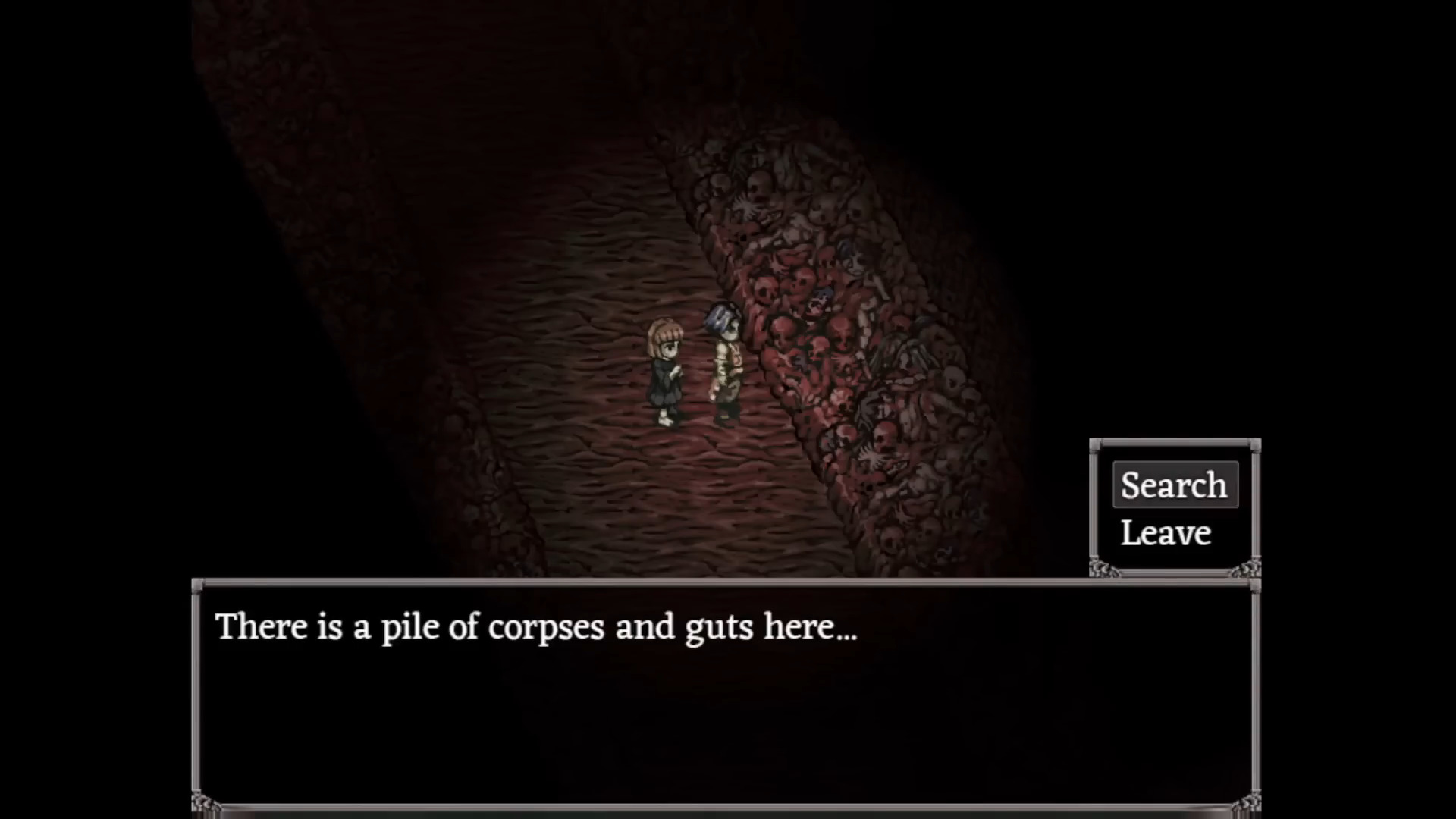
And a horrible place it is. The smell of gore and human waste of all kinds is a frequent sensory detail as you enter new rooms. Torture implements lie around as though they are decorations. Dark cells are either ominously empty or contain the undead remains of tormented prisoners. Every room has something that could kill you. Running too fast and step on a rusty nail that you really should have seen? Better hope you have some medicine that can cure infection, otherwise you’ll be dead in a few minutes. Run too low on food and you’ll starve to death. Run into an enemy that appears under the umbrella of whatever phobia your character has? Deal less damage and get brutalized into a fine human paste. Again.
As you worm your way through the initial passages, you start to get comfortable. Guards can be beaten. You can avoid Manebas and the little flying Gnomes that deal scratch damage but leave you with yet more infected wounds. You almost get complacent. That’s when the game does something new, unveils another twist. You reach the mines and then hear a strange noise, accompanied by the message “A TERRIFYING PRESENCE HAS ENTERED THE ROOM”. Staying to encounter the terrifying presence earns you a swift death. So you learn. You move faster. You get your leg imploded by a rogue dark wizard. You are devoured by an enormous water dragon. You are decapitated by a ghost you can’t hit. The list of ways you can die starts to become dizzyingly long. You have to start remembering what killed you all the previous times. Like a recipe that becomes inexplicably more complicated each time, you realize that you’re having to get more and more right the longer you survive. You have to fight your way through the dungeon. And why? All to reach Captain Le’garde – either to save him, talk to him, or kill him. The game’s idea of destiny – of heroes or mercenaries going to fulfill their duty – devolves into a messy survivalism, messier than the game initially implied. You start to get jaded.
You might (if you’re a monster) opt to offer up an innocent child to an Uzumaki-like human hydra, in the hopes it’ll give you something to help later on. You hack off the infected limbs of your party members just to keep them alive for later. You ration your food, and save the wine for your own character. You kill first and ask questions when you’re stomping on the lumpy, bony corpses of the monsters that inhabit this place, making sure they’re dead. One of the game’s best moments comes when you sit down in a dark, cold, near-empty landing, one of many in the stairwell. You can just plop yourself down in a chair and ask yourself – why? Why am I here? You could be anywhere else, the game says. And yet… you’re here. You’re in this miserable place, where you will die – where you have died many times before already! – so why keep going? Perhaps spite is the only answer that’s worth mustering. Beating the game is a goal unto itself, right?
But there’s more to playing video games than just beating them, isn’t there? You know there is. So you have a more careful think. As you carve your way through the last few enemies that stand between you and Le’garde, as you figure them out, you wonder. What is driving me here? For me, writing is a way to think through my feelings. As I’ve said a number of times before, horror games – and gaming in general – can be an emotional process. Horror games are some of the best forms of generating emotional vulnerability when it comes to playing video games. We are disempowered, and the very core of why we play games – satisfaction and empowerment – is thrown into stark relief. Yet I think all the best horror games have this unspoken promise built into them: hope. We have hope that we – or the other characters we like – will make it out okay. There’s catharsis in that, but there’s also catharsis in being caught, in being defeated. We can rest for a moment. We tried, and failed, but it’s okay. Games are all about repetition. About getting up and trying again, no matter how long that takes. In Fear & Hunger, your vulnerability is apparent through the entire game. It is that same vulnerability that makes triumph taste so sweet. That makes fighting for just one more day worth it.
The game does not end at Captain Le’garde. You might even find him dead, if you took too long, if you didn’t pull the run off as well as you could have. The game’s random elements might have conspired to screw you over – a map change you weren’t prepared for, or an enemy that did just a bit too much damage, or hacked your leg off, or something – and Le’garde is gone. But the game goes on. There are more depths to plumb. The psychosexual horror becomes subtler and more profound all at once. A mysterious City lies beyond the Dungeons of Fear and Hunger, and if you know how to open the door to it, you’re rewarded with answers, with catharsis, and maybe with hope. Maybe something you do in here will change the world. Or just change your poor hapless character’s life.
Fear & Hunger inspires me to not only make video games, nor simply to just write about them more, but to keep myself going in life as well. It is a game that takes an incredible amount of focus to exist in and to beat, and yet puts into focus everything that matters. That the human spirit is strong and sometimes senseless but is ultimately always worth fighting for. Love and dreams and hope – these can exist, even in the pits of the darkest, most horrible, most alien environments. Radiation-blasted hellholes stalked by ancient dinosaurs made of raw meat – even here, I flourish. Even here, my spirit glows.
You can buy Fear & Hunger on itch.io.
 Horrorgameanalysis