
“My dry, stainless, odorless child body had shivered all over and metamorphosed into a stinking, sweating, oozing hulk sprouting hair. I found myself disgusting.” This is just one of the many wonderful, revelatory sentences contained within my body — a Wunderkammer (hereafter referred to as my body). The writing is beautiful in its mundanity, and the way it relishes in sensory detail elevates your own bodily experience by immersing you in another.
Shelley Jackson is a prolific and famous figure within the digital literature community. She has written classics of the genre such as “Patchwork Girl” (1995), and has written a number of other works, including the short story collection “Melancholy of Anatomy”. Her works, therefore, tend to play on themes of body or embodiment. Her 1997 work of digital literary fiction, my body, is not a game in the traditional sense, at least in terms of the game’s I’ve looked at and recommended in this “You Should Play” series before. It is a hypertext work, which uses hyperlinks to help tell the story.
Hypertext literature is an important precursor and accompaniment to various games and game genres. It is literature that you navigate digitally, and if you were not navigating it through hyperlinks, it would be diminished. Hence why it is a kind of digital literature. The Body is part of the “Electronic Literature Collection”, which I have played through various pieces of over the years, but am only now going through in a concerted effort to educate myself on the classics of the form. “The Body” is a good start in this potential mini-series within my “You Should Play” series because it speaks to my own hyperawareness about my body at the moment. Every body has a history, but I have for a long time ignored mine, or ignored most of it in favour of putting off pressing questions about it. Shelley Jackson’s work emphasizes every part of the body, from toes to armpits to hips. Each link has at least one line of “oh…” attached to it, for me.
Jackson’s work – through the use of hyperlinks – allows you to see the connections between the stories about her own body, the history that it carries with it. Slowly you begin to form your own connections. Jackson writes: “I thought about people who went blind from brain damage, then learned to see again with an entirely different part of their brain. The neurons found another way to link up. If you needed to, you could rewrite your brain. What if you just wanted to?” The body functions as a gateway to narrative, that we can rewire at any time – even if that time is slow and crawling, a process of maintenance that is meditative in its temporality.
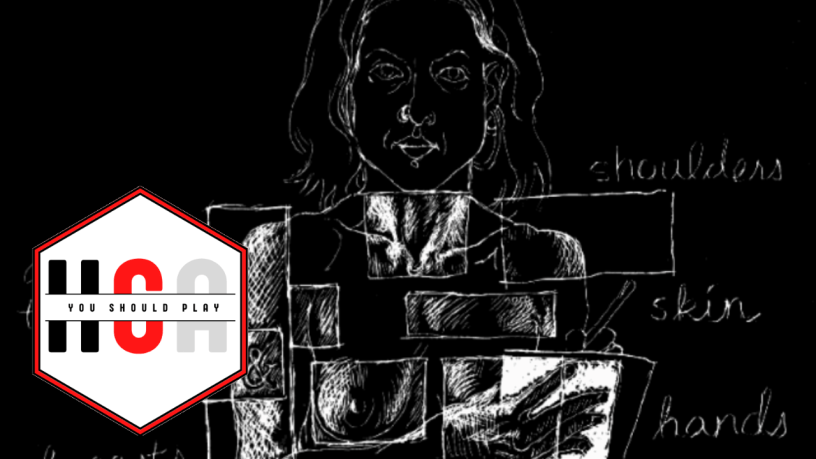
Brilliant little illustrations help usher us into the mood, scribblings of black and white, midnight and marble. She writes of the majesty of her body, of its subtle betrayals, and in doing so helps us reflect on the same processes that occur in our own. “It is a secret, busy space,”, she writes about the mysterious insides of her body, “and when I imagine myself inside it, I am filled with glee and self-satisfaction”. I am of course interested in the internal workings of the body, but insofar as what they can tell us about ourselves. Horror reveals the insides in a very literal way most of the time, externalizing our fears with the help of a machete or disemboweling claws. But horror can also be much more subtle, rooted within the mind, yet still rooted in our impermanent bodies. my body is all about the subtle joys that mix with the heady discomfort when we focus on our own body – and on other’s bodies – for too long. Or when we begin to question things we always took for granted.
One’s own body is such an important thing, and perhaps everyone else but me is aware of it, and has been aware of it for years. Or maybe it is something that people who are comfortable in their body never have to think about. I almost sincerely hope you never have to think about your body in the ways that I do. However, if you’re seeking to understand your body, there are few better ways than to get closer to someone else’s. The subtitle “a Wunderkammer” – refers to a “cabinet of curiosities”, or a “chamber of wonder”. And that is what a body is, after all, because that is what a human being is – wondrous in our potential, if we stop to think about ourselves for just a moment.
You can play my body for free at this link.
YOU SHOULD PLAY: my body — a Wunderkammer
 Horrorgameanalysis