
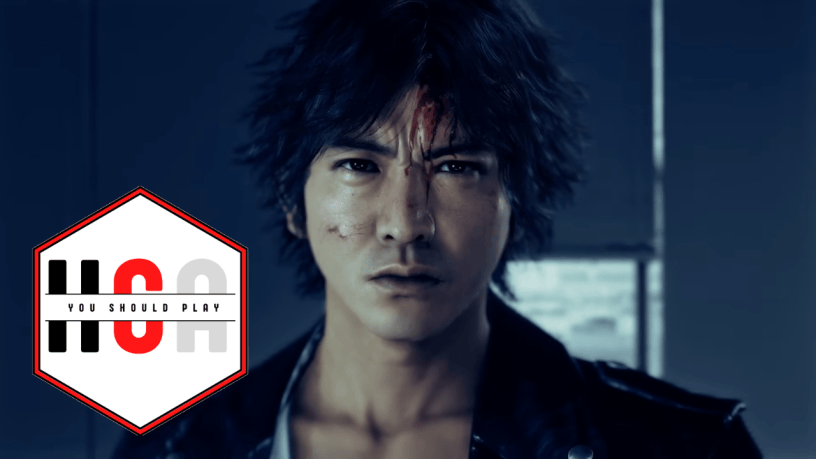
I am facing death. The end of my healthbar is cracked and broken from previous brutal fights, and now my opponents are surrounding me from all sides, and I know that I have already reached my limit. Detective Yagami’s pockets are not as deep as Kiryu’s – thus, I am running low on healing items, and everything seems hopeless. Well, not quite hopeless – I just have to execute this flawlessly.
So I sprint forwards and leapfrog over the yakuza. As I sprint, I grab the man by his throat, and spin around in the air with him so his head is angled towards the floor. His skull slams into the ground with a sickening crunch, and I roll elegantly to my feet. I keep moving, sprinting into a wall, and leap up onto it, before redirecting that force, bouncing off the plaster and slamming my knee into another man’s head. He goes down, sprawling. Two left – I unleash a flurry of punches as the other man looks on, dumbfounded, as his friend goes flying. The last man is briefly enraged as I sprint towards him, but he doesn’t have time to think as I grab him by the collar and toss him over my shoulder onto the ground. He grunts, his hands slipping on the lino floor as he tries to stand, and he looks up for just a brief second. Just long enough for his eyes to widen as my white sneaker connects with his head. All of that action is about twenty seconds of gameplay, and somehow it never quite loses its lustre.
Judgment (RGG Studios 2018) was a game I was not expecting to like as much as I did. To start with, I presumed it would be merely a spin-off game of the Yakuza series, which I’m obviously now a very vocal fan of. Here, my credentials: I’ve worked my way through 0, the original Yakuza, Yakuza Kiwami, Kiwami 2, Yakuza 3, and Yakuza 4. I’ve 100% completed 0, Kiwami 2, and Yakuza 4. So, evidently, I’m extremely invested in the series. My CV proves it!
I decided to pick up Judgment at the juncture I did because I’d heard of how infamously huge Yakuza 5 is. I wanted something a bit more digestible, and one that also gave me a break from an overarching storyline and characters I have been attached to. I was a little worried. After all – maybe the exploits of Kiryu were a one-off. Could anyone be as good a protagonist as he was? Could a new protagonist develop the same rivalry with the game’s main antagonists? Well, given that I’d already played through a bunch of games with multiple protagonists and each game was still somehow flattening me with how awesome it is, I really shouldn’t have been surprised that Judgment was good.
But what surprised me was just how good Judgment was. It wasn’t just that it was as good as the sometimes wonky original game or its Kiwami remake. No – it was better than that. It is even perhaps on par (or at least just below) Yakuza 0, the commonly-cited “best game in the series”. Judgment accomplishes this first of all with the aforementioned refocusing. The fact that each game has characters that stick out is incredible. It is hard to decide which characters are my favourite because Judgment, like the rest of the Yakuza series, gives each character their own moments to shine, in their own ways.
Protagonist Detective Takayuki Yagami’s journey also has an incredibly strong thematic throughline, and his personal story is weaved perfectly into the overarching narrative of the game. Once a proud defense lawyer, Yagami became a detective after a client he managed to free ended up committing another murder. Disgraced and disgusted with himself, Yagami’s hunt for the truth is what drives him through the story. The story is full of the usual Yakuza twists and turns, and as usual strikes the perfect tone. You have dark, serious storybeats, brought up and made a bit lighter by the vibrant and interesting characters within it. It is a story that knows when to take itself seriously, and when to pull back. But it’s a dark, conspiratorial story, where you investigate the grisly murders of yakuza whose eyes have been gouged out, their bodies dumped in the trash behind bars and clubs. The horrifying premise lends itself to villains that will stop at nothing to get what they want – and so Judgment dips itself into horror a bit more than the other entries in the series. Not just in the narrative, but in the environments – you fight through a dark, abandoned hotel in one section, as your companion is abducted in the dark and almost murdered.
The themes of the story – centered around what we’ll do to be perceived as “right”, what we’ll do to save human lives – lends itself to ideas of moral degradation. Yagami’s fight for justice takes him to the outskirts of society in Kamurocho and his insistence on the truth hurts a lot of people through the narrative, whether directly or indirectly. The plot is fun to figure out, even while the detective gameplay isn’t quite interesting enough on its own. It’s classic “hover over detective points of interest until they run out of things to say”, and it sort of plays itself most of the time. It is fun to go about presenting evidence and picking the right thing to say in the very infrequent interrogations and court scenes (something the game needed more of to give it a more distinct atmosphere from Yakuza). And at least those moments have some stakes, where you feel like if you get it wrong, you’ve missed out on something important.
The classic beat-em-up gameplay, where you run around and beat the shit out of thugs who look at you funny (or insist you looked at them funny) is supplemented by the detective stuff, but also drone flying, lockpicking, picking the right disguises, parkouring, and more. The sheer variety of gameplay on offer reminded me somewhat of early 2000s platformers, where maybe you could argue the core gameplay is obscured beneath distractions. But Judgment, like the best platformers, is happy to divert you from the main gameplay with stuff that’s generally just as good. Variety is the spice of life, and Judgment’s variety keeps you hooked. Even if you don’t like one bit of the gameplay, you’ll find another that you like. I just hope you like the “beating people to a pulp” part, because that is pretty darn important.
One of my favourite things about the series as a whole is just the ability to get lost in its world. As the story slowly begins, I found myself still wandering around and playing in the arcades. It really is surreal playing full video games inside another video game – in this case, Virtua Fighter 5 is fully playable within Judgment. It is hard to describe just how important it is that these diversions exist. Like I’ve said before in regards to video games and evil, it’s the potential of what you can do that is just as important as what you choose to do. Spending two hours playing Virtua Fighter 5 while blowing off several important leads in my investigation is essential to deflating the tense and fraught mood of the rest of the game. It’s that self-driven agential levity, that lets you decide when to take a break, that helps Yakuza and by extension Judgment, remain an accessible experience to everyone. If the heavy tone of the game’s narrative is getting you down, just go and play some puyo-puyo, or fly your drone around for a while, or do a side story where you chase after a bald man’s wig to prevent him from being found out as a fraud.
Sometimes Judgment wobbles a bit. As with most Yakuza games, it takes a little while to get properly going, and the set-up feels sometimes a bit extraneous. But then by the end you’re so immersed and enthralled by the never-relenting action on screen that you realize all the little set-up moments were kind of essential. Judgment’s ending is particularly strong, and its final boss is insanely memorable, and dare I say iconic, to use an overused buzzword. But it really honestly is. It is bizarre that these games are so overlooked in comparison to a number of the other triple-A experiences out there. So if you want to get into the Yakuza series but also don’t want to invest yourself in a thousand-plus hours of absolute pandemonium, the tight and focused, yet deep Judgment is a great place to begin.
You can buy Judgment on Steam.
 Horrorgameanalysis