
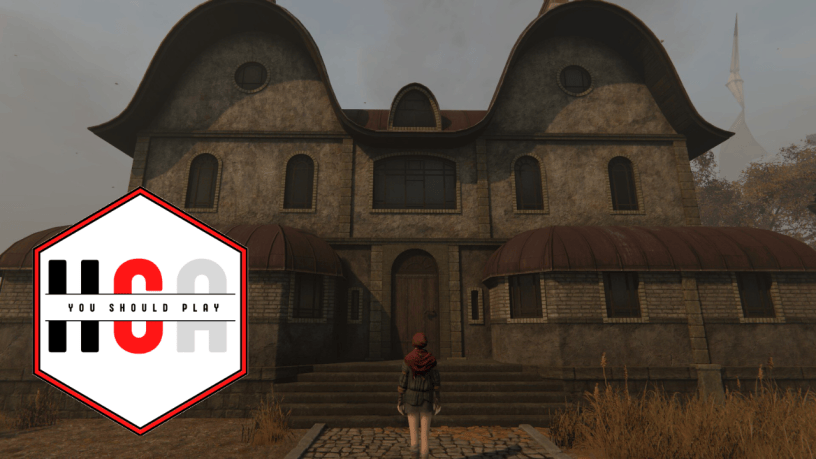
“Now we come to the time… when deities begin to die.”
– Pathologic 2, Ice Pick Lodge 2019
Yes, you should play Pathologic 2. Go on. Go! Do it. Right now!
Okay fine, wait, there has to be a more dignified and intelligent way to start this article. Okay, here, how about this:
Pathologic 2 is a game of such incredible sophistication that the narratives of other, “regular” video games pale in comparison.
Set in a dying town in the Eurasian steppe, Pathologic asks the player to decide what human values they hold most dear. As an outbreak takes thousands of lives and pushes the town’s limited resources to breaking point, you play as a healer who has the agency to make decisions but also is restricted by the nature of their position politically. It is a stressful, hurtful game that I have been writing about in some form or another for about seven years. So chances are you don’t need this article or this recap if you’re reading this.
Let me caveat this “You Should Play” anyway: the original Pathologic remains my favourite game of all time. It is a game of unparalleled narrative depth. Each character is representative of an ideology, with exceedingly careful consideration given to their narrative importance. The gameplay is difficult and harrowing, putting traditional video game design decisions to the test. What is fun? Pathologic asks, but it asks much more interesting questions than one that simple. What is fun is just the start. What does it mean to be attached to fiction, is one of the most interesting questions it asks. And what does it mean to be attached to a world that exists on your computer? Pathologic generates such intense longing and strong emotions that when you are separated from its world at the end of each playthrough that you don’t really want to leave. Pathologic 2, based on my feelings for the original, almost doesn’t need to exist. Yet I’m grateful that it does.
Pathologic 2 is the confirmation that the game’s themes and gameplay mechanics still have a lot to give. Let’s start with how that story is laid out, shall we? Pathologic 2 tells the story of Artemy Burakh, a surgeon returning home from time away studying. When he returns, he finds that not only has the Town changed, but it is about to undergo a terrible metamorphosis. You find yourself one of the key players – the key player, if you survive long enough – to transform the town around you. Getting there is not easy and often destabilizes a player’s sense of morality or even their sense of what a video game is supposed to be.
The game’s survival mechanics encourage you to think carefully about what you value. Do you check in on someone who has asked for your help, but risk infection and use up precious time, or valuable resources? Rather than games that ask you merely to make large-scale narrative decisions in a narrative mode alone, Pathologic demands you think about every scrap in your inventory. In a video game market stuffed with dull survival games that never go anywhere, with infinite resources and infinite time (I love Minecraft as much as the next girl, don’t get me wrong), Pathologic 2 remains a breath of fresh air for how it problematizes the infinite resource design of most video games.
The game famously calls into question what it means to die in the context of a video game. Traditionally death is impermanent, even arbitrary, in video games. It is a fail state that can be sidestepped by hitting “reload” in most circumstances. Pathologic 2 says that death changes a person. It can’t change a person as much as it might in other circumstances – we’re playing a video game still, after all. But still, death has a lasting impact.
One death might chip away some of your maximum health. Another might say that you have less hunger. One takes away your ability to hug and comfort people. All of this serves to frustrate many players. I’ve heard arguments like: “Why the heck would dying make the game harder? That’ll just make me die more?” And to be fair, I understand that. If you’re looking at this experience through a traditional video game lens, this design seems blatantly unfair. I think the other common rebuttal I hear is “well it’s not a traditional game! It’s meant to suck!” and I think that’s not quite getting to the core of it.
Yes, Pathologic 2 is not a traditional video game. It is thorny, ugly, and painful. It frustrates as much as it delights, and it delights in tormenting you, in pulling the rug out from under your feet and making you think about your next move, your next plan of attack. But there it is, there – that’s why Pathologic 2’s radical dislike for the player makes you behave differently. Death is a teachable moment in the game in a much more literal way than in other games. Death is a fail state in Pathologic 2 and one that you can recover from. Sacrifices have to be made. Games often do not require the player to make meaningful sacrifice. Perhaps within the narrative, you’ll get a game that asks a player to kill one character or another. But Pathologic 2’s gameplay structure asks you to make actual gameplay sacrifices.
Entire quests fall by the wayside. Bits of town decay in ways you couldn’t exactly predict. Things and people go missing because you just ran out of time. You can’t carry everything so you drop medicine that you’ll curse yourself for dropping, because now you need it two days on to save your childhood friend. Sacrifices feel more tangible because you’re the one making all the decisions, not just the big landmark ones. It’s a game that can be mastered and exploited, just as any other game with a narrative and well-defined rules. It can be easy when you know what you’re doing. But that first playthrough – gorgeously brutal and filled with moments of hope that you can actually build on – is unlike almost any other video game experience.
It’s not a light-hearted game, but it’s also not as awful as I and others sometimes like to lean into. Because that aforementioned hope is the cornerstone of Pathologic. It has a classic Russian literature-inspired distrust of people, but also has faith in people too. It loves the potential of people, and it loves what they can accomplish when they don’t give in to their worst impulses. Sticking together despite it all – spending time with one another at the end of the world – these are feelings that have only deepened for me in the six years since Pathologic 2 first released. Love – romantic and platonic and random – can be found even in the miserable alleyways of a town that is in its death throes. It is a game where delivering a woman a box of pills feels more triumphant than other games where you slay gods. Playing as the overstressed, overworked Artemy Burakh is a frankly healing experience, that pushes you to ask questions. Not “what is fun”, but rather, “what matters to me?” It puts a mirror to you and says – will you break? And even if you do, you can still get back up again.
I really recommend you do get up again. There’s nothing more beautiful.
You can get Pathologic 2 on Steam.
 Horrorgameanalysis