
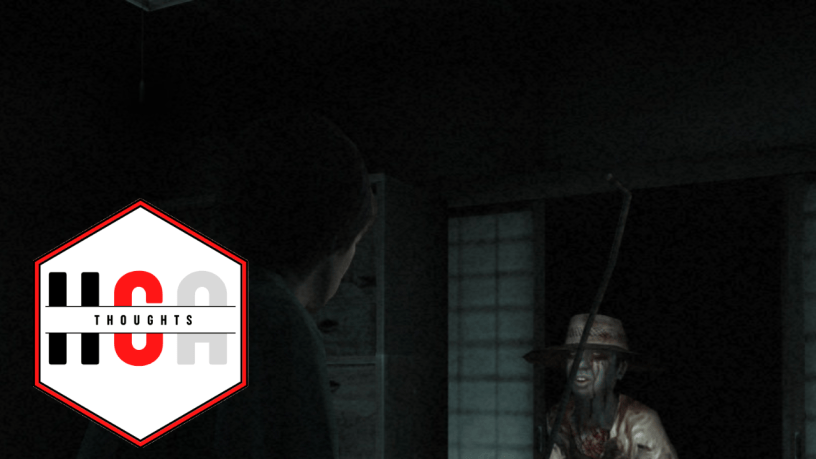
I am a glutton for punishment. Thus, here I am again, Forbidden Siren. I am kneeling in the darkness of the village of Hanyuda, holding my breath. The oblique blackness all around is crackling, bursts of obscuring fog sliding into place and then vanishing like breath on a cold wind. I am hiding in the shadows from the shibito armed with a flashlight and a revolver as he stumbles towards my manufactured distraction, a flare jammed into a metal barrel. Ah, but I did not hide well enough! He turns towards me, groaning in zombie-like stupefaction, and I know that death is soon to hit me. The game is famously stingy with saves and checkpoints. I will have to restart the whole mission. Or I would – if I wasn’t playing through on the PlayStation 5 emulated version of Forbidden Siren. I hit the Options button and twitch the left analogue stick a few times, I’m back about twenty seconds. I shuffle further as needed into the darkness, and this time, the shibito moves past me blithely to stare at the flare.
In my earlier playthroughs of the game, without relying on save states, the horror of Forbidden Siren was some of the most paralyzing in video games. Ten to fifteen minutes worth of slow, painstaking progress through hostile, labyrinthian levels populated by monstrous, merciless enemies could be wiped out, if you opted to stick your head out of a hidey-hole at the wrong time. It was a pitch-perfect, paralyzing simulation of loss. This generated fear and adrenalin on such a level that it was hard to find another game to rival it. But now, with the PS5’s painfully easy “Rewind” feature for its emulated classics, Forbidden Siren has been defanged.
That’s not to say the game doesn’t still have its challenges. The game’s objectives are still obtuse and deliberately obfuscatory. The game’s puzzles demand a focus from the player that isn’t often seen in survival horror. You have to follow a twisted trail of logic that is more logical than many of the puzzles in psychological horror games like Silent Hill, but is still bizarre and confounding. And I’ve still died a few times – but when those deaths don’t have to be sat through, as you don’t have to watch your character slowly die and whimper and take their last breaths through the enemy’s vision – they lose their impact.
It got me wondering about the old hypothesis – is a fear of loss, or more accurately fear of death, the only thing truly frightening about ludic horror? Let’s put aside the jumpscare, and let’s get rid of narrative elements. There’s a lot of scary narrative elements in Forbidden Siren. The concept of the shibito, for instance, as inhuman beings that grow beyond human bodies, mutating them into monstrous creatures, is a great one. Fear of change and mutation is a constant in horror – the fear of one’s own body rebelling against us.
So that’s easy stuff to cover. Narrative can be scary – existentially or bodily. But when we subtract fear of death, when death can be reversed or flipped around, is a game truly scary anymore? I would argue that Forbidden Siren has a few scary advantages that make ludic horror achievable and terrifying. The sightjacking mechanic, where you can see yourself from an enemy’s eyes, is inherently destabilizing and frightening. So too is the immediate nature of a confrontation with a shibito. Fights are tense and you still don’t want to lose. Duels with firearms are short and really depends on who pulls the trigger and hits their opponent first. The element of surprise is paramount.
But these encounters are nonetheless weakened by the fact that death is just a slap on the wrist. You might have felt that too in certain horror games – Outlast 2 again features here as a wonderful example of “what not to do”. Dying sets you back merely a few paces and you are left with the impression that the worst the game can do to you is not very much at all. So while I understand that the rewind feature isn’t some mandatory feature you have to use, it does allow for this kind of play that defangs the horror and the pervasive fear of loss.
The longer I play Forbidden Siren, however, the deeper its hooks still manage to work their way beneath my skin. The level design seems simple but it’s also impeccable. The way in which levels unfold and then re-unfold is still so clever, I wonder why more horror games don’t rely on the same structure. Breaking the town of Hanyuda into discrete sections gives those sections character, but they also change based on the amount of time that has passed. The level of immersion that comes from noticing changes (such as new construction work done by shibito, new enemy placement, or even just starting the level from a new place) and then figuring out ways to reinterpret the level grips you and forces you to engage with the game on its terms.
So then I think immersion – facilitated by strong level and audio design – is a key part to the horror. But now that the horror can be so easily shattered by the rewind feature, being aware of the game’s status as something highly difficult means a lot less. Mistakes can be erased at any moment. This is in contrast to how the game played on the PS2 or PS4. I remember the stark feeling of horror at having to restart the first school level over and over again on my first playthrough. Or running down the mineshaft as Akira Shimura and getting gunned down by a shibito I was having trouble ignoring.
So what is it about death in horror games that is truly frightening? It is getting the player as close to death as possible without actually killing them – which, as a design challenge, ranks up there with “find a universal constant for fun”. Death in horror games has to be a tantalizing possibility that’s also difficult to reverse. Being sent back thirty seconds won’t do anything for you – it has to be something meaningful.
Resident Evil – both the original and the remake – have this tantalizing sense of potential loss. The whole game is hooked up to this malevolent, pervasive feeling because saves are limited by a collectible item, the Ink Ribbons. If you misuse the Ink Ribbons, you could potentially have to start the entire game over again. It is a careful test of your own skills and your ability to predict the future, in that you must judge how much of a level you can beat without saving. This ratchets up the tension, the fear, the horror. But is this an artificial way to generate this fear? Many games rely on this tension but it also spawns a lot of frustration when you do take one too many risks. The brutal worlds of Fear & Hunger and its sequel are responsible for a lot of this frustration, as an hour of tense, meaningful gameplay becomes rendered – seemingly – meaningless by your death. You must repeat everything you’ve been through, and that is a painful prospect.
I do think that immersion is key to a survival horror experience, and what keeps me coming back to Forbidden Siren is its capacity to force the player to really slow down and absorb the locale, even when you start to learn the levels in and out. Immersion is the most frightening thing. It doesn’t necessarily have to be a sense of realism, although that is what Forbidden Siren attempts to achieve throughout its run time. Everything is slow and methodical, and the presence of real faces and highly detailed graphics for the time gives everything an authentic feel.
I was showing a group of players Paratopic, and I don’t think it was a fear of death that created the most horror. It was immersion within a horrifying world. The developers achieved that immersion through strong gameplay moments, where the player is allowed to be an active agent and at least attempt to shape the gameplay experience. The sense of responsibility over your character can be quite important towards generating a fear of loss for the player. That’s what a horror game’s fear of death is, of course – a fear of loss both in a traditional “death is confronting” way, and in a “damn I lost the game!” way.
So, horror games have a complex relationship to death. They want to prompt thoughts of death much more frequently than other genres – mortality and what lies beyond are terrifying. But they also don’t want to murder you, because that takes you out of that delicious horrified frame of mind. The balance seems difficult to strike. The original opening of Silent Hill 2 with its long walk and no real danger is still isolating and horrifying, generating a slow tautness that builds in your gut. As I design my own horror games to be released over the next few years, I’ve been considering my own relationship to death in games – and I realized, I need ludic death to be punishing in order to be horrifying.
HORROR GAMES AND DEATH
 Horrorgameanalysis