
7) MASS EFFECT 3| BioWare 2012
“Stand in the ashes of a trillion dead souls and ask the ghosts if honor matters. The silence is your answer.”
Mass Effect 3 is, quite frequently, extremely frustrating. It is a game that completes a trilogy of fabulously disjointed games. In the first Mass Effect, you command a team of experts to pull off a mission that no-one believes in. Defeat a rogue agent, uncover an ancient horror, and discover why an entire civilization just died out. In the second Mass Effect, join a terrorist organization to help defeat a small-scale threat that does not really align with stopping the totality of the threat outlined in the original game. In Mass Effect 3, watch in horror as these two approaches have to be jammed into a single game.
Mass Effect 2 is such an odd game because I love it, I adore it with every fiber of my being, but oh how I wish it had been part of some other trilogy, or was a standalone game – or hell, if it had been the first game in the series, it might’ve worked better. It wasn’t the middle game that Mass Effect needed, and it set up conflicts that Mass Effect 3 simply could not resolve adequately with the time it had left. In fact, it didn’t just set up unnecessary conflicts, it actively prevented the original game’s antagonists from remaining as interesting as they could have been. But we’re not here to harp on what Mass Effect 2 did wrong. And I’m also not here to complain about Mass Effect 3’s ending. Instead, I want to talk about what Mass Effect 3 represented to a twelve-year-old me, when I first played through the trilogy, and I want to talk about what missteps Mass Effect 3 suffered beyond the usual critiques I see.
The rest of this article spoils parts of the Mass Effect series.
Even as a little girl, I held self-discovery to be a virtue. I definitely wouldn’t have phrased it like that, and I don’t think it would have even been a conscious thought of mine. However, I was a voracious reader (was, I say, as if that’s changed), and one of the things I liked (liked, I say, as if that’s changed) to read was fictional universe encyclopedias. Anything that could make the universes I inhabited feel more tangible, I would take it. Collectibles items that are actual items from the game always were more interesting to me. Mass Effect’s collectibles, funnily enough, were out of the price range of a girl from New Zealand. But I remember treasuring my copy of “The Art of the Mass Effect Trilogy”, and pawing through it in the hours between when I’d get my turn on the PlayStation again.
This mammoth book contained sketches for so many of the characters that I loved, and as I struggled through a puberty that began to tear at the fabric of my mental health with increasing awful intensity, Mass Effect was a universe into which I could safely retreat. It is a locus of power fantasy – you are the only person who can save the galaxy from a threat that cannot be described, and your problems are bigger than everyone else’s. That doesn’t mean you can’t slow down to help other people, but ultimately, it is Earth that needs saving. This all felt a bit too uncomfortably anthropocentric for me even at the time, but now the underlying message feels a bit too Fukuyama “end of history”, pack it up, the U.S. won, military interventionism is required to save the world over scheming useless politicians, and everyone else’s homeworlds being massacred means nothing when Earth is on the line, dammit!
Mass Effect is dated in a few other ways. I think I should acknowledge that, because I certainly didn’t understand it way back when. So, I kind of wish that there’d been more done with the monoculture femininity presented by the Asari, who are a monosexual species of blue alien ladies. Every Asari we see is basically a sex symbol – all with boob armour, or gratuitous heels, or what have you. And I mean, like, by the goddess, I don’t blame them, but surely some Asari don’t want to present gender in that way. Why Asari even perform traditional human gender is a question, too. I would love to have new, weird, alien conceptions of gender played with. The artbook I talked about before was horrible for this, with every Asari ending up with massive breasts and a cleavage window, as well as armour that is just a skintight catsuit. At the time, it certainly giving me warped views of what women could be. You could be a badass warrior who could kill people with a single glance – but you also have to show us your boobs and wear heels while you do so. All of which actually has inspired me to start writing a second sci-fi novel alongside the other one I’ve been writing all year, which is getting closer and closer to a finished first draft! But goodness I’m getting a little sidetracked, a bit bogged down. Overall, I think it is safe to say that Mass Effect as a whole has many shortcomings. Mass Effect 3 has many more. It is the
Mass Effect 3’s focus on the terrorist organization Cerberus – which is variably a covert agency of spies and terrorists that is so elusive it cannot be found, and an enormous military organization that can attack developed interstellar nations and win – is a huge problem. The game is supposed to be about the Reaper invasion, these huge extragalactic monsters that have destroyed countless organic civilizations for perhaps millions of years. The Milky Way has been controlled, subjugated, and erased time and time again by these enormous monsters. They are (on paper, anyway) unfathomable, horrifying, and repulsive. Their method of war involves transforming organic species into degenerated versions of themselves. The horror of having to open fire on former friends or family is a terrifying idea… so instead, Mass Effect 3 says, let’s make half (more than half, maybe) of the game about shooting white-armoured faceless space marines. Revisiting the game and seeing just how much of it actually revolves around the impossible galaxy-spanning capabilities of a human terrorist organization is frustrating. In fact, revolves around is probably the wrong phrase – contrived around is much better.
But there has to be something that kept you there, I hear you say. Why else are you writing about the game in your reflection? And ah, dear reader, that is because I love Mass Effect 3. Even when its main plot fumbles – defeating Cerberus and their bumbling sidekicks, the Reapers – you are spending time with characters that are simply infectiously written. That’s why Mass Effect 2 works despite its plot flaws as well – because the writers are so good at coming up with characters. The grand scale of the plot falls to bits every five seconds, in new ways every time, but the characters – that’s where Mass Effect comes to life.
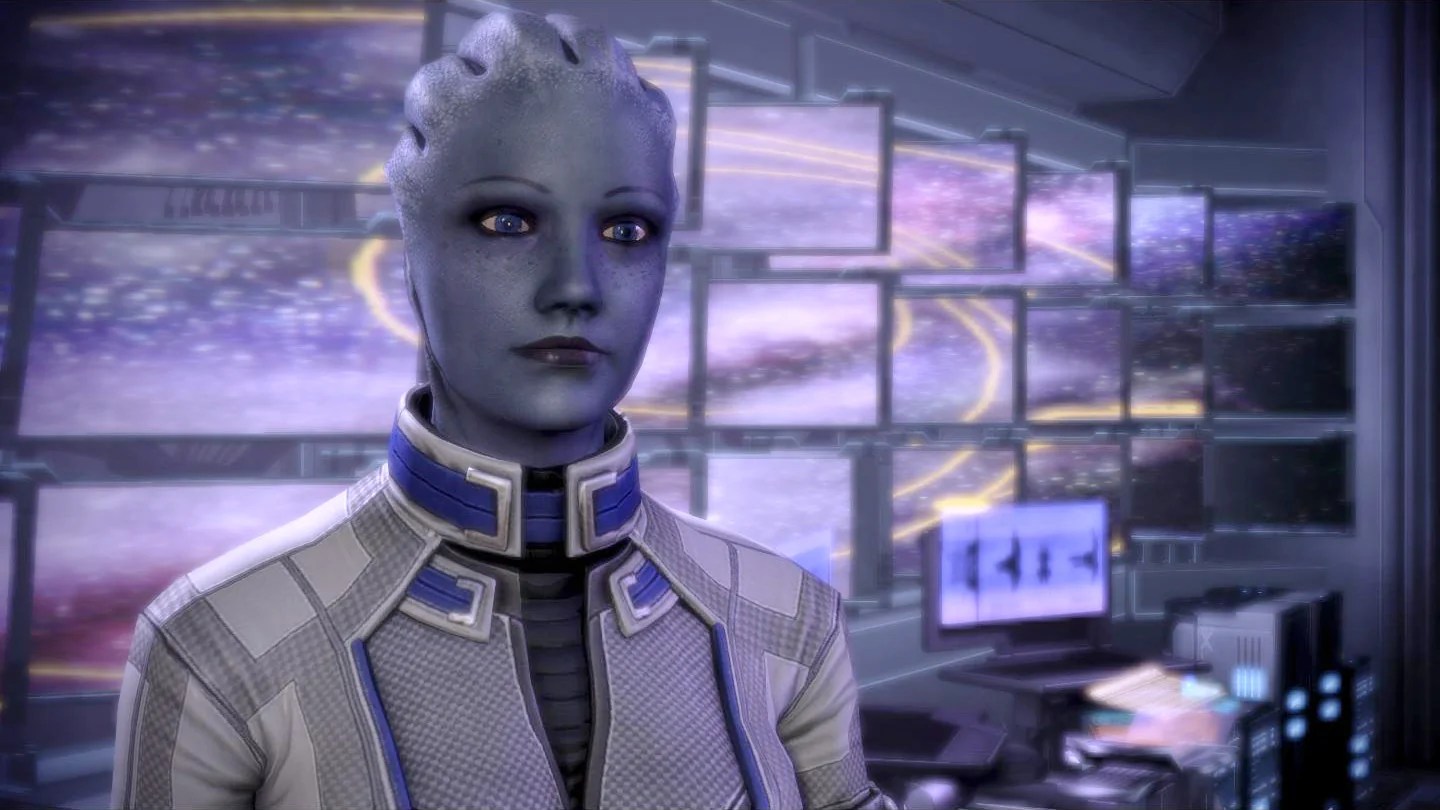
I have not played Mass Effect 3 in perhaps ten years. However, every single one of these characters stayed with me. Even minor characters introduced as same-sex love interests for this game only – like Steve Cortez, the shuttle pilot, and Samantha Traynor, the communications expert – have arcs and character traits that I remembered, ten years on. I might have made it sound like I hate Mass Effect and all of its missed opportunities, and I am disappointed in it, but I played it for forty hours this year. In a year like this, I consider any game that can hold my attention for that long to be doing something right.
The horror inherent to the setting shines through in some truly excellent missions, with some excellent design. The abandoned Asari monastery, filled with the corpses of dead Asari commandos and containing the horrifying Banshees, transformed Asari weaponized against their species, is a standout. What surprised me was that the scene I remembered being so heartbreaking as a young(er) person, leaving Earth after the tutorial mission, is still so affecting. The haunting piano score, played over scenes of Reaper after Reaper landing on the planet, carriers with civilians – including at least one child – being destroyed without a second thought – provoked an unexpected tear or two. I wasn’t expecting that at all. What I thought would be a fleeting half-playthrough, a dipping of the toes, became a complete playthrough all unto itself.
My Shepard this time around was a hardass Renegade, a woman who would always pull the trigger, was not afraid to make tough decisions, and ended up with severe bags under her eyes. Playing Mass Effect 3 as a standalone game is not as much of a mistake as you might think it is. Not only does it have easily the most fun, addictive combat out of the three games, but the terrible worldstate it leaves you with enables some more interesting moral choices. Rather than just picking a benevolent old friend and a seemingly bright future for everyone, you must now weigh the suffering of millions against the desires of one tyrant. Rather than just picking which character you prefer on the planet of Rannoch, Legion or Tali, you now have the much harder-to-justify choice of allowing the aggressor to wipe out a species of robots you have no specific attachment to, but whom you know are not at fault. They are just afraid, and the attack from their creators has left them with little recourse but to ally themselves with monsters, just to survive. These two sections in particular are a welcome relief from the main plot, if just because they let two other, more interesting galactic conflicts unfold. If the game won’t let the Reapers shine, at least it does a fantastic job setting up moral conflicts and letting the player in at the right place and the right time to make a difference. I’ll write more about the Tuchanka conflict in a separate article, but the new choice I made at the end of that was so masterfully done, it made my current Shepard feel like a completely different woman to the ones that had come ten years prior.
Mass Effect, as flawed as it is in this regard, was also an important, founding document in my sexuality. It is emblematic of the importance of queer representation, allowing players to safely play with attraction and discover what it is that they want. It’s certainly not the best – it privileges sex as the ultimate object of a relationship, the final step before everything settles and there are no problems – but when I think about the complexity of writing a video game like this, where you can romance like twelve different characters over the course of the series, I am astounded at the replayability of the romances. This time around I romanced Traynor, and her relationship with Shepard is just so cute. For my grizzled veteran Commander, she is the little crack of light that keeps her human. Even if the roleplaying and the narrative can be imperfect, again, it is the character writing that shines. As much as I wish there were more queer characters, BioWare also did the right thing by giving characters sexualities.
While playersexuality (the idea that anyone can be romanced by a player character regardless of gender identity) is welcomed by me in indulgent, romantic moments, it is much more important to me that characters actually have queer stories to tell. My last Male Shepard runs (those ten years ago) were a Kaiden romance and a Cortez romance, and Kaiden in particular was wonderful. I remember the love blossoming between two men who had a mutual respect for each other, muddied by time and circumstance, but coming together again in this terrible time, was done so well. I think the way the series writes women is frustrating – again, they are dynamic, interesting, with their own personalities and likes and dislikes – but they’re almost all sexualized. So many people, including members of the crew, that we are supposed to like, make weird jokes about women. Joker, for example, wants to get Shepard and Traynor’s sex tape. James flirts relentlessly with me, even though I wanted it to just be a friendly relationship, and while there’s no harm to it, it feels a bit uncomfortable that you can never ask him to stop. Yet again – the representation alone is important. The fact that the saviour of the galaxy can be a woman is so, so important. Female Shepard, Samara, Tali, Liara, EDI – these were some of my role models at the time (and some of my crushes, I can’t bring myself to be ashamed to admit). Both Mark Meer and Jennifer Hale do a fantastic job bringing Shepard to life – even if I wish I was allowed to have them give coherent arguments against Cerberus.
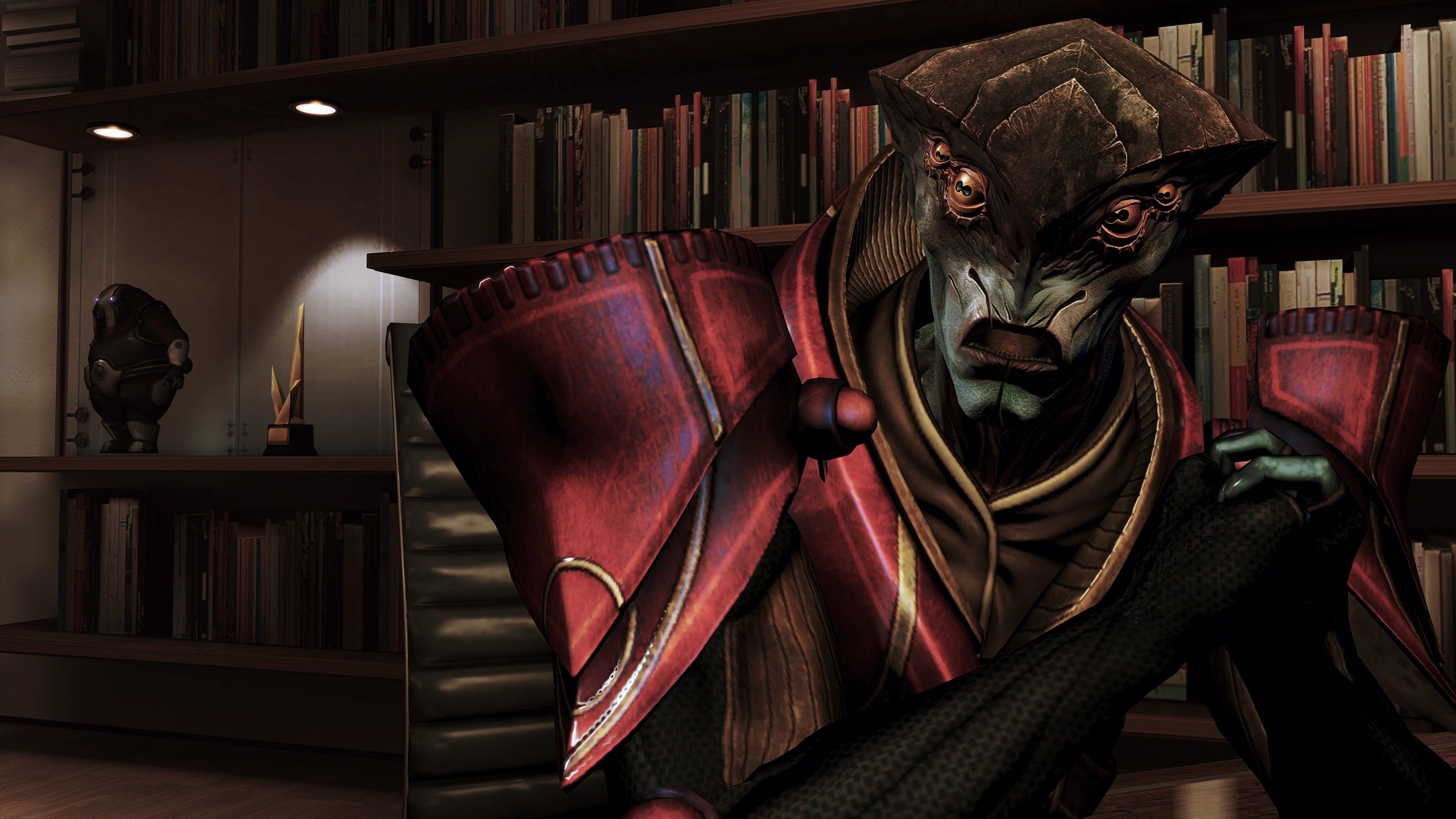
Mass Effect 3 makes many missteps, some of them small, some of them famously large. I never bought the optional “From the Ashes” Day One DLC back in the day, not wanting to reward EA for such greed, and now that I’m playing the Legendary Edition remaster with all the DLC available… I’m astounded they dared to cut Javik, the last surviving Prothean, out. The Protheans being the species at the heart of the first game in particular, their disappearance drove the discovery of the Reapers. Javik is outrageous, funny, and haunted, a character filled with such anger that he advocates for violence and revenge at almost all times. Which is understandable. He was born at the end of his species’ war with the Reapers, and he woke up in the middle of the next one, fifty thousand years later. He goes so well with Liara, the Asari scholar who has studied Protheans all her life. He is, in many respects, a disappointing Prothean. But that just makes him more interesting! It adds dimension to a species that went extinct 50,000 years ago, that lost their own war against the Reapers. To add insult to his removal, there are scenes – fully animated cutscenes! – in the middle of some main story missions you can optionally bring him on, indicating the decision to cut him was a crime. He’s a great character.
Mass Effect 3, for me, thirteen years on, is still a great game. Almost against all odds, I find it engaging, heartwrenching, funny, exciting, thrilling – it’s just an inspiring game. It feels impossible to fathom that it exists – that within the span of five years (2007 – 2012), BioWare made a series of roleplaying games so complex that there are hundreds of tiny granular choices to keep track of. It has so many flaws, sometimes simply because it dared to dream. It had queer representation in a landscape that had nothing in the big budget space. That queer representation still is lacking. It is a fun sci-fi shooter, with a bevy of fun, customizable, synergizing powers. It has a cast of ridiculously endearing characters. It has little moments of peace in a galactic war. It has such attention to detail that you can stop and listen to dozens of little conversations play out in hub areas, and offer your support. The payoff isn’t always great, but Mass Effect 3 has stayed with me for all these years for a reason, and sometimes for reasons I can’t quite articulate.
Mass Effect 3 is a special, addictive game that I haven’t been able to put down for a few weeks now. I have missed it, I realize. I have missed this world, and these characters. I am grateful I am here, today, grounded in the world, with enough time to spend flitting between the Normandy and the Citadel again. I am grateful I can look at the art book details and look at it with the maturity of a grown woman, rather than a naive girl. Mass Effect 3 this year did me the great service of reminding me how far I have come, and I how much I still hold those youthful thoughts dear. If you’ve never played Mass Effect (and you’re here, for whatever reason), I wouldn’t start with 3 – but there’s still something here for you, regardless. Thrilling combat is in almost every mission. There’s always a character that will appeal to you in some way, at some point. And yes, Mass Effect 3 has a story that collapses under itself. But as you’re lying beneath the rubble, you can at least have some tender conversations with old friends.
 Horrorgameanalysis