
6) METAL GEAR SOLID | Konami 1998
“You can’t save memories, even on that system of yours. Memories are fragile things.”
When I last played Metal Gear Solid, I don’t think I took it in as much as I should have. It was a few years ago now – perhaps during the COVID years, when I tried to pick it up. To be quite honest, I can’t even remember if I finished that playthrough. I must have, I suppose, but this year, my playthrough of the original Metal Gear Solid felt like a new playthrough of a new game. It was an important game for me this year in that it was what I would call a competency fantasy. I could practice and hone my skills as a super-soldier, even though it also didn’t feel like a power fantasy. Snake is vulnerable and painfully human, despite the reputation he has among his allies. Sure, he can sneak past a legion of highly-trained, enhanced genome soldiers, but take a few stray bullets and he’ll die just like them. I had to approach situations with care and thought. Even at this early stage, the Metal Gear Solid series makes you think about each room as a puzzle to be cracked. Study guard patrols, evade them at just the right time, and move through like a phantom – there is hardly a feeling more satisfying.
Metal Gear Solid is, unsurprisingly, a fantastic game. I’m kind of an oddity, I think, in that I’m more than happy to put up with dated or awkward controls if the game beneath is still appealing. Metal Gear Solid is such a fascinating, engaging stealth-action game, a military shooter that doesn’t encourage shooting for the most part. The scenario: you are the famous elite soldier, Solid Snake, brought out of retirement to deal with a terrorist attack on a secret black ops site off the coast of Alaska. The terrorists that have seized the base are all standout in some way or another. The philosophy driving each of them is deeply compelling. I think traditionally there is a lot of criticism of the way that boss narratives are structured. We beat the boss, and in their dying minutes, they relay their life story to Snake, and that’s how we learn all about them. While this is hardly realistic, I don’t think we should be playing games for a sense of total realism. The game achieves the requisite level of realism, I think, simulating enemies hunting for you and a lonely stealth mission to a tee. The game’s atmosphere serves the exposition well. Everything has this deliberately over-the-top atmosphere, but somehow it all remains just a little subdued as well. The emotional beats are strong, particularly after the second Sniper Wolf battle, where all the characters involved in the scene try to rationalize why they engage in conflict, what they get from it, and why war even exists. It feels like a homage to death soliloquies in the case of Shakespeare (“Tomorrow, and tomorrow, and tomorrow”, “To be or not to be”). While Shakespeare’s characters tend not to have a bullet wound in their lungs while they’re trying to ruminate, there’s still something of that feeling of melodrama that keeps me glued to the screen while Metal Gear Solid is on it.
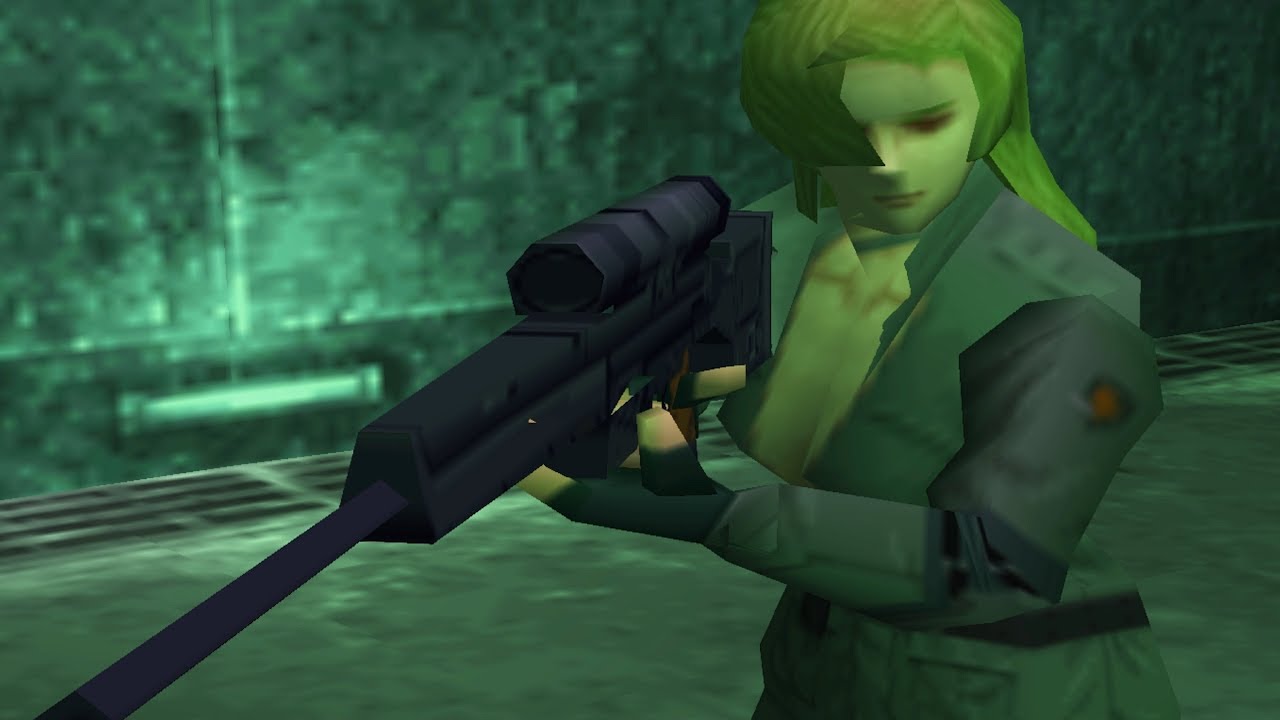
The game’s boss battles are all expertly designed from a mechanical perspective (yes, even the difficult sniping battle, mainly tricky due to controls). The battles do a lot to characterize the bosses even before we get their dying monologues. Sniper Wolf fights exclusively from a distance, of course. Ocelot is full of braggadocio, sprinting around and firing ricochet shots to hit you around corners. The center of his boss arena is a torture chamber for the man you’re here to free, illustrating his deep cruelty. There’s the oft-overlooked Vulcan Raven, who has two boss fights – one from behind the seat of a tank, illustrating his love of big guns and destruction, and the second, deep within a freezer in the facility. He sprints around with a minigun in the world’s most treacherous game of cat-and-mouse between rows of enormous containers. Snake lays claymores, his breath fogging in front of him as the sound of a sprinting giant wielding an enormous gun thunders towards his position. That might actually have been my favourite boss in the game, where it felt like I had to be on my guard at all times and use all my resources I’d gathered to defeat the mountain of a man. The main terrorist, Liquid, also has various boss fights. The first, against a helicopter (“a Hind-D?”) illustrates his sense of total superiority over Snake. When Snake brings it down, Liquid then outwits him in one of the best plot twists in video games, before facing him in the eponymous Metal Gear, an enormous robot mech with enhanced weapons capabilities. It is a deeply frustrating and difficult boss fight, which has a resonant beat with another former boss of the game, Gray Fox, who swoops in to rescue Snake. After that, you face Liquid in a hand-to-hand conflict, having finally brought the man down to your level. This battle atop the ruined Metal Gear is shockingly epic despite the clumsy CQC system, before making a tremendous escape from the base. All of these conflicts are memorable and engaging, just as so many of the rooms are.
Psycho Mantis is probably the most famous boss, which subverts the physical elements of the game itself – controller ports, memory cards – and makes them untrustworthy. But it also lets you outwit Mantis by using those same tools, by thinking outside the box just like Kojima and his team at Konami. You feel clever, and that’s key to the competency fantasy. You don’t just overwhelm enemies with superior firepower. Instead, you outwit your opponents, which is infinitely more satisfying.
The game’s narrative is supported by the frankly ingenious Codec system. The Codec allows Snake to get in contact with any one of his support team at almost any time, and they provide contextual dialogue for all kinds of things. Call Colonel Campbell, for example, and he’ll always remind you what your current objective is, if you’ve forgotten, or need a basic hint on what to do to accomplish your mission. All of the characters in Metal Gear Solid are likable, in fact. They all have human dimension to them, qualities of being that make them memorable. I suspect I’ll always remember their quirks and idiosyncrasies.
You can call Mei Ling to save your game. I think calling a character to save your game, frankly, is fabulous from a character writing perspective. It forces you to get to know a character, and Mei Ling is a likeable, endearing character. She quotes Chinese proverbs and even Shakespeare at you, both inspiring Snake and causing him to reflect on what is pulling him through this mission. Personally I find her much more engaging than the second game’s Rose. But there’s a bit that inspired me to make this video in the first place, that felt like a moment of profundity in and and amongst all of the mayhem of shooting down helicopters and evading endless legions of gene soldiers.
Mei Ling: Don’t forget to save your memories of me too.
Snake: You can’t save memories even on that system of yours. Memories are fragile things. After you reduce them to binary numbers and send them through the air, they’re not memories anymore.
Mei Ling: I wouldn’t be so sure of that. There’s nothing that my systems can’t do.
Snake: Memories aren’t just sounds and pictures. They exist somewhere between the sounds, between the pictures.
Mei Ling: I don’t get it. Anything can be done digitally.
Snake: If that’s true, why don’t you go ahead and try to save what I’m thinking right now.
Mei Ling: I can’t save that type of thing. You have to put it into words, at least…
Snake: That’s right. And that’s what memories are…wordless.
Mei Ling: I don’t know about that…
Snake: No matter how far data technology advances, you’ll never be able to penetrate the human heart.
Mei Ling: You’re wrong. It’s just a matter of time…
Snake: But first you have to understand human emotions, Mei Ling.
Mei Ling: And how do I do that?
Snake: You have to allow yourself to fall in love with someone.
Snake is pretty corny here at the end, of course, but there is something exquisitely engaging about these calls. They shine unexpected lights on characters who you initially do not expect to contain such depth. The story of translating Metal Gear Solid is itself a treat, and goes a long way to explaining why the dialogue works so well for me. Everything lands with the right amount of pathos, seriousness, and tongue-in-cheek military melodrama.
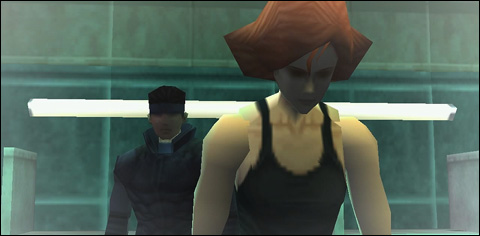
I think the best part of the game is Meryl, however, who is really the heart and soul of the game’s humanity. Saving her is a direct result of your own efforts while resisting horrible enemy torture – something you can fail – and succeeding feels like a genuine triumph, even if it is just mashing buttons really fast. Meryl, though, is just such a good character. While the game’s camera – and Snake – do their best to ogle her and reduce her simply to an object to be lusted over, she’s nonetheless given some great lines, and her voice acting is delivered terrifically in a great performance by Debi Mae West. She shows courage in the face of overwhelming odds, expresses doubt about her dreams to be a soldier, and, like the rest of the cast, wonders at the whole point of war and conflict. The game’s ending cutscene, which I’d forgotten, is exquisitely beautiful. “You mustn’t be allowed to be chained to fate,” the game argues directly. The point of life is to live. There can be no doubt that this is the ultimate message of the original Metal Gear Solid – that senseless conflict creates senseless death. Fighting for fighting’s sake is itself a worthless endeavour – you have to have something to fight for, an ideal, or a person. That person could be yourself, even. But you have to have a reason, otherwise life feels empty and bitter. It is what spells the end for so many of the other characters, who die without a cause they truly believe in. Living is a challenge, Metal Gear Solid admits, but it is one worth undertaking. And if this all sounds a bit too corny or heartfelt for you, maybe this is the game for you anyway. If there are some things this world needs a bit more of, it is wide-eyed earnestness and belief in other people.
While Metal Gear Solid is not my favourite game in the series, it is still one of my favourite games in general. It has a mood that cannot be replaced or surpassed, the cold snow feeling tangibly frigid even today. Every character feels authentic to themselves, interesting and engaging and promising. I want more from them even now. It is an extraordinary achievement in video game storytelling, foundational, landmark – but also just very human. Metal Gear Solid was an exceedingly important game for me to play through this year, a game about human values in a world that sometimes feels devoid of them, looking at it from an abstract perspective. Phenomenal.
Game #5
 Horrorgameanalysis