
Like an oily doctor in a snakeskin coat, Ice Pick Lodge’s 2026 game Pathologic 3 is hard to hold onto. The game has ambition that, frankly, is a little intimidating. The game is full of interlocking systems, with each set of mechanics working in concert to put you in the shoes of the always beleaguered Bachelor Daniil Dankovsky. And as you find yourself in his shoes, you naturally find yourself in his mind, adopting his mental state. Pathologic has always been extremely adept at shaping your perception of the world based on the character you are playing as. To no small degree, this is due to the dialogue you’re allowed to choose. Sometimes you can demonstrate beyond a shadow of a doubt what kind of prickly prick you’re playing as. However, Pathologic 3 also makes a genuine effort to level up its mechanics to match the Bachelor’s more cognitive headspace. Some of this, I think, is a great success.
The game’s most central mechanic is time and temporality. It just so happens that I am a big fan of how time can be toyed with in video games. We are not constrained by time’s linear passage in video games, and why should we be? Even in the most bog-standard video game, we are expected to save and reload upon death. Time already holds less meaning in video games, so naturally Pathologic 3 is interested in interrogating what exactly it means to “manage time”. Previous games in the series were time management simulators in that they expected you to plan a route for the day based on the missions you were given, which could (and would) repeatedly upset you with twists and turns. You were forced frequently to backtrack through dangerous areas. You waste time at the whims of the characters that want you to finish the mission. Similarly, the player wants the satisfaction of a job well done. This is all very stressful considering there was often just a little more each day than could reasonably be achieved. You had to pick and choose which objectives to complete. Pathologic 3 makes completing every day’s objective in one go impossible.
The initial impossibility of conquering time is fitting for Pathologic 3, a game which stars a thanatologist obsessed with defeating death. For him, time is always slipping through his fingers. Newspaper The Guardian published a piece just a few days ago by Jo Marchant titled “Is time a figment of our imaginations?”. Marchant writes:
time itself seems scarcer than ever. Psychologists have identified the rise of “time famine”, where the more efficient and productive we try to be – the more precisely we measure time, and the more we try to pack into our busy schedules – the less time we actually feel we have. This has a big impact on quality of life: studies show that people experiencing time famine are less likely to do things they enjoy, eat healthily, seek medical attention when they need it or help each other. We can become stuck chasing seconds in a vicious cycle of ever-decreasing time. (2026)
Pathologic 3’s time is demanding. The clock is always ticking. Unlike previous games, even conversations advance time when you click on an option. Now every set of words has added weight. So when you inevitably fail in your tasks, make a wrong decision, and reach the end of the day, you must introspect. You must think on yourself. This is performed in two ways. Firstly, the game’s narrative framing device is that we are being interrogated by a representative from the government in The Capital. Daniil Dankovsky must defend himself as to why it is that he ended up outside of a Town that was destroyed by the Plague. Was it not his responsibility to save it? How could we let things go so wrong? It is our job to tell the story to this interrogator, and, in one of the game’s most inspired choices, it is our job to interrogate ourselves. This is made literal in the moments when the game flips who we are talking to, so that suddenly we are that character talking to the Bachelor. It is a surreal, delightful reversal that allows you to see the Bachelor for the man he is – the man you are playing him to be. Can he truly be defended?
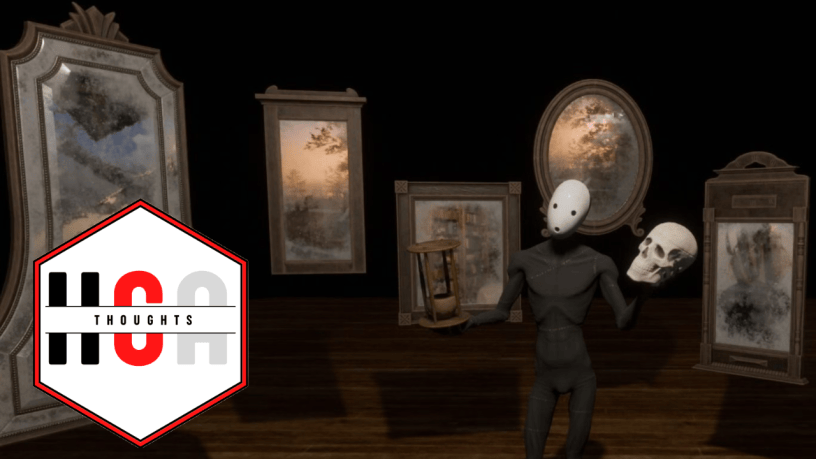
The other form of introspection is performed in perhaps a less satisfying way, but the Bachelor has a fascination with mirrors. Mirrors are a required object to obtain amalgam, which is a new resource required to enable time travel to and from each day, when a day has been completed. The Bachelor, however, is interested in forward momentum rather than staring wistfully into a mirror, and so smashes the mirror to allow himself to keep searching through the past. The introspection then takes the form of the Bachelor destroying the visual, repurposing the mirror as an item. No longer is it a place to sit and gather yourself, or to stare agonizingly at your own imperfections, but it is an obstacle to be destroyed, a thing to be harvested. The game is a heady mix of metaphors, mechanics, and misery, with road blocks put in your path frequently. Sometimes this is because you went back, changed the story, and end up making a mistake for you to fix later on down the line. This quickly becomes a complex back and forth, where you’re having to strategize about where you need to make the most difference, without wasting amalgam. If you lose all of it, you lose your save and have to start the entire game again.
Some of these mistakes can be fixed at the game’s Edict board. By proclaiming a curfew or suppressing riots, you can try to tamp down on the infection or unrest, but you have to manage both in order to make sure the town doesn’t collapse. So it is easy to get lost in time. To be adrift, immersed in something, and to not even notice the hours scurrying away. As Marchant writes about time, “[w]e have no sensory organs for detecting it, nor any dedicated brain areas for tracking it. Our experience of time can vary hugely: minutes drag if we’re bored or uncomfortable; hours race if we’re excited or having fun; we can easily be fooled about how much time has elapsed. And in certain circumstances, our sense of time can even go in circles, break apart or stop altogether”.
We call this kind of experience ‘diachrony’, explained by Italian philosopher Giorgio Agamben’s “In Playland”, a chapter in his book Infancy and History: On the Destruction of Experience. Agamben argues that play is a way to decouple us from our experience of linear time. This is particularly true for a child, but for a player who can become suitably immersed in a video game, this is also true. In the article “Chronotypology: A Comparative Method for Analyzing Game Time”, film and game studies scholar Darshana Jayemanne explains diachrony. He says that “diachrony […] is associated with play […] diachrony splits [frames of time] apart, as in Pinnocchio where “Playland” represents an eternal holiday without the structuring principles of the calendar: Time seems “out of joint,” to whirl past. Many a gamer, glancing in horror at a clock after a particularly immersive session of play, can attest to the capacity of digital games to generate this sort of experience” (2020).
Pathologic 3 taps into the diachronic, in that it is about the terror of losing oneself in one’s own narrative. We lose time and we do not know where it has gone. I would thus like to say that every point of the game’s ambition works for me, and that the cavernous realm of infinite, hyperlinked time where we jump between days and tell repetitive stories about ourselves until they become true (i.e. when we succeed). The game, however, frustrates itself with some of the more mundane concerns.
The game removes the survival mechanics that made the previous games so uniquely immersive. Instead it is replaced by a mental health meter. Dankovsky is either Manic (running around really fast, hemorrhaging health as his heart beats to a tachycardic rhythm) or Apathetic (moving slowly, unable to even talk to people, and losing amalgam as he drifts aimlessly through the streets). While this seems okay in practice, the Apathetic state mostly seems worse, as the slow movement is a killer for the rest of the game’s time-precious mechanics, as I’ve already established. While you can lose a lot of health to Mania, you tend to have a fairly generous supply of healing items bestowed on you at the beginning of each day. While this mitigates the frustration on the design end from having to figure out what you had in your inventory at the end of Day II (which could have been terrible and / or hours ago), it also cheapens the game’s desperate survival.
The Plague, also, is weirdly toothless towards Dankovsky himself. We can no longer contract the Plague, and it is literalized in the form of the Shabnak’adyr, the famous unseen woman of bone and clay that is talked about in the previous games. So instead of a game of survival against a disease that moves in clouds of screaming faces, or tornadoes of black particles, you now run around firing a particle dispersing device to deter a giant woman from picking you up and tossing you around like a ragdoll. I am not particularly a fan of “monster chase you” design when it doesn’t need to be incorporated, or you have better options already. It was bold of them to experiment – the game’s ambition, again, is insane. I have a deep admiration for what the team was able to achieve. But I feel some of it comes at the cost of Pathologic’s established identity.
I haven’t even touched on the marvelous diagnosis / investigation mechanics, or the fact that moving between districts is now a loading screen or fast travel. The game feels sometimes so immersive that when we are snapped back out by a giant monster chase sequence, or a fast travel loading screen, it becomes tangibly frustrating. I think the game is less immersive for its attempts to simulate diachronic time and the feeling of losing oneself in a place. But, oddly, the original Pathologic still does that best for me. It is a liminal space unto itself, a place where time goes to die. A dream that is hard to wake up from.
Pathologic 3 is not necessarily that, but I think it is so daring that it ends up becoming, in a way, the most accessible of the Pathologic games thus far. You can replay days, only really worry about managing two things, get immersed in the narrative without having to scrape by for another morsel of food. In so doing we replace the earthiness of the previous games with an airiness, probably exactly what the team wanted to achieve. The game is somehow less tangible but is still powerful in its own right. There is, still, nothing quite like Pathologic. And I look forward to seeing what the rest of the game has in store for me.
Reference List
Agamben, Giorgio. 1993. Infancy and history: The destruction of experience (L. Heron, Translator). Verso.
Ice Pick Lodge. 2026. Pathologic 3. HypeTrain Digital.
Ice Pick Lodge. 2005. Pathologic. Buka Entertainment.
Jayemanne, Darshana. 2020. Chronotypology: A Comparative Method for Analyzing Game Time. Games and Culture, 15(7), 809-824.
Marchant, Jo. 2026. “Is Time a Figment of Our Imaginations?” The Guardian. https://www.theguardian.com/science/2026/mar/22/is-time-a-figment-of-our-imaginations
 Horrorgameanalysis