
Not being really sure what to title this article beyond “A Personal Reflection”, I really just wanted to write about what a very special game Silent Hill 3 really is. And what it means to me, particularly this year. The article will spoil most of the game going forward.
I first played Silent Hill 3 during COVID, having missed out on it, being a little girl when it came out. Shockingly, I wasn’t old enough then to play through the game. Instead, I played Crash Bandicoot. Probably was more age appropriate, I suppose. I managed to avoid the Silent Hill series other than those haunting, shocking glimpses in gaming magazines. I would luxuriate over every little weird screenshot, over every bizarre monster design. As a child, I never quite understood what drew me to the grotesque, despite being so disturbed by even a screenshot that it would give me bad dreams. I was sensitive to the imagery, but I think there was something about the promise of those strange places that called to me, even then.
But when at last, I came to Silent Hill 3, it was having already struggled through a life that, by and large, I am supposed to be grateful for, but that I cannot come to accept as having been mine. Silent Hill 3 very swiftly became my game.
It is only in the last few years of living as myself that I came to see the depths of meaninglessness that I, by necessity, imbued on large swathes of my life. One of the few places where I could impose meaning was video games – but I’d always been interested in games that complicated meaning making. Power fantasies are everywhere in video games, and so are games with tragic narratives. It’s not like Silent Hill as a series were even the first horror games I’d played. I still consider Pathologic in 2017 my first real look into the horror genre as someone mature enough to understand what horror games should be trying to do. And what is it that they should be doing? I think horror games have a responsibility to broaden our emotional understanding of other human beings.
I wrote an article a few years ago now on composer Akira Yamaoka’s song The Day of Night from Silent Hill 2. There’s just a few Silent Hill songs I think, that I actually listened to before I played the games in any real capacity. But the most memorable of those is Silent Hill 3’s Never Forgive Me, Never Forget Me. It was one of the few “forbidden” bits of YouTube I ever snuck myself onto as a little girl, just to listen to those really spooky pianos and tones play up and down, over and over again. And now, I can still put those albums on and think back to times when it really was just me, sitting alone, playing Silent Hill on a crummy little TV. One of my fondest, stupidest purchases was of the Silent Hill 3 soundtrack CD, for about $140-something NZD. That CD is now about $600 NZD, so I mean, I invested in something that held its value in money. But it also holds its value in sentimentality.
I have a lot of favourite albums. Bowie’s The Next Day from 2013 is one of them; I love the way that album tells a coherent thematic narrative, creating a pastiche of the twentieth century. I have long been a lover of listening to albums in their totality to really understand the music within. I’ve come to rely on music as one of the only reliable tunnels out of my brain when it is at its worst. It is quite frequent that I love video game music, but far rarer that I would actually sit and listen to an entire album of video game music, regardless of how good it is. Sometimes, it just doesn’t really feel like an album listening experience – it can’t be separated from the game itself, because the game is the thing that tells the story alongside the music. In Silent Hill 3’s case, the music tells as much of a story as the game does.
The album is wonderfully sequenced, and includes various voiced songs, including of course You’re Not Here, a teenage-angst 2000s ballad that still makes me happy, before sinking into horror and melancholy in the track immediately following, Float Up From Dream. That one’s accompanied by the voiceover of the villain, Claudia Wolf, giving her little antagonist introduction. Then we move into End of Small Sanctuary, the game’s most iconic track possibly, instrumental acoustic rock that you never want to have end. But, it is one of the last places on the soundtrack, fittingly, that you can feel safe and happy and secure. The album then starts into an intoxicating, lengthy sequence of melancholy-horror ambience pieces that show Yamaoka working at full capacity, before shifting gears into Letter – From The Lost Days. I guess that’s where the album worked at the same point as the game for me, and made me cry for the first time, listening to it. I know that Yamaoka’s lyrics are melodramatic, and a bit on the nose, but they are just transparently beautiful, elevated by Mary Elizabeth McGlynn’s continually gorgeous voice.
Hey there to my future-self, if you forget how to smile
I have this to tell you, remember it once in a while
Ten years ago, your past-self prayed for your happiness
Please don’t lose hope…
It’s not exactly subtle poetry, but it still makes me tear up. Whether that’s nostalgia or simply the fact that my emotional needs haven’t really changed in the intervening… lifetime that I’ve needed them, the song has remained almost constantly on circulation. And all this without talking about the game yet.
In so many places that I go on the internet, I see hyperbolic statements that don’t really mean much of anything anymore, to me. Goodness knows I’ve written a lot of that kind of thing myself, at times. Over the last six months, I’ve been struggling to write articles, or to face up to recording my own voice. Funny how something that never used to bother me all that much is now functionally unbearable. I cannot listen to it for the painstaking hours required to put together a video essay. Hell, I can’t even muster the courage to stream a video game these days because my voice is not my own, seemingly no matter how hard I try. All of these reasons are all contributing factors to my lack of presence on the channel and the website. It’s disheartening to me to look out at the sheer volume of stuff that’s being made, and struggle with the fact that so much of it is uncritical. A lot of the game articles I try to write just fall to bits because, while the game itself is good, or worthy of discussion, it just doesn’t manage to capture my attention. And while maybe that’s itself an indictment of my own mental health and the grief I’ve been struggling with, life has not been cooperating, regardless.
Silent Hill 3, more than anything else to me, is a game about grief. It is a game about a teenage girl coming to realise that she has been cheated out of the life that she deserved – namely, to live with a loving parent, to have her bodily autonomy respected, and to retain her innocence in the face of deeply traumatic experiences. Heather, the protagonist, loses a lot through the game – but, crucially, she never loses her strength. There is only one point where she collapses, unable to move for an undetermined amount of time – when she returns home to find her father murdered.
The sequence where you wander through her little apartment afterwards has always stuck with me as being one of the most emotionally daring and honest sequences in a game I have ever played, simply because it arrests you in a single space. There is no urge to move on, to immediately leave. You want to look around. To see what kind of a life Heather and her dad shared. You want to try to understand what kind of thing you’re expected to go and avenge for the second half of the game.
People often struggle with the pacing of Silent Hill 3. The mall follows the subway follows an enormous office building before the main plot in earnest really, truly kicks off, and it becomes clear what the game is about. I understand why people don’t like those early hours. But to me, it’s some of the most magical survival horror I’ve ever played. Wandering around the subway system for hours in the dark gave me something else to focus on besides a crushing sense of isolation – a sentence which, perhaps, is laced with so much irony that it could sink a ship. But nonetheless, it’s true, isn’t it? Narrative is often about finding ourselves and our experiences on the screen – for me, who even subconsciously struggled to identify with male protagonists, could still latch onto the emotions that they felt that validated my own experiences. Struggling through the sewer system at the end of the subway and bludgeoning fleshy tadpoles to death with a medieval mace might not be a universal experience. But I think that the game is all about Heather having to make sense of the trauma she has been left with. There is no-one else to do that for her. The interpretive frameworks other characters provide – God, Paradise, illusions, logic, reason – can’t support what she feels, and what she experiences. She feels rage. Anger. Hatred. But she also feels deep love, kinship, and empathy. She tries to talk down the antagonist briefly, at the end of the game, even after everything she’s done.
When Heather discovers that she is the reincarnation of another girl, and the memories of her other lives start to come back to her, you can’t help but feel that she has been cheated, forced to come to terms with shocking revelation after shocking revelation ahead of her time. Yet she always keeps her cool alongside her anger, her sadness alongside her defiance. Shut your stinking mouth, bitch! has to be one of the most iconic lines of the survival horror games in the 2000s. Not to mention, don’t you think blondes have more fun? Heather Morris’ really wonderful, earnest voice acting has stood the test of time to create my favourite survival horror protagonist of all time. Sure, there are so many other greats – but the more I play and reflect on Silent Hill 3, I think it’s the game I’ll stick with, because it’s the one I keep returning to.
I did want to talk about the antagonist a bit, because her role in the story seems initially to just be your classic crazy, barefoot priestess, foretelling doom and encouraging the protagonist to do horrible things in order to further her own agenda. But when you stop and think about Claudia’s role for a bit, you can really easily just step back to her traumatized childhood. And while of course you are responsible for your actions as an adult, you are made to be responsible for what happened to you as a child. You are the only one who can figure it out – and without support, that person can grow up to be a zealot like Claudia, possessed by no real spirit but the institution that abused her since she was born. She lost the only person that ever truly loved her unconditionally, and begged her reincarnation to hate her. She is a tragic figure of the best kind, hateful and heartbreaking all at once.
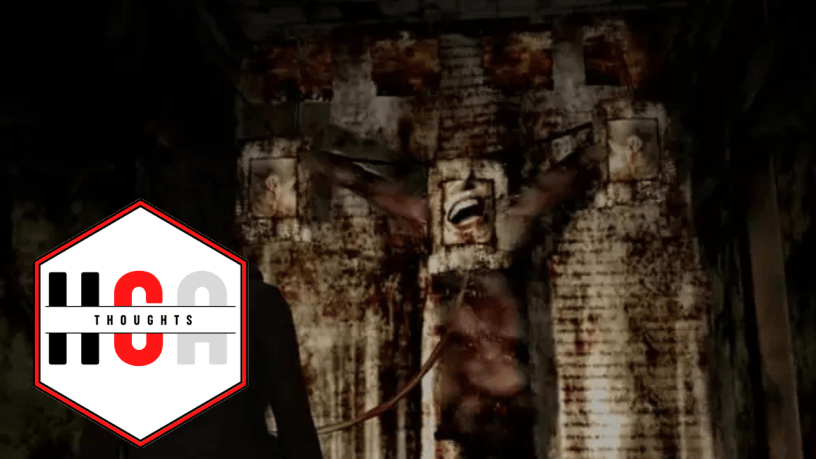
It’s worth noting that the game is probably the hardest in the Silent Hill series. Maybe Silent Hill f is harder, based on my Hard playthrough of that game. But Silent Hill 3 is easily the toughest among the first four games developed in-house by Konami. It earns its difficulty by being outrageously well-balanced. I have played the game countless times, and I still find myself sometimes scrounging for ammo or healing items if I play a little poorly. Unlike so many other survival horror games, which often fall away to pure power fantasy at the end (see: Resident Evil series), Heather is never given real gameplay power. Her greatest act is rather one that she does not commit – her revenge is disavowed by the game as a bad ending. This gives her more reasons to be angry, and she gets to take it out on one of my favourite monster designs of all time, God. Enormous skeletal hips, an exposed spine, stubby boney limbs, and a quiet, content face on a human head. All that accompanied by spraying fire and slamming body parts on top of Heather. She was so difficult that I think I had to throw out my first playthrough because I didn’t have enough healing items to survive her at the end, or enough ammo. It is the mark of an excellent game that I didn’t mind trying to do it all again just to make sure that Heather got out of there okay.
Somedays, I line up my favourite games in my mind and contemplate which one is my favourite, my de facto wow, yes, play it, number one forever! Silent Hill 3 would technically be a regretful choice because outside of emulation, it is extraordinarily difficult to find anywhere. No modern storefront sells it. Second-hand copies continue to climb in price. Old hardware continues to break down. I look at the competitors to the title; Pathologic, The Void, Metal Gear Solid 2, Silent Hill 2, Fear and Hunger 2, Forbidden Siren, and about another fifty games I can’t list here, and I realise I can’t really decide. But Silent Hill 3, I think, is the game I hold to in the dark. I listen to Never Forgive Me, Never Forget Me on loop to comfort myself, to draw me back to my younger self. I wish I could say to people, play Silent Hill 3 right now. Maybe it won’t have quite the same impact. Its lengthy, mazelike sections where you fight through weird enemies while loud, distorted industrial noise plays might not appeal to everyone, exactly.
But the game’s art style and sound direction hold everything together. Its gameplay is wonderfully balanced, and sticking it on easy isn’t shameful if you’re worried about ending a playthrough like my first one – that is, not ending it at all.
This year has, like so many years of this decade, not been a stable one. I think the best way to put it is that when I finally had the courage to wake up again two years ago, my life has been soaked in grief. That my coping mechanisms, even, were grief-avoidance tactics. And while I have slowly been reclaiming myself, I have also been realising that what I thought constituted a life was really no life at all. I have experienced wonderful joys over the last two years – the highest, most healing joys of my entire life. But I have also been struggling through the worst lows I have ever felt, because now I have nothing else to do but feel them. I have people with me to help me feel them, which has made all the difference – and has also naturally distanced me from the internet, by and large.
One of the few games that has accompanied me through these last two years has been Silent Hill 2 and 3. Perhaps I’ll do a similar article on 2, but I do want to let it be known that Silent Hill 3 is my favourite game in the series.
Sometimes a video game is just personal, you know?
For the extended hiatus from writing, posting, and video-making, I apologise.
To all of you, I extend my deepest gratitude and appreciation. All the human love I can muster.
Look after one another.
 Horrorgameanalysis