
The following article spoils the entirety of 2001’s METAL GEAR SOLID 2: SONS OF LIBERTY.
“Find something to believe in, and find it for yourself. When you do, pass it on to the future.”
“Believe in what?”
“That’s your problem.”
A whistling wind howls over the industrial facility known as the Big Shell. A single figure makes his way from room to room, as stealthy as any other agent of the legendary FOXHOUND unit. That is to say; stepping on loud metal plates in the floor, panicking because he just made a lot of noise, drawing enemy soldiers to his position, and getting riddled with bullets until someone screams his name through his CODEC call. The last thing this legendary agent hears as his lungs deflate in his chest is his commanding officer’s eloquent eulogy:
RAIDEN! RAIDEEEENNNNNNNNNNNNNNNNNNNN!
Even if a pawn becomes a queen, it is still just a playing piece…
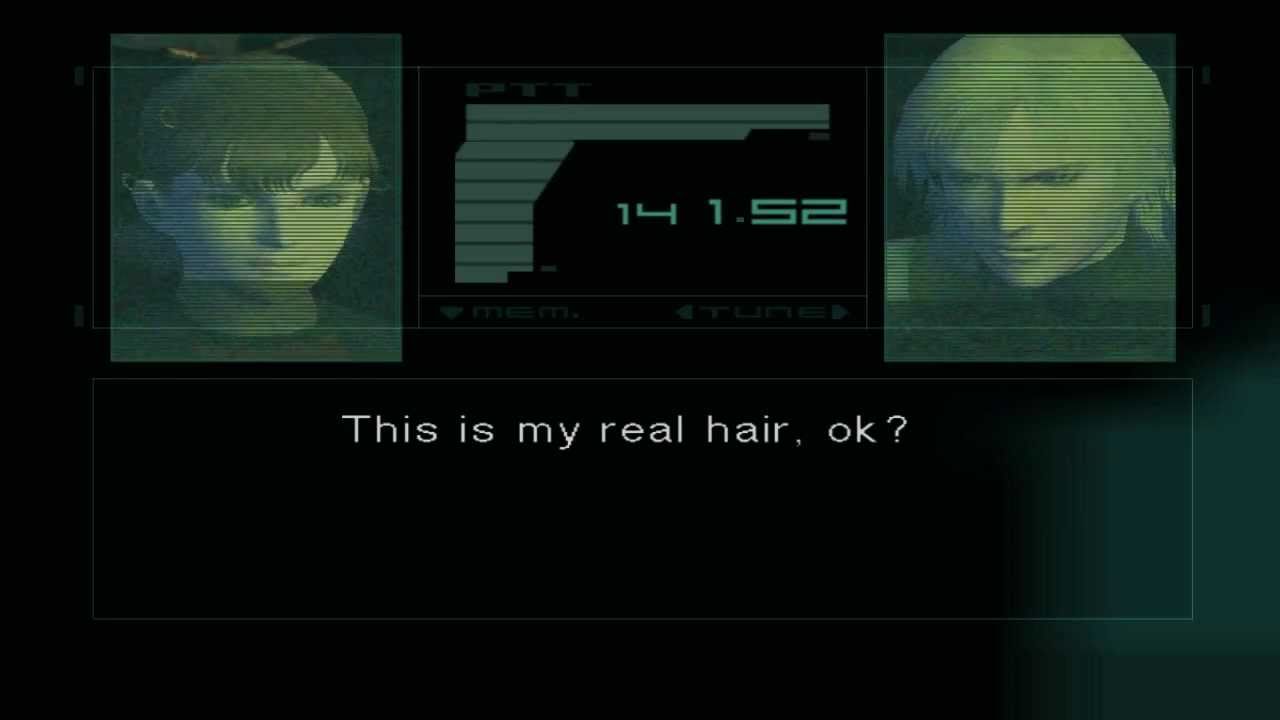
Having made my way sporadically through the Metal Gear series over the last year or so, I came to Metal Gear Solid 2 with a bit of nervous apprehension. This was the game that, in gaming magazines I read when I was a little girl, was the subject of various homophobic slurs. The protagonist was a number of unmentionable things, but above all, he was a disappointment. He was not the shining beacon, the model of meticulous masculinity, that the legendary Solid Snake was, star of the previous games in the series. He’s an inferior Snake, people seemed to say back in 2001. Instead, after a brief opening mission where you see just how cool and tough Snake is to play as and listen to, we spend the rest of the game controlling the much more svelte, effete Raiden. And yet Raiden is nonetheless clearly a model of masculinity, albeit a different kind to Snake’s. Rather than Snake’s effortless confidence and jaded disaffection with war, Raiden simulates those things.
Raiden is insistent that his experience in VR training has made him the best fit for the mission. As he comes to discover, he is badly out of his element, and as events spiral out of control, he is left grappling with a past that is riddled with trauma. Trauma that he cannot shake, as it turns out, that also has a terrible relevance to the mission he’s on right now. Raiden has been trained to simulate competence, but simulation of competence is not equal to competence. He’s already a killer, a former child soldier. The real problem is that Raiden has an artificial identity that he does not allow himself to fully inhabit,perhaps cannot fully inhabit, the identity of the calm and collected, disaffected soldier. His actual identity – that of a human being who wants to love his girlfriend, and a child who doesn’t want to hurt anyone anymore – is not initially allowed to be even visible. That’s what the player wants, after all. The game just trained us at the start to expect Snake again. And Raiden is a soldier too. So players expect to control a soldier. Yet in Metal Gear Solid 2, a player’s participation in classic video game violence is on trial, in a way that many postmodern videogames also interrogate.
As the medium has evolved, we’re more and more interested in the morality of simulation. As the simulations become more complex, and more akin to actual world scenarios – see the various SWAT first-person shooters for a contemporary example of this – we are naturally interested in what they say about us. Our capacity to enjoy these things does not make us bad people. However, what are these video games training us to feel? To think? What skills do we acquire? How does our identity form through simulation? Metal Gear Solid 2 questions all of this, to the point that the game is often considered the first video game to deconstruct the medium. Sons of Liberty is perhaps the first work of video game postmodernism, or it is at least the most famous one. One of the key things up for debate is identity, which in this game revolves around performances of masculinity.
In Metal Gear Solid 2, Raiden’s perceived failed masculinity is rendered through three avenues: his androgynous style, his trauma, and his relationship with his significant other, Rose. His androgynous style obviously does not discount his masculinity, and that’s a fairly uninteresting, surface-level reading of his masculinity. I love his cartwheels, his long hair, and his skintight suit. For purely aesthetic purposes, you understand. But I also love his bewilderment at events unfolding before him. When you boot the game, you pop a codename – or your actual name – into your save file. You and Raiden, from that point on, are linked in bewilderment.
The game, developed in 2001, is often cited for its prescient takes on artificial intelligence. There’s a speech given towards the end of the game – essentially a nine-minute monologue – delivered by the game’s rogue artificial intelligence, the game’s primary antagonist. It’s about how we are all collared and controlled in our digital landscapes, put into our little ponds to believe rival truths, truths that cannot be reconciled. Because what is truth if it’s two different things to two different people? It’s a post-truth speech, through and through. And it is a good speech, don’t get me wrong; chilling, amazingly delivered, and still relevant to our digital political landscape. Something like historian Anton Jäger’s Hyperpolitics would sink its teeth into the speech still, I think. Yet, I don’t think this is what interests me most about the game. I do not particularly enjoy cynicism, as you might have gathered if you have read other bits of my game criticism. While a healthy dose of reality and pessimism is a necessary fact of my existence, believing in hopelessness is, I think, an unreasonable philosophical position to hold. Why do nothing if we can do something?
Metal Gear Solid 2 is a game that demands a certain level of player mastery. It comes from a different age, an age where control schemes could be whatever the hell they wanted. I know when I play it, my fingers are perched all over the show – standing on my tip-toes to shoot a guard in the head with a tranquilizer dart requires a lot of thought. You have to hold R1 to go into first person mode. Hold square to lift your weapon. Press the back triggers to stand on your tiptoes. Carefully release your grip on square while gently touching the left stick to keep the reticle on the enemy’s head, hoping to land an instant takedown. It requires focus and energy at first, even if it does become automatic. You begin to master the simulation. Slip into the role required of you. It’s worth noting that more modern controller-mapping and design sensibilities might have found a way to streamline the game. Sons of Liberty does not care what you think about control schemes. You either master it or you die, evidenced best in the game’s swimming section, which many people famously loathe. Is it a test of mastery if the game keeps introducing new mechanics to master? What are we learning from the game? What is it simulating? This is the question I shall interrogate.
As the situation aboard the Big Shell escalates, the game prompts novelty and distress in equal amounts; boss fights increase in difficulty and complexity, new weapons are introduced, and the plot thickens. But what is it that Raiden is doing as the protagonist? What do we become while controlling him?
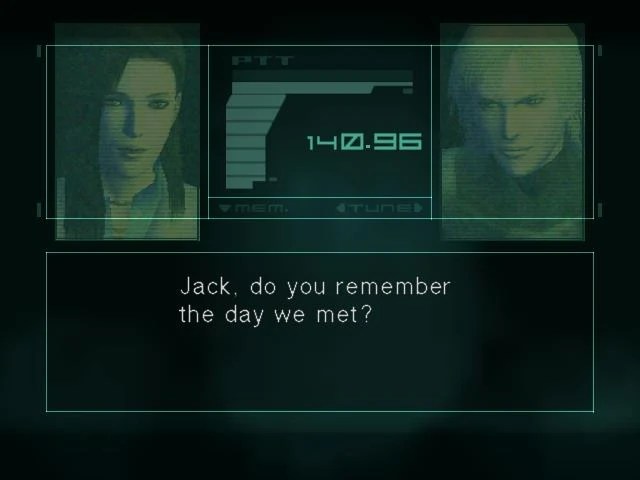
I started the game feeling a bit frustrated with his relationship with his girlfriend, Rose. The two of them are combative, Rose is a bit snippy and abrasive. She often brings up relationship drama that, realistically, probably wouldn’t be appropriate to bring up in a situation where the president of the United States has been taken hostage. However, as I played more, and then replayed the game, I came to see Rose and Raiden’s relationship as the cornerstone of the game’s humanity, as strange and annoying as it may seem. The two of them have a complex, knotted relationship, with Rose only entering a relationship with Raiden to spy on him. But she develops – as spies often do – genuine feelings for him. But if Raiden’s selfhood – tenuously starting to be claimed after a traumatic childhood – is built entirely on falsehoods, what is Raiden’s masculinity actually built out of? It is built from uncertainty, fear, and trauma. His “real name” that other characters keep throwing at him is Jack. But is Raiden capable of being either Raiden or Jack? These are titles that he has to live up to in other people’s minds. Is his boyfriendhood, to use a bit of a silly term, enough for Rose? Or does it actually begin to distress her, that the man she has fallen for is identityless?
It is no wonder that Raiden’s response is to calcify, to retreat into his shell, to fight back by saying no more. In other words: Raiden’s masculinity is formed under extreme duress during play, and is subsequently destabilized when trauma reenters the equation. It is not that Raiden becomes unmasculine as he runs naked around a giant Metal Gear that powers the world’s propaganda systems. Instead, Raiden becomes an unstable protagonist, someone who we hopefully can deeply relate to, as complex, frightened little human beings ourselves. What would you do when you found out that your past was artificial, your heroism built only on digital escapades, and your combat prowess temporarily overpowered by shocking betrayal after shocking betrayal?
Rose ended up as one of my favourite characters in the whole game simply because she doesn’t know what the fuck she’s doing. She is unstable herself, an expression of constructed femininity – long hair, necklace, sitting far away while her boyfriend does the violent fieldwork. But she’s trying to break free of that role, trying to get them both to break free. Or break free at least while still being within the Kojima-framework boundaries of his women characters. You begin the game skeptical of Raiden and his credentials after an opening where you inhabit Solid Snake’s gruff, no-nonsense, of course, I can handle this new development persona. But the game continues, and Raiden’s own attempted gruff no-nonsense Solid Snake emulation begins to glitch and fail in the face of the mission going wrong. And I was sitting there at the end of the game, in love with Raiden as a character, wondering – what game did those game magazine writers actually play? Because Raiden is persistent, questioning, tough, and capable. He has to form an identity anew, live, in front of the player, because the identity the player inevitably assigns him – inferior Solid Snake – does not work for Raiden. He is not an inferior Solid Snake. He is not Solid Snake. He is, to put it bluntly, Raiden.
The game’s action-stealth is terribly fun and addictive, as one would expect from a Metal Gear game, if you’ve ever played any. But as I said before, the game destabilizes the player’s expected mastery through the introduction of various new gameplay systems. A player coming in from the first game will expect certain mechanics. Sons of Liberty says, okay, well, how about bomb defusal? How about swimming? How about more complex sniping? Do you remember steering a missile through a ventilation system? Well how about disguising yourself as a guard? Do you want to learn to fight with a sword? Better learn how to do it fast, because the final boss is a sword fight. Good luck, have fun!
The game is constantly changing, constantly forcing Raiden to inhabit new personae, to learn about people, to lose them, to struggle with what is real and what is not. Raiden is, by the end of the game, completely destabilized as a person. The sweeping shot at the end, where he tosses away his dogtags with the player’s username on it, is a not-so-subtle message. Raiden is not to be authored by anyone else. His selfhood – insofar as a character can have selfhood, of course – is self-authored. If this was the last time we ever saw Raiden, the character might have been stronger for it. Of course, it wasn’t, and that’s also not necessarily a bad thing.
Nonetheless, I am interested in characters that are allowed to self-author, particularly after traumatic events, or the insistence from others that they must behave a certain way. That they are a character sheet of prescripted qualities rather than a person with their own selfhood. Raiden carries on in this fashion in future games, of course, but we’re talking about Sons of Liberty here. So, let’s finish.
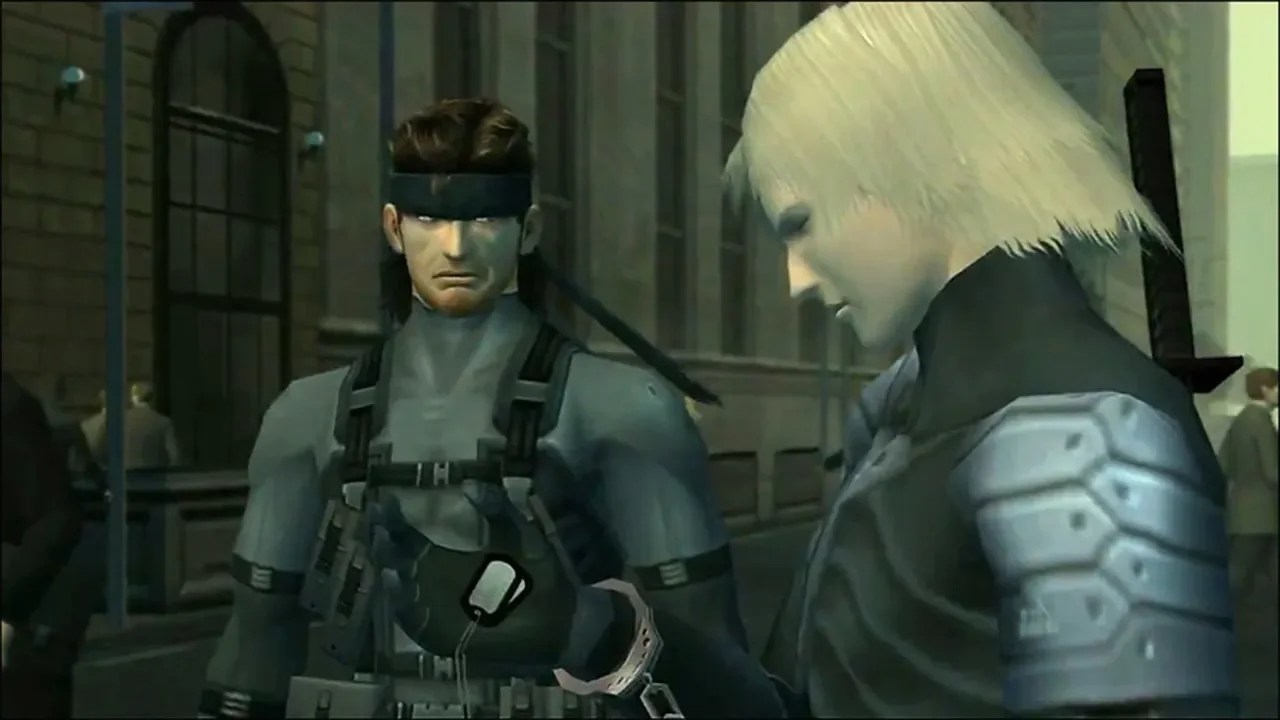
I came to Metal Gear Solid 2 armed with a number of preconceptions. That the game is postmodern; that it interrogated artificial intelligence and the idea of truth; that Raiden is a character that fails at masculinity. All of these things are what I’m interested in – the perceived failure to act out one’s identity. In video games, identity is a kind of liminal construct. We agree to inhabit another character for a while, but that character also takes on some of us, as well. When I played Raiden for the first time, he was fumbling, unsure of himself, and generally a bit uncoordinated. Hardly great spy material. When I reinhabited him for a second playthrough, I could more clearly see Raiden.
The game is a simulation of covert ops, spy missions, absurd sci-fi twists, and violent gunplay. You can play Raiden as violently or nonviolently as you want, the game giving you a non-lethal option unlike the previous game in the series. And yet he still grapples with his capacity for violence, at what war has made him into. At the same time, true to form, the game offers a kind of Brechtian alienation, where you are made to reflect on your own participation in the madness. What does any of it mean, the game asks? And it trusts the player to make up their own mind – at least, at this point in the series, it does. Heart on its sleeve, it rejects cynicism, as it argues that whatever you experienced meant something to you, regardless of who you were at the time. The game critics who mocked and misunderstood Raiden, in fact, acted as a key part of the game’s marketing for me. I shouldn’t expect Raiden to be tough. But he was, in unexpected ways. He became someone worth giving a damn about because he fought so hard for a scrap of himself. One of the game’s most disastrous reveals is when the Patriot AI links his taken name, Jack, to a nickname for a Japanese fighter plane in World War II. His identity is a weapon, they say. It is up to Raiden to decide whether he takes that on board.
Metal Gear Solid 2 remains one of the most whip smart works of postmodernism in video games. Kojima’s writing remains as on-the-nose and as cheeky as ever, but it’s also writing you can easily find yourself infatuated with. I adore the CODEC calls, learning about our team, or hearing people bicker. They are interesting to listen to! The Metal Gear games are filled with characters that are larger than life. To use this game as a pool from which to draw, you’ve got Solid Snake, Otacon, Fatman, Fortune, Vamp, Solidus; and each of them, however small, gets little humanizing moments.
Metal Gear Solid 2, at its core, is a game about Raiden, and the player, trying to identify what it was they loved so much about the original Metal Gear Solid. What is it that draws us to these stories, these simulations of spygames and violence? Power fantasy and violence? Seemingly classic representations of masculinity? Stealth and mechanical depth? Can we say, with any serious authority, that everyone comes to these games for the same reason? No, I don’t think so. But Metal Gear Solid 2 deconstructs the fantasy the original game presented with genuine earnestness. Could you be Solid Snake? No, the game says – but that’s not a bad thing.
You’re still you, after all.
And you’re still here.

