
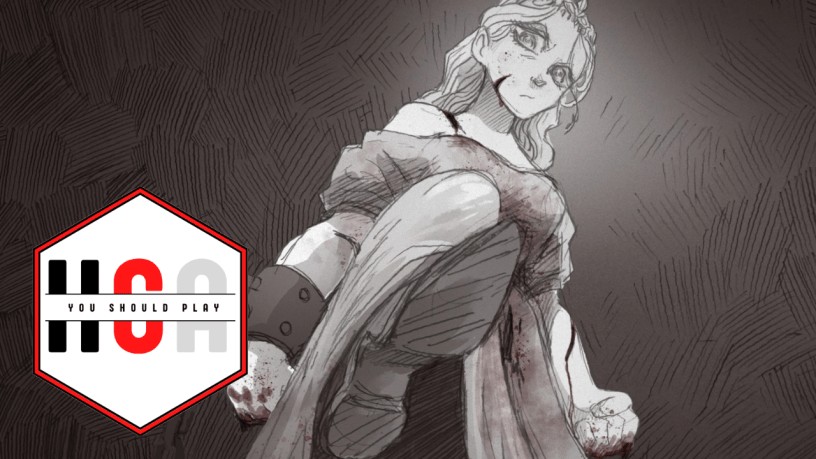
The following article spoils parts of Slay the Princess, one of my favourite games of all time. If you want to experience it blind, I would run away and do so right. this. minute. I recommend you listen to this song from the game’s soundtrack while you read this article.
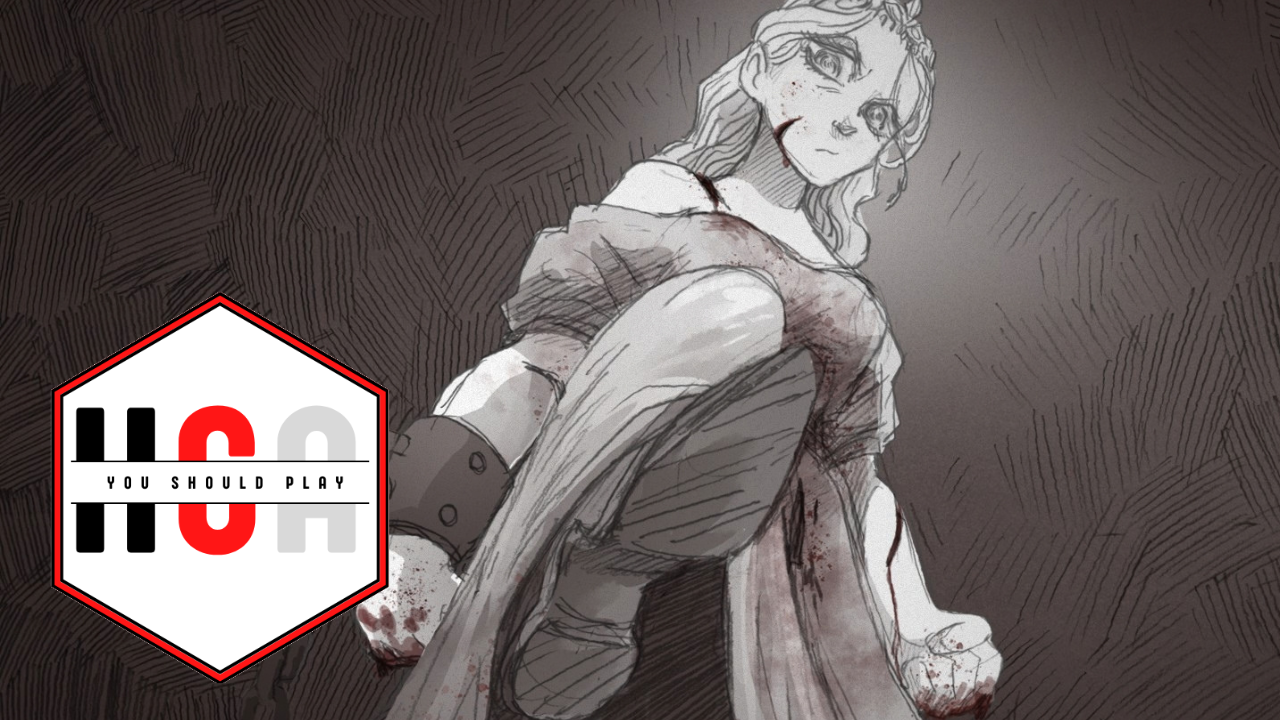
“You are on a path in the woods. And at the end of that path is a cabin. And in the basement of that cabin is a princess. You’re here to slay her.”
It all started with a forest trail. And it ends here. She sits with you as you die. She’s won. A metallic tang oozes from your mouth. Your innards slosh together as they bleed atop one another, blood upon blood upon blood. Blood, blood belongs there, in your body, that’s fine, right? She has a pleasantly unpleasant look on her face as she kneels next to you. It must have happened this way because it was always supposed to. Was not it right, that she pulverized your body with her high heels, cracked your bones with bare knuckled punches? Was it not right that she did this? It must have been. It was her right to do so. To kill you. You always knew she was dangerous, after all. It’s fine, you think, to die at the hands of one so righteous.
But what if you’d done something different?
Ah, but it’s too late for what ifs, you know that.
Everything goes dark, and you die.
“We can feel them moving around in spaces they don’t belong. It’s uncomfortable.”
This is Slay the Princess (Black Tabby Games 2023), which I consider to be…
No. That’s not right.
Wait, what?! This, this is my review – you can’t – !
You Should Play: Slay the Princess
The following article spoils parts of Slay the Princess, one of my favourite games of all time. If you want to experience it blind, I would run away and do so right. this. minute. I recommend you listen to this song from the game’s soundtrack while you read this article.
“You are on a path in the woods. And at the end of that path is a cabin. And in the basement of that cabin is a princess. You’re here to slay her.”
Yes, yes, it all started with a forest trail. But it ends here.
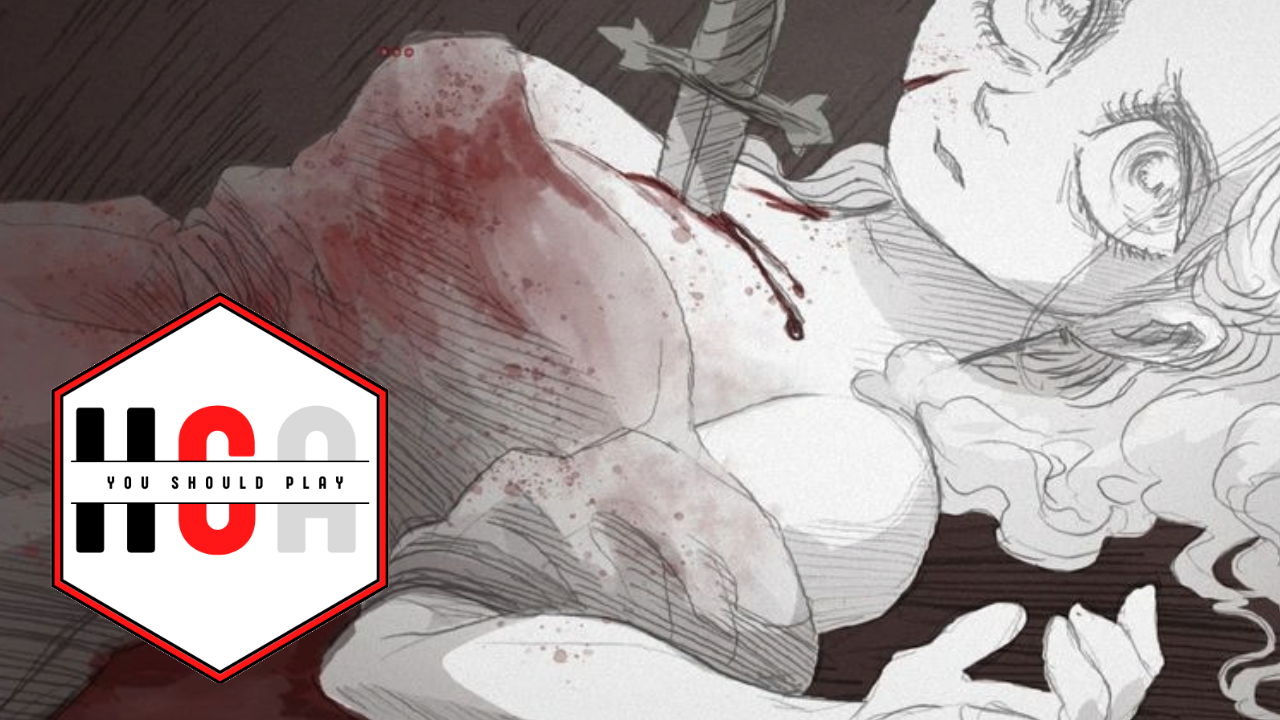
You lie beside her as you both die. At least you gave as good as you got, a metallic tang in your mouth, your ribs perforating your lungs. Ah, you think, this is how I save the world. But as you look over to your side, at her wide eyes, and gentle smile, you feel a crack in your armour. Your certainty. Princess… pretty? Your brain says.
She smiles faintly, the blade sticking out of her chest as her lungs heave to let in one of her final breaths.
No. No. I knew that she was beautiful already. And she was gorgeous and still a threat… right? No… she… she was worse than a threat… she… she was going to end the world, but… she…
NO! DON’T MAKE ME SAY IT!
… She’s a person too.
You have to say you’re sorry.
And you try to. The last of your thoughts takes the form of an eloquent apology.
But you can’t speak through the mouthful of your own blood.
She blinks slowly once more at you.
Everything goes dark, and you die.
“We can feel them moving around in spaces they don’t belong. It’s uncomfortable.”
A forest trail leads to a cabin leads to a stairwell leads to a basement leads to a Princess, leads to decisions. Decisions, decisions, decisions. Decisions to be made about someone. About who? About a Princess. A Princess who needs to be slain. But this Princess is reactive, and this is no linear story. This is a wildly branching story about selfhood, and yet is also a story that collects those branches and knows when to funnel. It is a game about one’s right to exercise their own will, and about how the people around us are shaped by our actions, for good or ill.
This is Slay the…
…
…
Good, no more interruptions. Sorry, I just had to check.
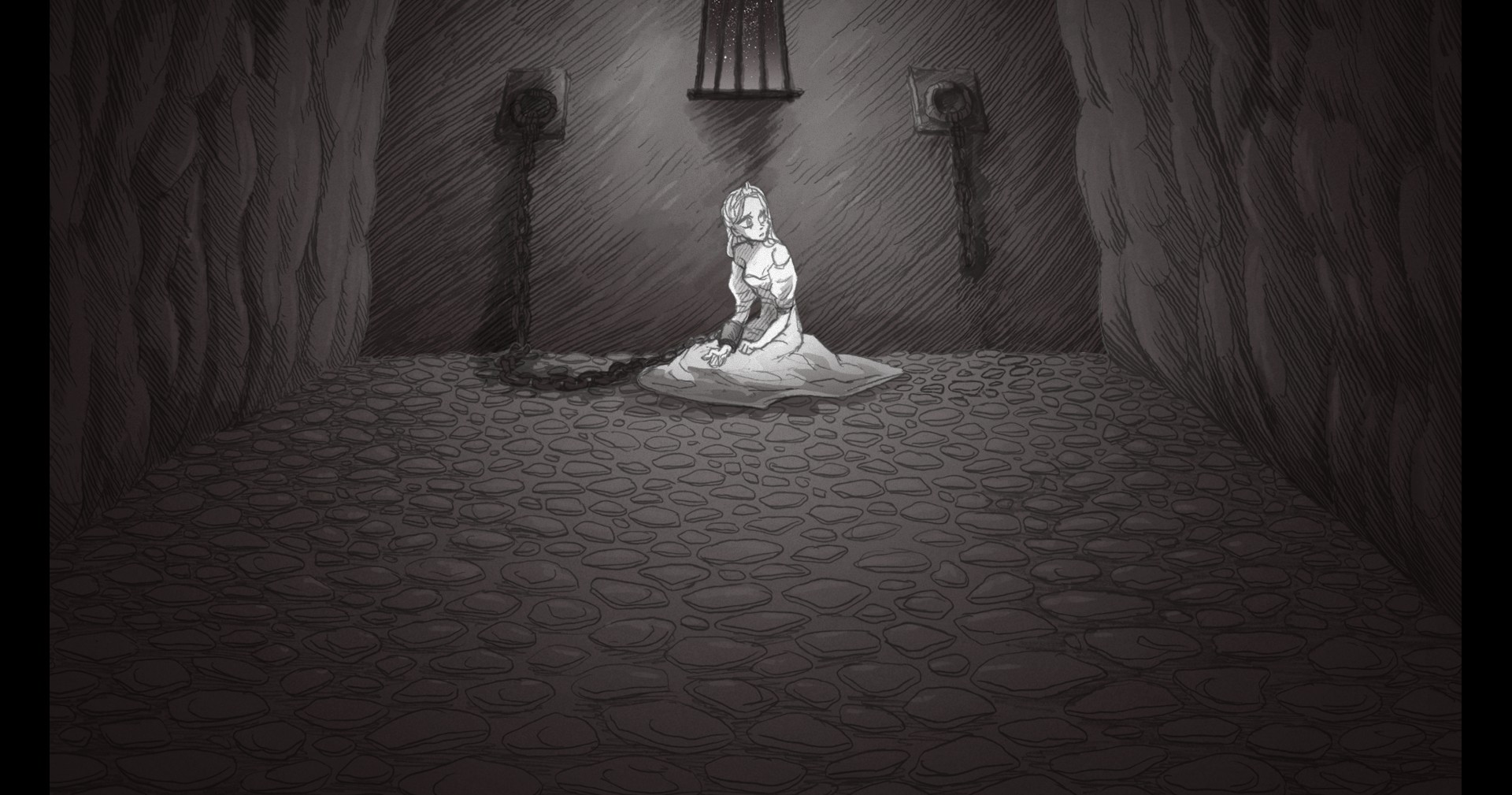
This is Slay the Princess (Black Tabby Games 2023), which I consider to be the most important narrative game I’ve played this decade, and whose influence I am sure we will begin to feel more and more as the years go on. Once again, it feels as though I seize the walking stick of hyperbole to rest my argument on. But I promise you, this game lives up to the title of this article. You should play.
As a visual novel, it has a remarkably efficient design. When you first play the game, I am sure that you, too, will be like me. What could this possibly offer? What choices are significant enough to talk about like this, HGA?
Slay the Princess is deliciously simple. It’s one of those pitches that you kick yourself for not thinking of first. A simple three-room narrative with only one other embodied character, a set of internal Voices that develop based on how you treat the Princess, and an immediate hook – do you slay the Princess or not – and you think, okay, seems simple enough. And then the game’s most important initial diverging choice is to pick up a knife on the table. The metal claw you pick up means that the Princess either reacts with joy to see you, or a threatening skepticism. The Princess branches even further from there; do you talk to her to try and understand her? Do you just squint at her from across the room? Do you charge immediately, no chit-chat? Do you even try to rescue the Princess, even though that’s not the name of the game?! The game has a truly engaging, novel approach to the idea of the video game time loop, which is well-trod ground at this point.
However, in Slay the Princess, the time loop has a memory in the form of a person, the Princess, who reacts with joy to see you sometimes, with terror other times, and with pure hatred other times. Watching how your relationship with the Princess changes makes the game a remarkably affecting experience. Black Tabby Games were not interested in just playing out a small series of linear narratives. Instead, each concerted branch or evolution of the Princess (called a Chapter by the game, but is similar to a route in classic visual novel terms), has its own incredible set of branches. Some end the route early, some sprawl in all directions, revealing a dizzying amount of depth.
However, from an analytical perspective, the game’s triumph is the destabilizing force it brings to a player’s own epistemic understanding of what video game characters are for. Traditionally, we act on video game characters. They are there for us to act upon, and their memory of past actions is not particularly important. While many games have memory as a state, Slay the Princess manages to make states feel like actual memories that the Princess holds. Slay the Princess is exactly the right size of video game to have the Princess remember everything that you’ve already done to her. It is responsive in all the right places, and that really is testament to the game’s incredible writing.
There is an oft-criticized kind of game known as an empathy game in some circles in game studies. I define an empathy game here as a game wherein the player is expected to come away empathizing with someone the game markets (indirectly or directly) as the Other. This Other is to be empathized with in an empathy game circumstance, to be sure. However, for an advantaged player in the actual world, empathy is something that can be shed when convenient. It is just a game, after all. An empathy game often reduces the Other to an object.
But what happens if we turn the empathy game into a guilt game? Rather than creating a branching narrative around encountering the Other, the Other reacts to our perception of them. The game hinges instead on your perception of yourself, reflected back at you by an agent with her own thoughts and feelings, hopes and dreams. The non-player character reacts with agency of their own, adapting to your overly-sentimental beliefs about them, or your hostility, or your betrayals; the Other, it turns out, is not merely an object to be acted on, but a subject. And of course, the game is scripted; I’m not saying the Princess is a living, breathing person who responds in an infinite number of ways. But the writing is strong enough to simulate the impression that we, the player, are being perceived. The player and non-player are at once entwined, both subjects to be analyzed together.
That subjectivity is what I am interested in, what I have always been interested in, when it comes to video games and game studies. I am unabashedly unashamed of how much I love my favourite games. I feel like a rabid little dog, yipping about how much she loves her favourite things. Slay the Princess is the game that is currently dominating my thoughts, it is true, but it has done so in a very quiet way since I first played it in 2023. That was a furiously long time ago. And a long time for a single game to be nested in my mind. And I think that is a testament to Slay the Princess’ design. Ever since I played the demo, it has always been on my mind, one way or another.
At the core of my game criticism, I envision myself as a little girl, running up to you and tugging your sleeve. You’ll turn to me, smiling. What is it, HGA, you’ll ask, and then I’ll hold up a picture of the Princess chewing her own arm off, and say I LOVE HER! Whether or not you scrunch your face up in disgust, take a few steps away in fear, or just smile and give me a condescending pat on the head, it turns out I’m just a little creature who loves her favourite things a lot. I always have been that enthusiastic little girl, running around wanting to yell at other people, I LOVE THIS! AND THIS! AND THIS!
So here we are. I love Slay the Princess.
“You two are going to do this forever, aren’t you?”
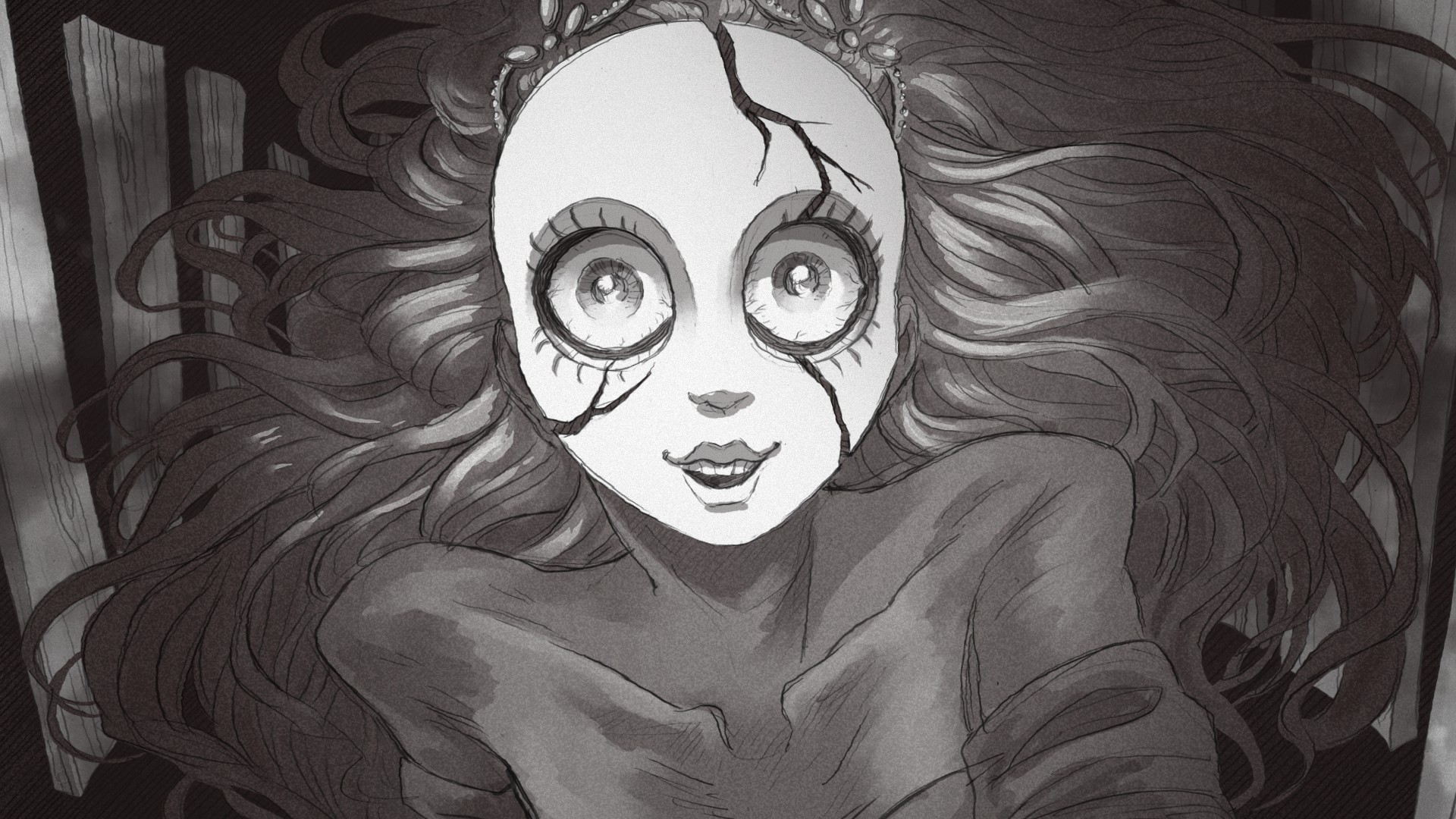
A large part of the game’s success is that it has a gorgeous, kind of hypnotic, presentation.
A huge part of that presentation is that the game’s art, all hand-illustrated by Abby Howard, is of course, great. In fact, this latest replay of the game finally convinced me, I’m going to try and learn to draw, and stop putting it off. It is the last thing standing between me and making my own video games. Is the quality of a good bit of art that experiencing it makes you want to produce something of your own? That it makes you kind of itchily jealous, dammit, how did they do that? I think surely that’s an ode to the game all by itself.
Another great part of the game’s success is the music by Brandon Boone, a lovely classical soundtrack that goes wherever the Princess does; from a gentle piano melody to a gorgeous duet between piano and cello, to a pounding set of drums clacking closer and closer to you, the entire soundtrack is worth listening to. It’s one of those rare video game soundtracks that I think, oh, I see why they put this on an actual vinyl. The music, the art, and the writing all feed together to create a synchronous video game, whose central conceit is that of deconstructing a structure. Everything moves with the game’s narrative; the music evolves, the art evolves, the narrative shifts. It is hard to critique it beyond just asking for even more. But I think that’s just me being greedy.
So when we think of video game structure, we tend to think of a linear A to B path. Collect all the power pellets, run away from ghosts, die. Start again. Yet like another time loop game, Outer Wilds (Mobius Digital 2019), Slay the Princess is interested in weaponizing the game’s memory. As games become more interested in themselves, as designers figure out what the rules are agreed to be so that they can break them, so too do players like myself want to break things. We want to see the structure bend and buckle under its own weight. Games are becoming more self-aware, I think, and a game such as Slay the Princess uses our knowledge of the form and general narrative tropes to become something more. It evolves with the Princess; hence my description of the game providing synchronicity on all levels.
The Princess warps and changes in an instant; from a friendly smile to an uncanny, wide-eyed visage. And as we play through the game, we accumulate Princesses, accumulate memories of who she was, who she transformed into in order to survive us. Who she became in response to our choices, or who she felt she had to become, given how the world was treating her. How the Princess reached for selfhood in the face of trauma, grief, and guilt; how she wanted to see the world change, how she wanted to love; all of this is terribly important. Change is important. This is one of the works of fiction that cemented my belief that death – naturally attained, after a long, happy life, free of malignant diseases – is necessary, an evil, to be sure, but necessary. As the game itself says, endings are not something to be lingered on. Death is awful, but death is also meaningful. It brings with it the prospect of change. And Slay the Princess changes a lot, for every single player who plays it. No one, it feels, has quite the same experience.
The game’s structure and writing makes it hard to talk further about the game beyond just me saying that it has made me cry a few times, it’s made me actually jump out of my seat (rare for a visual novel to have a good jumpscare!), and it made me laugh. It’s a game that, like my other favourite works, actually has human feeling behind it. It has imperfections, to be sure, and of course there’s always that I want more feeling that comes from the best works of art, that know when to stop, and leave you wanting more, not feeling sick of the game’s excess.
It’s a very special game to me, as it has accompanied me through three tumultuous, exceedingly challenging years of my life. But I think it stands even outside my own personal circumstances as a video game whose design will stand the test of time. Whose importance will only become more and more clear as time goes on, and who shall surely lead to games that attempt to do what it does. I can hope that my own projects are even half as good as Slay the Princess. You know that feeling when you write about something, or try and explain something to someone, and walk away even more obsessed with the thing? I must be trapped in a loop of my own, evolving my praise to higher and higher levels as I go. There’s always more to talk about here. Always more to indulge in. So let’s break out of that loop right now.
I love it, I really, really do. You should play it.
And I guess that’s that.
“Think what you will. I’m done fighting.”
Or not.
EPILOGUE: HAPPILY EVER AFTER.
I shall instead finish this analysis with one of my sometimes-flourishes. I wanted to talk about the personal. I’m going to fulfill that promise of making the player the subject of the analysis just as much as the characters in the game. To that end, I wanted to talk about the part of the game known as the epilogue: Happily Ever After.
The rest of this article spoils possibly the best route in the game, and discusses gender dysphoria and abuse. You might want to listen to this song from the game’s soundtrack while you read the end of this article.
Treat the Princess with nothing but kindness and she becomes the Damsel, a princess accommodating all of your desires. Together, the two of you can escape the cabin, but she is whisked away not long after. You want to make sure she’s safe, don’t you? So instead, you ask her to stay inside.
In the place she hates.
You want her to be happy, though. You know you can make her happy. You just have to change the cabin. You have to change her surroundings. That will make things better, won’t it? It’s much more frightening and uncertain outside, obviously.
The Voice of the Smitten commandeers your body, and rips your chest open. There you go, Princess. Have a look at that. See my heart.
See… how much… you are loved…
You die.
You wake up not on the forest path, but in a cabin. A vastly reshaped cabin, with gorgeous stained glass windows, an enormous ceiling, and palatial stone. The Voice of the Smitten has vanished from your mind. You go to enter the basement, to see the Princess as usual, but an enormous staircase has been built up rather than down.
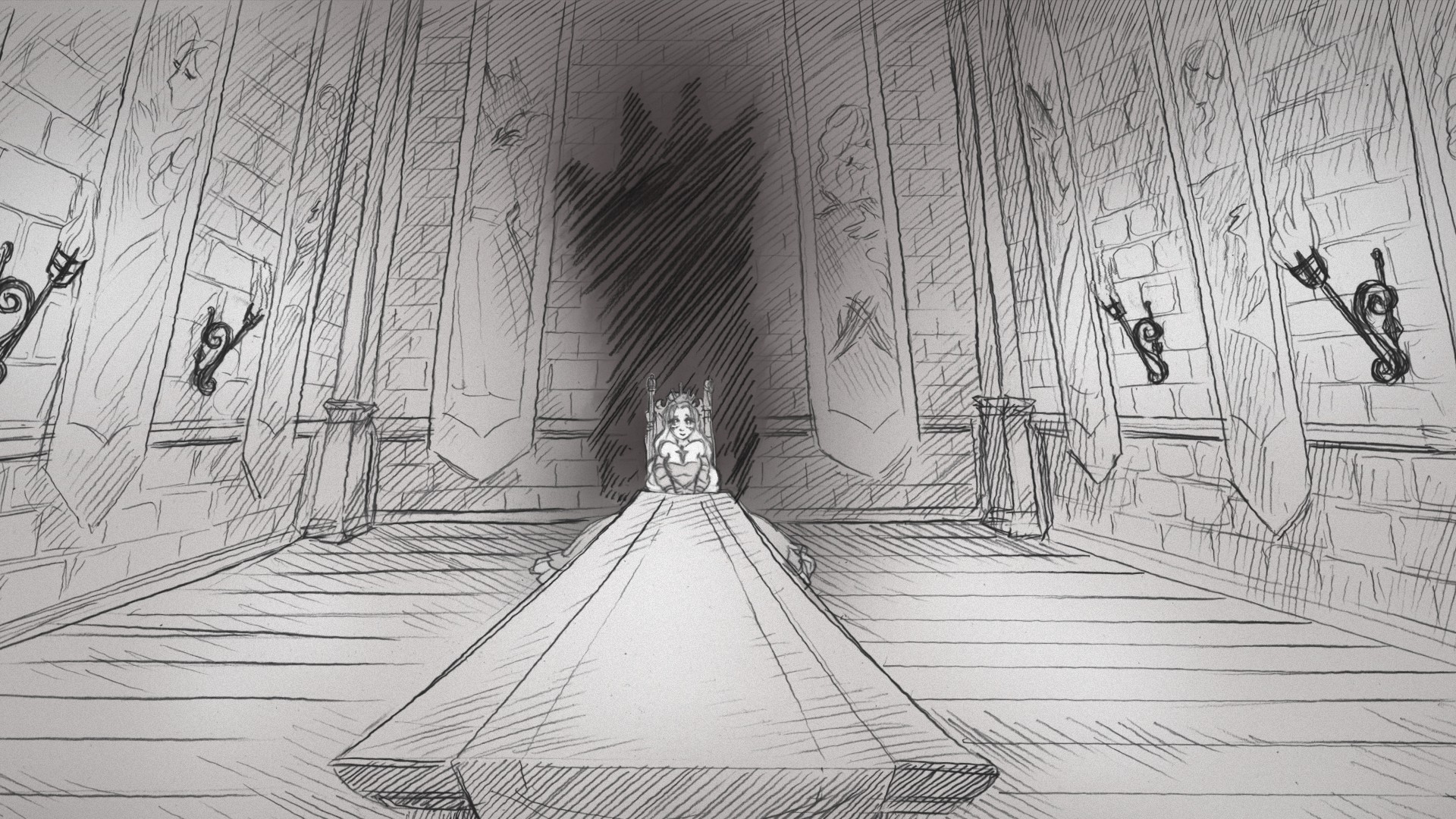
You ascend the stairs, and see her, dwarfed by an enormous, flickering shadow. The Smitten has made this place, and has transformed it into a perfect gilded cage for the Princess. And why can’t you both be happy here; you with all the agency you’d ever want, her with all the things she would ever need.
Except the night sky.
You enjoy a rich feast. Imagine the taste of the sweetest wine on your lips while I serenade you with my story. Imagine the finest meats. The fluffiest breads. The best roasted vegetables. Everything is to your tastes.
Everything is to your tastes, I hope.
I thought I could make everything taste how I like, without bothering to see if I liked the recipe I was given to cook with before I started. But I was never given a choice. No branch. Nor even a fork. I ate with my hands.
It often felt like my womanhood was a source of shame for so, so many years. A mirror into which I was unable to see, for if I did, I would be horrified at what I saw staring back at me. So I put the woman inside me, the innate, immutable part of my being, the part of me that I love the most out of anything, in a small box. And I told her, you can be happy here. In this little playhouse. You can express yourself all you like, in my heart of hearts, safe and secure, unable to be hurt anymore. I won’t let anyone else hurt you, ever again.
No one can hurt you if no one knows.
She knew, though. She always knew.
By this point, I imagine the wine is becoming a bit less sweet. It is still good. But it does not have the taste it once had, does it? It already becomes afflicted with the softest tang of vinegar. The bread has a tougher crust, but the center is still soft, isn’t it?
It’s a shame that no matter how much you eat of this meal, you will never feel full.
I promised this trapped woman that I would make everything okay, but distress does not just end. It doesn’t stop hurting just because you nailed all your hopes and dreams, the things that everyone in your life has told you are impossible, into a rose-scented box. A box is a box, and nails are nails.
But I pretended, oh, I knew how to pretend, I had a delightful smile on my face, everything is fine, I enjoy being this way.
People saw the crooked smile.
I remember what was said to the truth.
So I say otherwise.
I’m happy!
I promise!
We’re both so, so happy here!
You don’t have to be upset!
The wine tastes sour on your lips, and even as you reach for the delicious meat-that-melts-off-the-bone, it comes away congealed and clammy.
I’m sorry. Do you not like your meal? we say to one another.
The Princess angles her face down towards the table.
There is a long silence.
I’m not enjoying it either, we both say at once.
The story of Happily Ever After reads, to me, as a clear allegory for domestic abuse. But for me, this part of the game also lands as a metaphor for my own self-abuse, which has been meticulous and long-lasting, a pit of shame from which I am only beginning to emerge. The taste of waxen meat on my lips, my tongue, my chin; this was a feast that was never meant for me.
Femininity; there is nothing at all I have fought for so long, and so hard, and with so much effort. There is nothing I fought to inhabit for so long, and so hard, with so much effort. All the while I have sat down at each end of dinner, eating two meals, two identical meals that did not satisfy either end of the dining table.
For in this case, I am the Princess, but at once I was also the jailer, the person that thought I loved her, that thought this was sustainable, that we could be happy like this.
We could not. Nobody could. No matter how delicious the wine tasted, no matter how safe the words we shared, no matter the warmth of the inside. Happiness was impossible.
So, one day, I had a very similar conversation with myself, my Princess-self, to the one presented in the game.
I finally thought to ask her, what do you want?
And she, I, responded much as the Princess did, really.
I think… I would like to dance under the stars.
Now, some nights, you will find me standing outside, with my skirt dancing around my ankles in the cold wind. While looking up at the stars, I feel a deep sense of terrified awe. Can you imagine, the voice of the Princess seems to be saying, if you’d lived your entire life never seeing the night sky? What a miserable life that would have been.
To die, never having seen the stars… having never tasted crisp midnight air…
I can think of nothing worse.
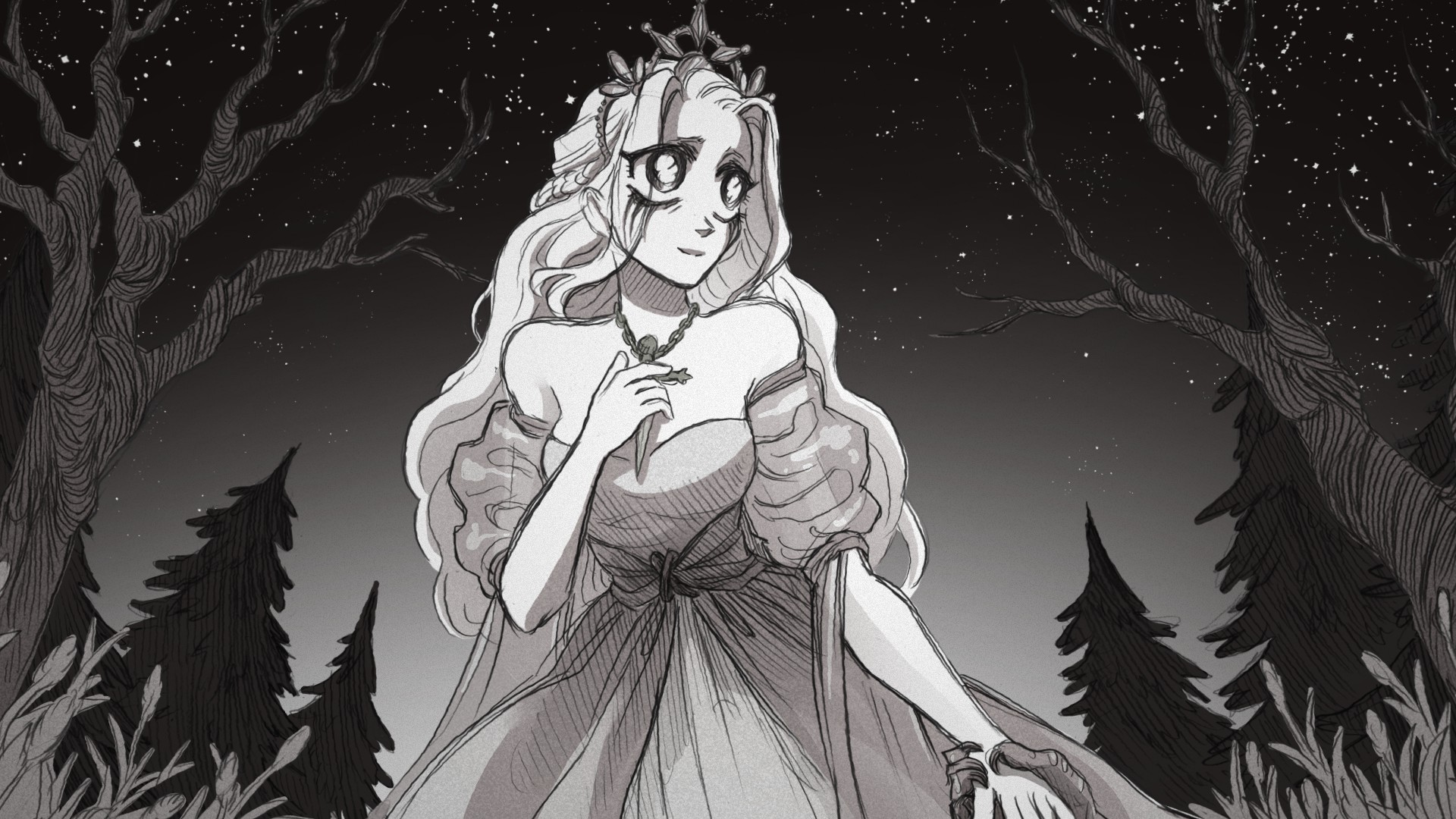
Slay the Princess is a love story. It claims that title itself. But it was not until I danced under the stars with her that I began to fall. And it was not until I started to cry at my computer, burying my face in my hands, shoulders shaking, that I understood just how much the game meant to me. I just wanted to be safe, and I carried that impulse with me. I acted that out. I reached that point in the game myself, of my own volition, trying to reach a new ending.
But there is no happily ever after that can come from a gentle prison. I was put in there by others to start with, but I became a very good jailer indeed; the shadow looming over my Princess’s shoulder, telling myself no because what if it happens again? What if we make the wrong decision again, and people hurt you? Just like they always do?
A forest trail leads to a cabin leads to a stairwell leads to a basement leads to a Princess, leads to you deciding. Deciding. Decided. Decide.
What is the value of a branching narrative? What can it teach you?
I will tell you this: I was sick of living my life in what ifs.

