
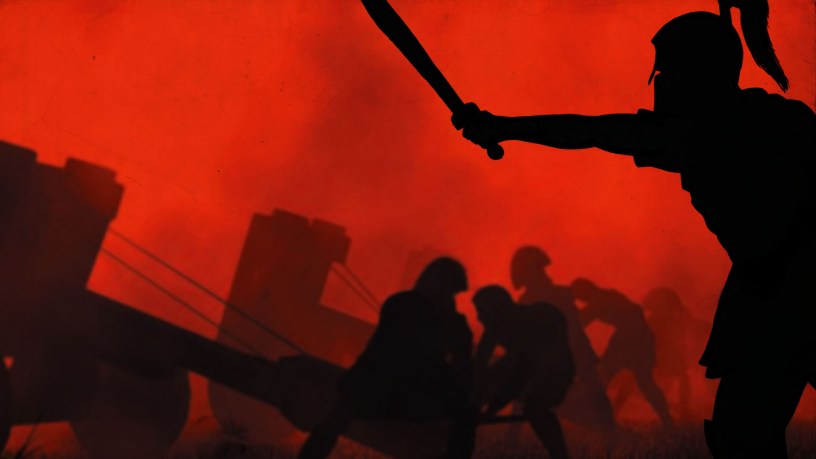
As the sun sets, Aulus Scipio looks at the city he has just conquered, the field of corpses that lay at the gate, and sighs. After a long and bloody battle, the city has been taken.
The story begins not with Aulus Scipio, the youngest of the venerable Scipii patriarch’s children, but with his older brother, a thirty-year old inept warrior called Quintus. Quintus is tasked with conquering Syracuse, a city owned and heavily garrisoned by the Greeks. He takes many men, and rides south from Messana to conquer the city.
It is a dismal failure – he encircles the city, but is attacked by another army accompanying the garrison. He destroys the first force, but the second force all but annihilates his troops, and kills every one of his bodyguards to a man. He is one of the few survivors, fleeing in disgrace back to Messana.
Stewing with feelings of anger and a desire for vengeance, Quintus implores his father for troops. He falls on bended knee, and asks for forgiveness – and a second chance.
His father casts a disapproving eye down on him – but his glance flickers to Quintus’ youngest brother, a weedy looking eighteen year old named Aulus Scipio.
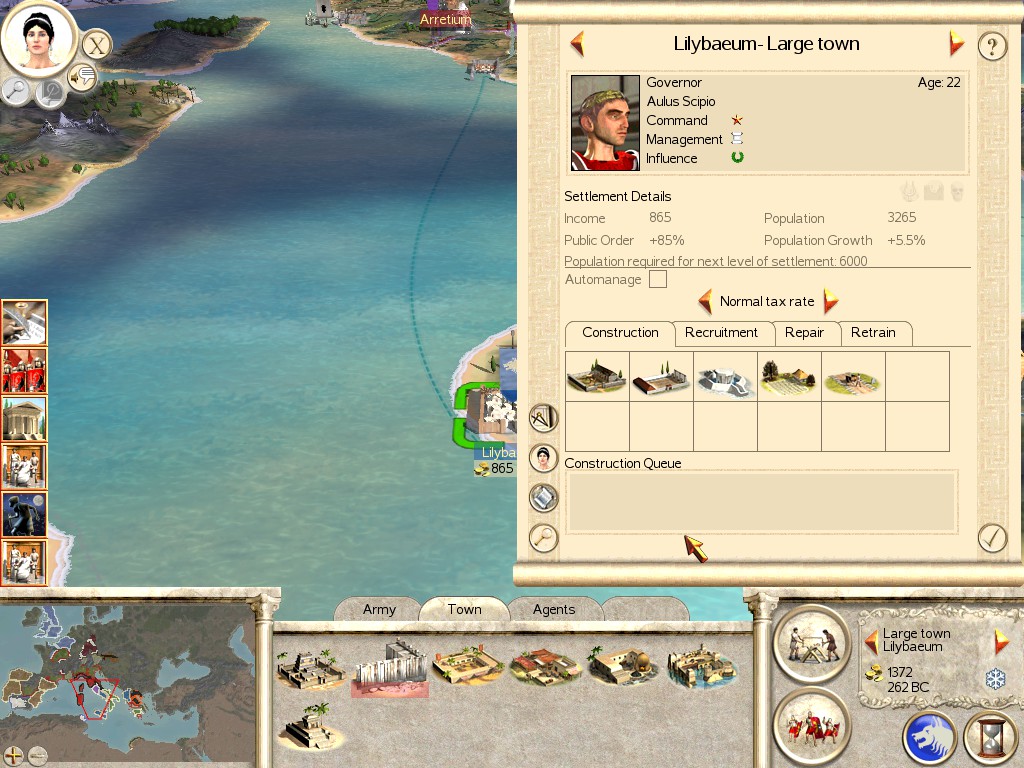
Aulus Scipio is hardly of sturdy constitution, and his mind for combat is worse than his older brother’s. In summation, his father would probably call Aulus something of a disappointment. But he has little choice. Aulus and Quintus, brothers in arms and brothers in blood, are both selected to lead the next force. It is perhaps the last chance the fledgling Scipii family will have to make their mark on Rome. Another failed attack will destroy their economic and military standing, and leave Messana open to a Greek counterattack.
Quintus is, for all intents and purposes, leader of the second assault force. The balding would-be warrior-general stands at the front of his troops for the march, riding south as quick as he can to catch the Greeks off guard. The Greeks, now all garrisoned inside the city, soon find themselves once again the victims of a Roman siege.
After a few months of the siege, Quintus calls Aulus to his side. Aulus has never been tested in real combat before. His bodyguards are a variety of well-trained men, but they too have never tasted real battle. Good armour and good spears are no equivalent for combat experience. This was something that rested heavily on Aulus’ heart. He both relished and dreaded the day combat would come. He had heard the stories from the few surviving men that had come back with Quintus. They were not decent stories to repeat – but they were ones that repeated over and over in his mind. How the long spears of the hoplites had pierced the hearts of the skirmishers, caught completely off guard. How Quintus had slain one army, only for another to come over the hill.
These thoughts rush through Aulus’ mind all at once as Quintus announces that Aulus should ready the men. The attack commences tomorrow.
The battle itself is a rush. A set of ladders and a siege tower reach the walls, which are white with Greek uniforms. A battering ram is set completely ablaze, and a set of town watchmen mostly cut down in a hail of arrow fire. A distraction as the siege ram takes the right of the gate, and the ladders take the left. Hundreds of Roman troops pour onto the walls. Over half the Scipii army is massed there that day, and they push in on both sides, crushing spearmen into tight, narrow formation, forcing them to draw swords and fight. Archers are thrown from the wall, and Roman archers themselves climb the wall and kill hoplites trying to escape to the center of town on the streets. It is blood and slaughter.
The gates taken, the Roman troops slowly push through the streets, killing stragglers and setting up a formation on the edge of the town square, where the last Greek troops remain. Quintus orders Aulus to charge – it is Aulus’ first moment of bloodshed. Quintus joins the battle only when it is about to be won, and after the battle is finished, the city flinches at the sound of Roman cheers. A new day dawns over Syracuse, as the Romans merely occupy the city.
It is not a day the Greeks relish.
As the season turns from Winter to Spring, the Greek population of the city catches Quintus by surprise as he rides through the streets. Quintus is spending that day performing a routine inspection of his troops, who are guarding the new Temple to Vulcan that he has built to symbolize the stability of Roman rule. It does not take long for a pitchfork to catch Quintus in the gut. His troops move around him, pushing back the Greek citizenry with force, but the riots continue long into the night.
Aulus is called to Quintus’ side, the wound having been too deep, too grievous to survive. Quintus’ last words are hardly prophetic, or wise, or anything approaching the sort. He is exhausted beyond words, and can barely muster words of encouragement before he expires, just as the sun is at its lowest. Flames burn outside as Aulus weeps for a brother he fought beside only once.
A Greek diplomat shows up, asking for the city of Syracuse back, else they will attack. Aulus beggars no illusions. His brother killed only the troops who resisted Roman rule. His peaceful occupation of the city was rewarded with his own death at the hands of a raucous mob. When Carthage’s spies begin to creep over the border, Aulus sends word to his father. It is the last time the two will correspond – Aulus’ father dies as the new year begins. Still, Aulus’ oldest brother takes command of the Scipii family. Aulus is still inexperienced, fresh – but he knows the harsh realities of command, and conquest.
He rides west without explicit permission from his eldest sibling, taking up the sword. It is with dismay that the Carthaginian king finds himself completely surrounded by Roman troops, watching from a city he thought he would merely be visiting for a season. Aulus is quick to action, besieging the settlement and then bringing his troops to bear.
The gates are smashed open by a battering ram, the wooden walls not providing much protection for the Carthaginians. Aulus watches with satisfaction – right up until the Carthaginian king rides out, his heavy cavalry and masterful blades trampling and hacking underequipped Romans. Aulus, in desperation, orders his troops to attack all at once – a mass of Roman bodies encircles the far more experienced Carthaginian kingsguard. The king’s vision turns red, and after a few minutes of hacking and slashing, finds himself cut off from the rest of his bodyguard, amidst a sea of Roman troops. Moments later, he is pulled off his horse, and hacked to death.
The other bodyguards try to flee, but they find themselves in a similar situation. It doesn’t take long for Aulus to move into the city, and kill the others. Their king dead, they find no solace in retreating to the town square. Aulus kills them to a man.
When time comes to decide what must be done to the Scipii family’s newest city, Aulus enslaves the local populace and sends them to other corners of his family’s growing empire. An example must be made – and he did it. Now, Aulus turns his gaze across the Mediterranean, to Carthage itself…
Rome: Total War might be an old game, but it still has the capacity to tell interesting, dynamic stories. That’s a reason I like grand strategy games, I think. Their storytelling capacity is fluid and dynamic, and every campaign feels your own, and is uniquely different in at least some way. It’s still one of my favourite strategy games because there’s depth there, but the depth isn’t obscured by menus or spreadsheets or anything. Its greatest flaw in the modern era is that the A.I. has been superseded a thousand times over by other games, but still – for a sense of living in the Roman world, it is a game that still feels fairly unrivalled.
I was hoping to release another Silent Hill post today, but I’ve been quite busy, so I’m afraid this post is all you will receive this week!
I was hoping you could still buy the original game on Steam, but it seems you have to buy “Rome Remastered” now to play the original version. Still, there are plenty of old CDs kicking round of this game. Shouldn’t be too hard to find.
 Horrorgameanalysis
Definitely one of your most well-written articles so far. The Total War games are great at encouraging interesting stories to unfold as the player expands, and it’s wonderful to see one of those stories expressed in such a detailed way.
LikeLiked by 1 person
I’m a fan of Attila myself. It’s noticeably more difficult to get the hang of, but I really like when grand strategy games shake up the usual empire-building by throwing crises at you that threaten to wipe you off the map.
LikeLiked by 1 person