

The following contains spoilers for both Clock Tower (Human Entertainment 1995) and Lamentum (Obscure Entertainment 2021).
I have been playing through Clock Tower Rewind (Wayforward 2024) lately, the remastered version of the original 1995 survival horror game that had never made its way out of Japan officially before. One of the game’s endings is to escape from the house prematurely, by driving out in a car. The game’s protagonist, Jennifer, escapes after dismissing whether or not it is important to know whether her friends have survived or not. The game does this in a clever way, as the car key is easy to find. On first interacting with the car, car key in hand, Jennifer wonders what has happened to her friends. She has to know! If you’ve found that all of them are dead, or even that one of them is still alive, you can opt to escape in the car. If one of them is still alive, this feels like the coward’s way out. But if you interact with it three times, Jennifer decides that well, she could indeed escape, and escape right now, just to save her own skin.
The ending punishes Jennifer by having the killer hiding in the backseat of the car. Not only could Jennifer not save her friends, she could not face up to the truths at the heart of this awful manor. She meets her grisly end at the hands of the scissor-wielding serial killer.
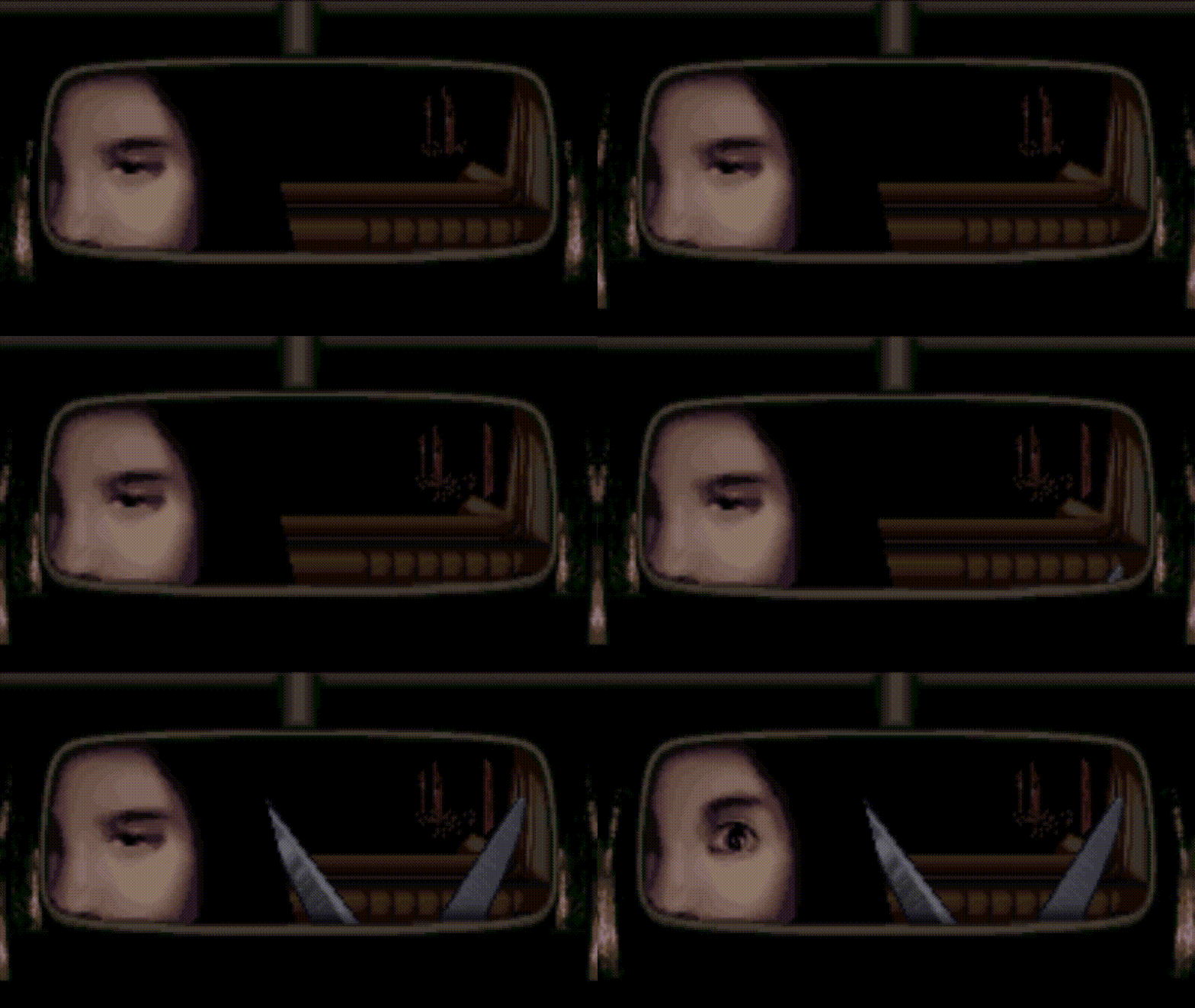
This got me thinking about a game I played on stream in 2023 called Lamentum, a survival horror I hadn’t thought about for some time. Because I realized that that game had included a homage to Clock Tower in its early escape ending. At about the halfway mark of the game, there’s an option for the protagonist, Victor, to bail on the quest to find out just what’s happened to his (very obviously dead) wife. Ostensibly, this is an identical choice to the one Jennifer makes to save her own skin and get out. However, the way the game framed this ending always sat poorly with me.
Lamentum is a game with a plot very similar to Silent Hill 2’s (Konami 2001). The main character is a doting husband and loving partner. He is forced to watch as his wife becomes more and more ill, and so, desperate, Victor is willing to go and see some reclusive old rich person who lives in a manor and promises the cure. The manor – clearly steeped in the occult – is red flag after red flag. Victor, however, is not willing to see any of this, and his first night there ends with him slipping into a coma and his wife vanishing. When he awakes, the whole manor has become the site of a demon outbreak, with monsters everywhere. Typical survival horror-ing ensues.
The game seems to be building towards a message that we need to accept loss as a part of our lives. Victor’s wife Alissa (hmmm, Clock Tower 3..?) is this ghostly presence who never says anything to us and is always just out of our reach. We go to increasingly dangerous places just to get a glimpse of her, to try and help Victor get past his infuriating genre-blindness. In the case of Silent Hill 2, I could buy that James was a bit genre-blind, because he seemed like he didn’t care whether he lived or died. Victor, while mostly lacking a distinct personality, always seemed to me genuinely clueless that he’s in a horrifying situation, one that he wants to get out of alive. The game seems to be building towards a message that human life, while exceedingly precious, will always have a finite time limit on it. Sure, we can dream about immortality, and what it would mean for us to live for hundreds and hundreds of years, but that is not achievable. So, Lamentum seems well equipped to tell a story about that letting go (similar in function to how some of Silent Hill 2’s endings work).
This early leave ending signals that maybe this will be an escape from the madness. What a bold move, I thought to myself as I first played the game. This will be an opportunity for the game to really comment on the futility of Victor’s quest, and maybe include a satisfying little jab at the insistent desire we finish video games. That desire to finish video games sometimes comes at the detriment of the characters whose lives we hold on our hands – so this would have been a nice little subversive moment, before, y’know, I go and see the final boss and so on. For completeness’ sake. But that’s not what Lamentum does.
The escape ending takes Victor into the fog, where it is said he wanders blindly, forever to be taunted by what he perceives as his failure. I strongly dislike this ending because it implies that the only way to be satisfied is to continue searching for answers, beyond the point of all reason. Let me reiterate that this is a house full of demons, inhuman abominations, and monstrosities. I understand that Victor would be feeling upset at his own failure to find answers, and that the fog would take some time to move out of. But I don’t think it’s a fair moral lesson to impart on the player, given the game’s context. And it’s here that I started to wonder what the use of a game as a moral vehicle would be. Let me be clear that games do not have a responsibility at all times to be perfectly moral, and that I do not equate representation or simulation to endorsement. We should be allowed to depict things we do not agree with, things that are wretched or horrible, without people pointing fingers and losing their minds over mere depiction. Certainly, I think many games need to do more to think about what their gameplay loops are actually teaching people. When you really boil it down, what is a game like Fortnite’s solo battle royale mode actually arguing through its gameplay loop? Perhaps that there can only be one winner, and that winner must shoot, loot, and deceive their way to total victory. Even if people don’t think a game is influencing their thought process, I think after enough time has passed, there are effects we can notice on a micro level, even if it doesn’t change someone’s entire personality all at once, in most cases.
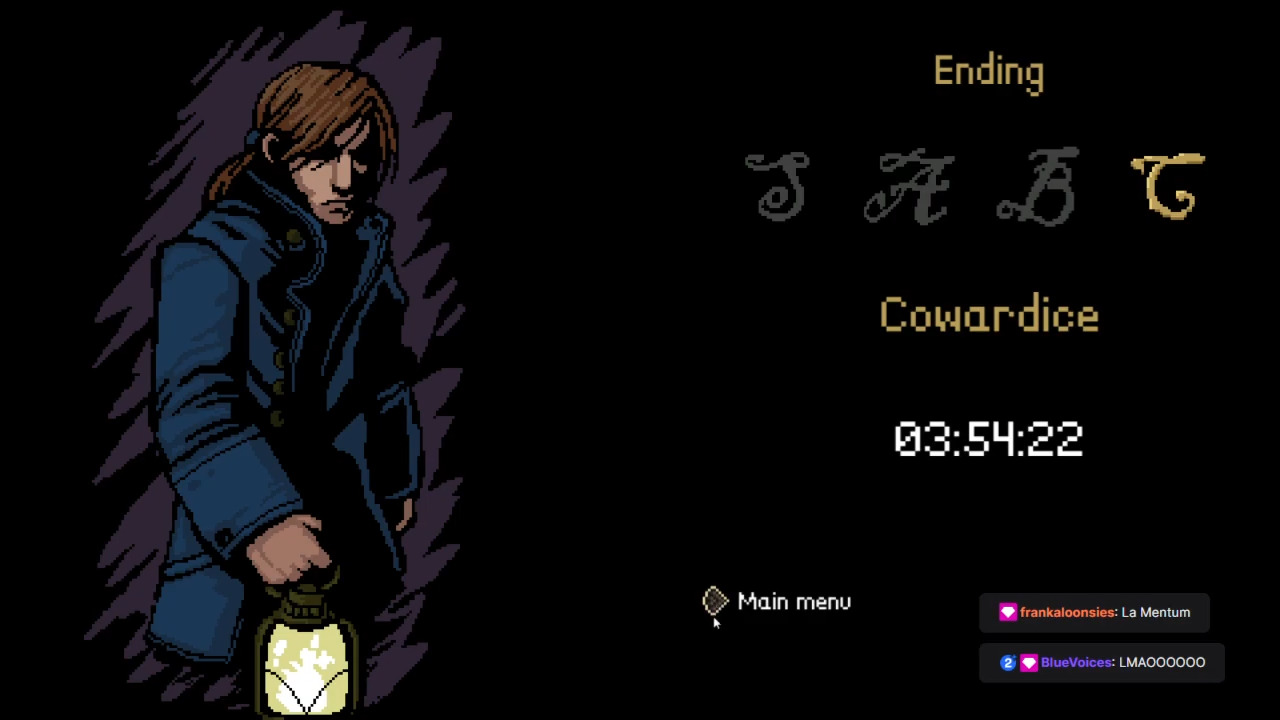
Lamentum’s narrative seems to be reaching for a story that beautifully illuminates the flaws of the human condition – that we can never have everything we want, but we strive for these things anyway. I was hoping that the escape ending would have been more than just a fancier fail state or game over. I had some faith that Lamentum would acknowledge that, even in the context of demon-worshipping rich people’s manors, there is something to be said for accepting that you have suffered, and that’s okay. I think Lamentum sabotages its chance to tell that story simply by saying you failed. In fact, it’s worse than that – the game calls this ending the “Cowardice” ending. This is a developer imposing their morality on you through explicit judgment from the game’s interface. That’s something I dislike. A reputation meter going up or down is fine – that’s diegetic. But morality? Outside of something like Star Wars, that’s a much thornier concept to have to code in to your game. It’s a pitfall, in other words, an obvious trap. Lamentum suffers from this, just as something like Fallout 3 (Bethesda Softworks 2008) does when it’s poorly thought through or scripted badly.
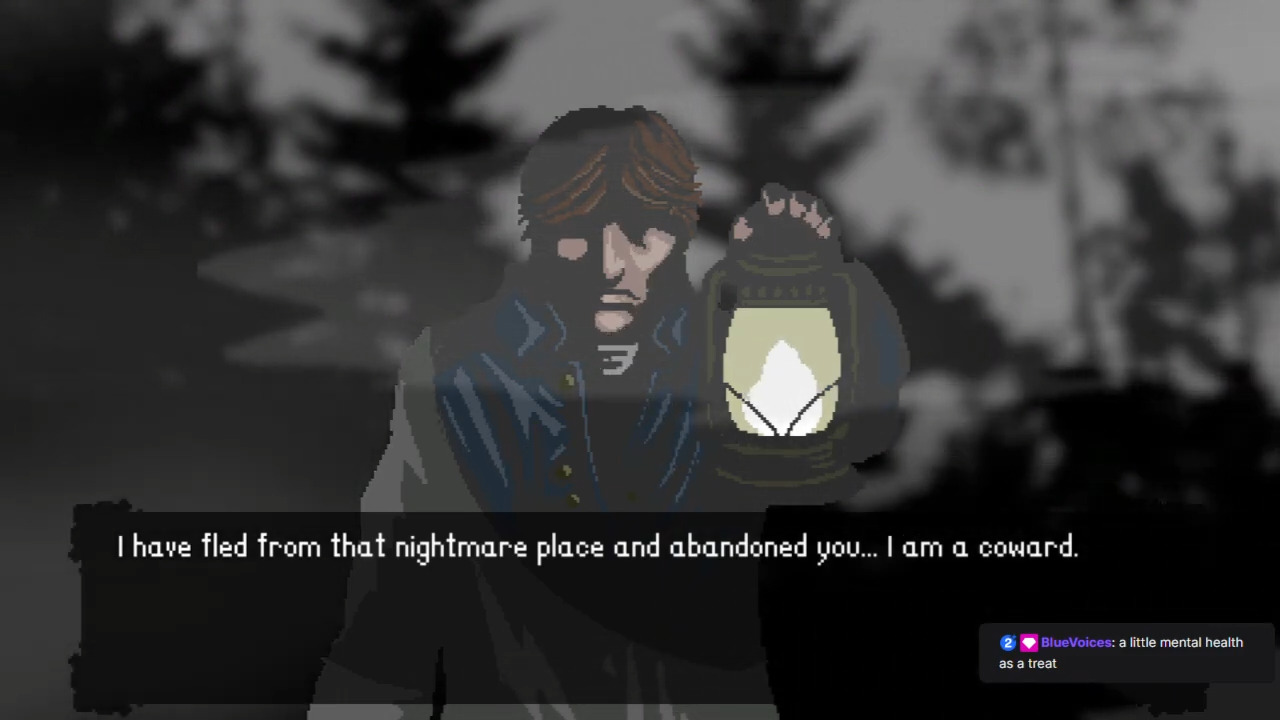
It’s at this point that you’re probably thinking again of Clock Tower’s car escape ending. Because I think that car ending seems, on the surface, similar to Lamentum’s laughably-named “Cowardice” ending. Clock Tower’s escape ending punishes Jennifer with death for abandoning Jennifer’s friends and the search for the truth, and Lamentum’s ending punishes Victor with a lack of peace and resolution for his own inability to discover that truth. But where one game is about saving one’s friends and obtaining justice for the dead, the other game is about much headier, more existential questions. When is it right to say goodbye? When do we say that our own survival is more important than that of true, total closure? Adding supernatural elements merely complicates this matter. The developers of Lamentum say that total closure is not only possible, but that it is the only route to take, even to the point of seeing even more grotesque abominations and witnessing our own total destruction, mental or physical. Taking the rest of the game’s themes into account, I consider this an irresponsibly self-destructive attitude.
A game’s narrative framing is exceedingly important. A game’s themes are exceedingly important. When a game misinterprets – seemingly – its own themes, I can’t help but feel frustrated. It felt to me that Lamentum’s developers included it as an option just to taunt the player. Clock Tower’s ending ramped up the horror – the killer is in the backseat! – but Lamentum’s ending stumbles at the finish line, collapses into a ragged heap, and says… you suck. That also could have been a good ending if the narrative had cohered more. If Victor’s wife had indeed actually seemed alive. If there’d been more hints that things could have a happier resolution. If it hadn’t been a game about pursuing the spectre of one’s dead loved one. Taken at face value, the game’s message endorses an endless, unhelpful obsession with memory and “better days”. But fleeing is the choice that fits the game’s themes and its narrative – and the game scolds you for taking it. We have a responsibility to do better, and to demand better, from a game talking about serious human experiences. It’s fine to have a joke ending, or for a game to fall flat – but critique in the latter case is always important. It’s clear as well that Lamentum means it when it says you’re a coward. It’s not joking around.
Should games be moral vehicles, all the time? No. But I think game developers need to think more carefully about the lessons imparted not just by mismanaged ending dialogues, but by the gameplay themselves. There’s more to come from me on that front, but I’ve been looking at expanding on some of what Ian Bogost says in his book Persuasive Gaming (2007), and in the book Persuasive Gaming in Context (2021), which reflects on the successes and failures of that movement. We do ourselves as video game players a disservice to not reflect on the games we play, and the messages they contain. It’s exceedingly important, in an age where authoritarian backsliding claims video games are immoral, to acknowledge the flaws of the medium while still spitting in the face of those who demand censorship and for video games to just go and be edutainment all the time, or even worse, to just kill the medium off entirely. There’s a middle ground – video games can establish their procedural rhetoric more carefully and more thoughtfully, making for deeper, more mature gaming experiences. At the same time, games should also not go about trying to prevent you from pulling the trigger as a demon worshipper’s face is turned into a meaty paste by a shotgun.
There’s a fine line to be walked in the coming years, and I hate dipping my toes into the culture wars – a distraction from the bigger problems of wealth inequality and the authoritarian centralization of power – but video games, I think, are going to be an increasingly political flashpoint. They can tell stories about ecology, about resource mismanagement, about the horrors of political injustice. They are vectors for defiance in regards to gender, sexuality, climate, gun laws, immigration, genocide, war, and mass death such as that being horrifically dealt to Palestinian people right now – and we, as game lovers, game critics, game scholars, game players, have to use them for good, now more than ever. Free games like those made by Twine creator Porpentine offer defiant readings of modern society and selfhood. Video games can be sites of resistance, as well as places of good storytelling. And that, I think, is why rightwing advocates are afraid of them. Should games be moral vehicles? No. But they should be defiant and put forward coherent narratives and gameplay, ludo-narrative harmony rather than dissonance, that give us reason to strive for better. We owe it to each other as human beings.
 Horrorgameanalysis