

Things have been hard lately, so where better to go than Star Wars for a nostalgic escape? Star Wars; a childhood franchise that I am so well-versed in, I have encyclopedias dedicated to the universe on my shelf, bought with childhood birthday money. I pored over these, luxuriating in all the details I couldn’t get from the novels. It would have been more expensive to have bought all the novels than just one chunky encyclopedia, you see. So I found myself imagining stories based on snippets, and reading about a fictional world’s history as though it was real had a genuine impact on my appreciation for the setting. There’s something special about the structure of the universe itself, a setting that comes with so much rich baggage, so many stories told in the background of all of these galaxy-wide conflicts. Over the years, my knowledge of the worldbuilding was able to be justified as I finally bought some of the legendary stories told in footnotes. Some of the stories, of course, are better than others.
Star Wars Knights of the Old Republic II: The Sith Lords (Obsidian Entertainment 2004), aside from having a really long title, also has one of the best Star Wars stories ever told. In fact, dare I go one step further, it has one of the best video game plots ever. At least, it does for most of its runtime. I’ve played The Sith Lords a lot, on a number of different machines, but I mainly associate it with a little nook in my grandparents’ house, which often basked in the sun and had a nice look out on a brick area for dining and playing chess. I can almost hear my parents’ fat laptop whirring as it reads the disc. Remember laptops with disc drives? I feel like that question is going to date me and this article terribly now, let alone if someone excavates it later in the next twenty years.
Putting aside questions of nostalgia, however, I think The Sith Lords is a game that would still grip people today, and it does so even if you don’t have any knowledge of Star Wars, either. In fact, that might even help, given The Sith Lords feels a bit different from other Star Wars media. Part of what makes The Sith Lords sing is its story structure. We progress from hostile and claustrophobic, to a small albeit restricted hub, to traditional planet exploration. The game begins in an abandoned mining facility known as Peragus. Peragus is hostile, foreboding, and abandoned. It is littered with corpses, and the robots that once worked alongside the people are either destroyed or insanely hostile. Unpicking what happened here forms the first part of The Sith Lord’s story, and it makes for a dour introduction to a Star Wars game. Unlike the frantic battles and gorgeous scenery of the original Knights of the Old Republic (BioWare 2003) – which emulated the journey that A New Hope (Lucas 1977) puts viewers through – The Sith Lords asks players to have a bit more patience.
Let it be known once again that I am an unapologetically huge fan of Star Wars, if the first paragraph in this article didn’t make it clear. I loved almost every bit of Star Wars I could get my mitts on when I was younger, which has made revisiting some of that material as an older woman difficult, I think because I’m now no longer as interested in sheer bombast as I used to be. Well, I still like it, but I think a work of fiction needs to have particularly strong characterization to be interesting. Characters have to grow, evolve, and show that they are thinking and feeling beings. Thus, it is that the characters of The Sith Lords still occasionally surface in my head as pinnacles of video game companion writing.
What is the purpose of a good companion in a roleplaying game, anyway? It’s to make your experience more interesting, right? To deepen our understanding of the world. Rather than just having one’s own perspective, we can now ask for a companion’s view of the world, which – I believe – is inherently valuable. Obviously some will gel with you more, but some you will probably find are inseparable. It is the strength of the companion writing that I remember elevating the game when I was younger. It is part of what I will focus on specifically in this series. I haven’t played the game in its entirety for years now, although I opened last year’s set of blog posts singing its praises. But that was a long time ago now frankly, and the last year in particular has made me a better writer. At least, I hope you’ll agree! Looking back on that post, I’ve come a long way.
So now, I wanted to make a series of posts that examine the game in parts as I replay it this year. I have a deep, nostalgic connection to the universe and the game itself, as I’ve said. Now that I’m older and wiser (more Yodarly, one might say), I want to be able to turn my analytical abilities on The Sith Lords. Some posts will focus on game mechanics, while others will be overviews of areas, and some will focus on a couple of companions each at a time. I also hope to have a look at the game’s overarching philosophies and moralities, because the more I play it, the more I realize that it was such an influence on me. When I look at game writing – and as I am writing a game or two myself right now – I instinctively think back to the models of choice and consequence this game presents. The game always prompts you to consider moral systems in games as a whole, even as you pick between “be nice” or “be mean” at certain points. A snide Dark Side character is still an essential function of any Star Wars roleplaying experience, but The Sith Lords deconstructs it more than any other Star Wars media I have yet encountered.
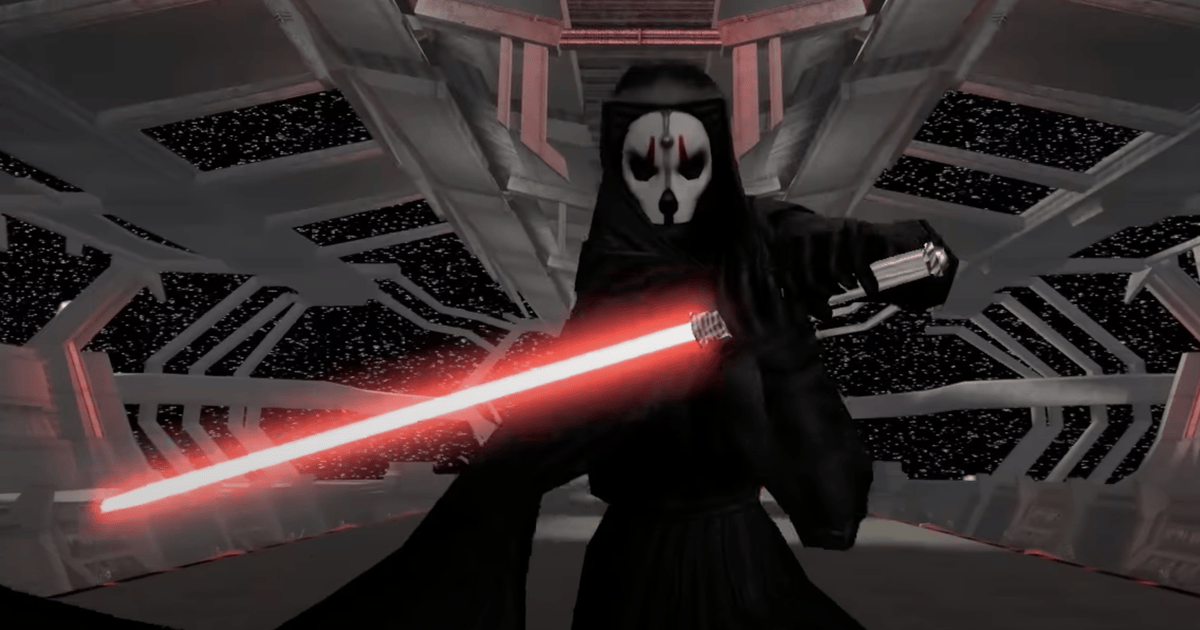
Another aspect of the game that I have always loved is its incredible atmosphere. Each location in the game links strongly into the game’s overarching themes – that of trauma, and recovering from war. The original Knights of the Old Republic tells the story of a jedi-in-training, rising to help the Republic defeat a Sith Lord with an ancient war-machine building engine at his beck and call. Of course, you can choose to side with him and declare war on the Republic, but the story is always one of triumph for you, the player character. The Galaxy, one way or another, will be saved. Except… that’s not how it really goes.
Knights of the Old Republic II tells the story immediately following that of the original game, just a short five years later. It looks at the situation left at the end of the first game and tells a story with, you guessed it, consequences for the actions taken by characters in the previous game. It is a galaxy that has been torn apart by war. Some planets are scarred by war crimes, others beholden to alliances made in war that have rendered them subjects (in some people’s eyes, anyway). Others are abandoned, ghostly places now, far from the once-bustling hubs they were in the original game. Criminal organizations have stepped up to fill the position of authority once held by a now-bankrupt Galactic Republic. While senators bicker at the heart of the galaxy, unsure of what vast projects to spend money on, common folk grow more and more distrustful of the system. And among all of this, the Jedi, the monastic order of intergalactic warrior-scholar-mage-knights, have gone all but extinct, with only a few remaining in hiding. Stalking them are the Sith, but instead of the vast war machine presented by the original, the Sith are now a clandestine organization that employs trained assassins and spies to destabilize the Republic and pick off the Jedi, one by one.
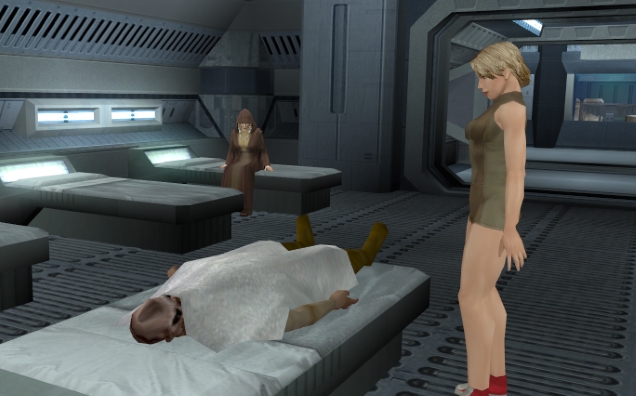
At the heart of all this is you, the Jedi Exile. Canonically a female Jedi named Meetra Surik (and the name I’ll be playing this playthrough with), the Exile used a devastating weapon that destroyed a planet during the Mandalorian Wars, wars that took place before the first game. They followed the renegade Jedi Knight who would become Darth Revan into the Mandalorian Wars, and they were the only Jedi who returned to the Jedi Council for punishment. As such, they were severed from the Force. Wandering the galaxy for many years, evading notice – until, of course, the beginning of the game.
This hopefully-weekly series of articles, then, and perhaps a video adaptation of these articles when I’m done, will examine The Sith Lords firstly as a game – with all of its mechanical systems – then as a set of narrative spaces, and finally as a character-driven philosophical piece, commenting, I think, on the nature of war and the repetitive conflicts that drive not just the Star Wars galaxy, but actual conflicts in our own world. It is a special, special game, and I look forward to exploring it all over again with you. In particular, I encourage comments and thoughts on these posts more than any other article series that I’ve done, because this game still fires me up and immerses me like almost no other – and I’d love to hear what other people think of this world and these characters as I bring them up.
I shall be taking a slightly different approach in some ways from my usual, more academic-centered approach for this series. Certainly sometimes I will be engaging with academic sources, but I want to take this opportunity to write something that has a bit more of the experiential and anecdotal about it, perhaps a let’s play in the moment, and an analysis running in conjunction with that. Additionally, I will go on various tangents – some articles will focus on broader subjects and questions as they become relevant. Nonetheless I’ll be engaging with game studies, popular culture academia, and media studies theorists going forward.
Before we begin, however, and I’m not sure this is the place or time for it, but I also wanted to mention and dedicate this series, at least in part, to the late Shamus Young, a game critic and writer that I very much looked up to. I remember reading some of his very early articles in that same nook at my grandparents’ house, though I was introduced to him via his satirical webcomic interpretation of Lord of the Rings via Dungeons and Dragons, “DM of the Rings”. He tragically passed away all too young in 2022, but left behind a deep, oftentimes hilarious, and thoughtful body of work. His most important series to me was the one he wrote on Mass Effect, breaking down the trilogy not just chapter-by-chapter, but looking at the series as a whole, examining its themes, and how it changed. I still consider his work an inspiration, and I feel that this series is an attempt to strive towards the work he did on game analysis and criticism outside of an academic space. It is some of the best long-form analysis I have ever read. He also hosted a great breakdown of The Elder Scrolls, by author Rutskarn. His children now operate the site, and I highly recommend looking at it and supporting them, if you haven’t already. I feel regret that I did not talk about Young earlier, but I think now, as I attempt to echo his long-form style in my own way. I would just like to say thank you to him posthumously for all the years of entertaining reading, and thank you to his children and his wife for keeping the legacy of his website alive, and bringing it into a new era. I can only hope that the writing I am about to digitally pen does indeed hold to the same standard I consider Young’s work to be at.
So, now, without further ado, let’s get stuck into Knights of the Old Republic II: The Sith Lords by asking the question – what the hell is this thing they call a “roleplaying game” anyway?
 Horrorgameanalysis