
It is dark. So dark. The forest is alive all around you, swelling with pustules in the leaves, in bodies, and fear is building in your mind. You’ve had a hell of a day, meeting an abrasively adorable cousin, inhabiting a sagging, creaking house, and running off to investigate cryptids in the dark with a cute girl you just met. You can’t help but ask yourself: what is going on in this town; this small-minded little place that expands your mind; this Scarlet Hollow?
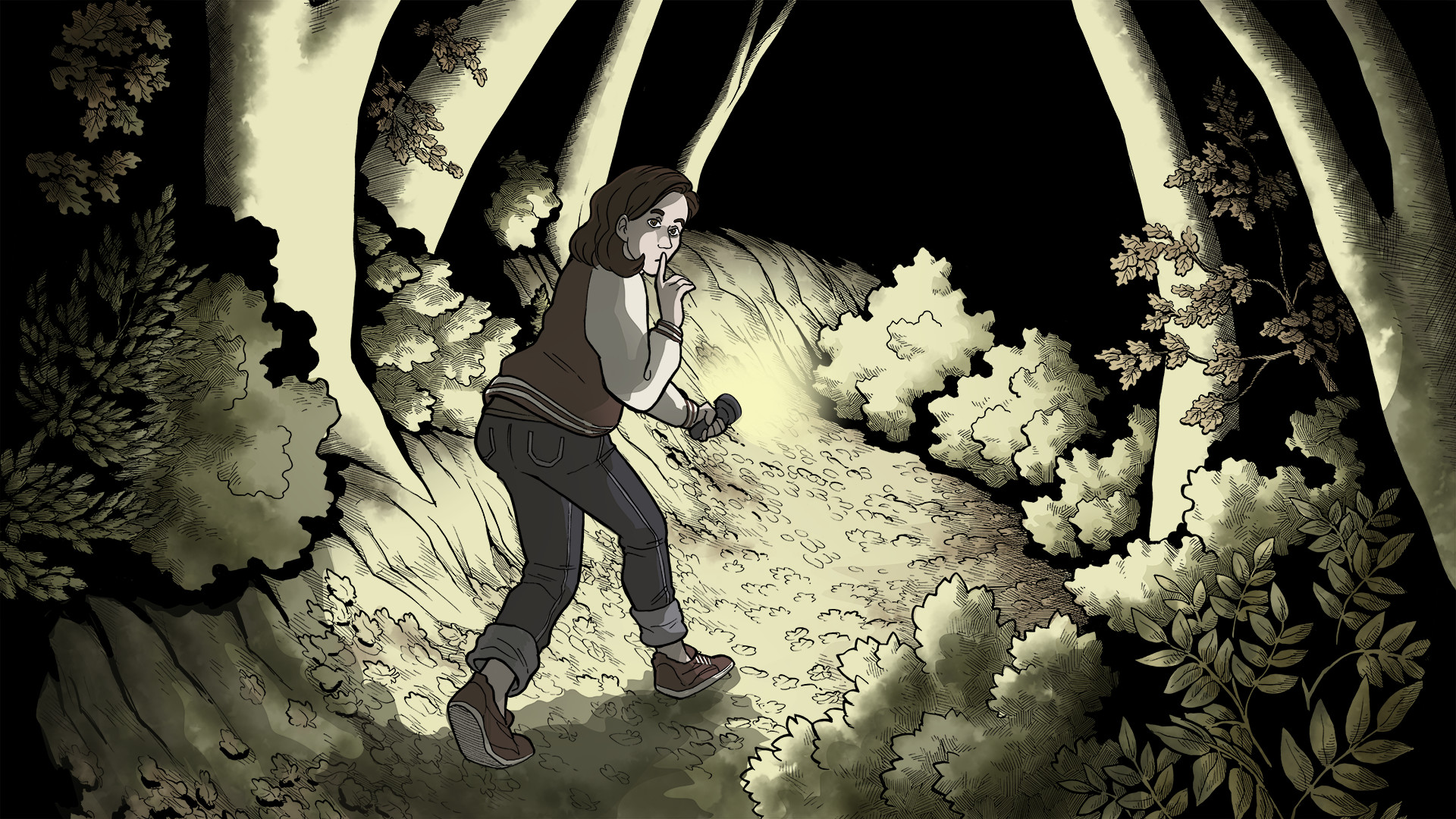
“I thought you weren’t afraid of me. Did something change?”
I feel I frequently dip into hyperbole. To put it another, more paranoid way, I feel that I must be perceived by my readers – by you! in the cheap seats! – to dip into hyperbole. I suppose when I find the drive (or feel the urge) to write about video games on this website, it is to rant. I do some raving too, I feel, and generally it is my responsibility to be a madwoman about whatever it is I’m obsessed with. I hop on my digital soapbox and cry out: it’s my website and I’ll do what I like! This is the persona I share with my students as well – it’s my class and we’ll talk about my favourite video games! Not actually, but, I mean… sometimes.
So, it’s with this overly-aggressive opening paragraph – seriously HGA, what’s your problem? – I declare that the episodic narrative-driven visual novel Scarlet Hollow (Black Tabby Games 2021 – Present) is yet another one of the best games I’ve ever played. Top ten, top five, top three, top one? Whatever I settle on, in the meaningless leaderboard war in my head, know this: Scarlet Hollow rules.
As a visual novel, it is impeccable. It branches so far within a single scene that it feels uncontrollable, possibly miserable to write. I know from my own visual novel efforts in the background of this blog, scripting things in a way that doesn’t drive you insane is so hard. It is in itself an insane ask, to write seventy-thousand words of genuine branching dialogue and narrative. But Scarlet Hollow does it. And the game continues to inspire me, all one million plus words of it.
The game’s dialogue is gorgeously written, and seemingly endless, responding to each and every little thing I would ever want to say. It also is well-written enough to forecast what exactly a player would want to say in any given situation. There is enough choice that everything feels like another bit in an interlocking puzzle. It was always going to play out this way, one might say. Ha, the game responds, replay and see if that’s true.
And it really isn’t.
The game is responsive, allowing a player to roleplay and to engage in what I call self-actualization, which in Scarlet Hollow is to really just flirt with everyone that’s available, while analyzing all the horrible things that are happening. Well that’s not true, actually. As those rare video games with good roleplaying options often allow, I fell for two characters immediately and then stuck like glue to the one that was actually interested in me.
I ended up roleplaying a kind of fawning puppy dog with a bookworm’s mind on my first playthrough. She was a tough-talker in dialogue but a roll-over-show-my-tummy-lesbian-puppy kind of pleading in actuality. Spend time with me, I always plead to characters I like, and yet in most video games, such things aren’t possible. In the majority of video games that are even interested in attempting to simulate relationality, romance is delimited, and so is friendship, for that matter. Everyone has their little moments, their small roster of lines, but so often the narrative is not interested in who the characters are as people, beyond ticking trope boxes. In most games, you can’t just hang out with whoever you like. And yet Scarlet Hollow actually responds to my febrile pleading. The game lets you spend time.
I can’t tell you how valuable I find this, as a fairly recent convert to the idea of friendship as something you can just… ask for. It is nice to see such casual hangouts, fun chats, sharing breakfasts or coffees or teas, simulated and represented in video game form. And the art style! Everything looks gorgeous, as you would expect from Black Tabby Games and Abby Howard’s marvelous art style. Everything has that southern gothic radiance, beauty and disgust mingled at once. Characters can look so happy and friendly and lovable and then be transformed just by lighting or facial expressions or angles. A person you love can be transformed in moments. It is like horror magic, like pulling the rug out from under you, time and time and time again.
It is so easy to fall in love with all of Scarlet Hollow’s characters, and be horrified when you have no choice but to make yet another obnoxiously cruel choice to decide their fates. And the game doesn’t back away from that, either. It remembers and acknowledges your choice, in a structural rather than aesthetic way. It is an impressive feat, to have characters I am so terrified of losing that I will disadvantage myself just to throw myself in front of the danger. And sometimes even then that doesn’t work.
And it’s Stella, by the way, for anyone asking. I love Stella.
“Yeah, Stella is sad. Give it a few years and you’ll be sad, too. Time comes for us all.“
Horror in video games is very subjective. I know I know, says the lady who calls herself Horror Game Analysis in this sector of the internet. And yet in my years of playing horror games, I have become deeply, deeply jaded. It is one thing for an occasional well-orchestrated jump scare to give me a little nervous jolt in my seat. That’s a pleasantly ordinary human reaction. But for a game to build a sustained aura of dread and actually maintain it? That is a much, much harder task. My nervous system is, at this point, very particular about what interests it. That’s why Scarlet Hollow plugs straight into my spinal column and says Stella Stella Stella Stella! over and over and over again.
I call what Scarlet Hollow does character-oriented or relational horror, wherein it is not the threat of what will happen to you, or even the fear of the dark, that motivates my jaded, sunglasses-wearing amygdala. It is, instead, of course, characters. Lovable characters that we don’t want to see hurt, that the game puts in awful terrible situations.
Scarlet Hollow’s design philosophy stands in direct antithesis to something like Man of Medan or Little Hope, the Dark Pictures games developed by Supermassive Games. Many of the characters in those games seemed to be designed to be annoying, which seemingly counters the player goal of those games: keep everyone alive. Survival horror mechanics or tense decision making alone does not make a good horror experience. Why should you be enthused to save a character that doesn’t show any human emotion? That doesn’t feel like someone you’d actually want to hang out with? It’s one thing to have a character be a bit purposefully annoying, or an asshole – but to have an entire roster of abrasive, annoying people who don’t grow or change for the better? That’s a recipe for disaster when it comes to horror immersion.
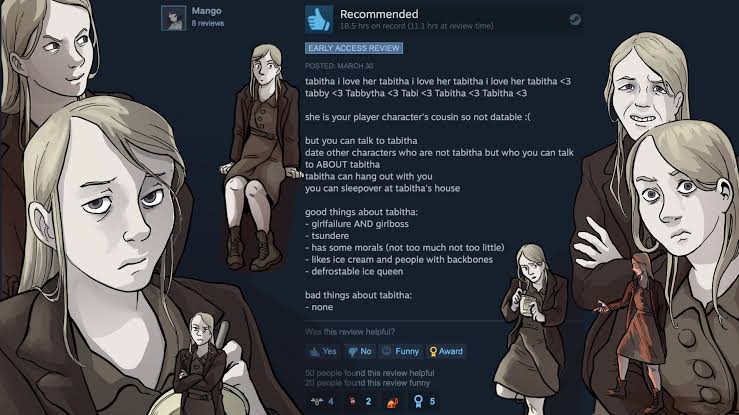
Fortunately, Scarlet Hollow resists such a disastrous mistake. Take Tabitha, for example, your player character’s aforementioned abrasively adorable cousin. She’s horribly cute, to start with, but she’s also horrible. Like, genuinely rude, don’t-touch-my-stuff horrible. She hates it when you clean her toilet, because there might have been a priceless family heirloom in her bathroom you inadvertently threw out when you did. She’s just kind of a jerk. But she’s also a stressed woman who is trying her best in a practically impossible situation. She’s been groomed from birth to run a failing business in a crumbling, creepy small town, where everyone depends on that business to survive. Without her, the town ceases to function. And so you start peeling back layers of Tabby’s personality, and subsequently you discover her personhood. You find out that she really wants children. And I’m going to be honest, as small as such a moment might seem to some, I felt seen. I reflected in her complicated, responsive personhood. When she smiled properly at me for the first time, I felt a few tears forming. Hell, I properly cried for her when she told me about the dark things she had to suffer through, and when I saw the evidence of her awful childhood. Why? Because I got to know her. I saw myself in her. I got to see her humanity. And don’t get me wrong, Tabitha doesn’t stop being a jerk. But she becomes my jerk.
Scarlet Hollow’s relationship system wasn’t an obligatory completionist’s checklist that I made it through in order to do so. It was time. Time is the mechanic of intimacy. Time is crucial, integral, precious; it was time I wanted to spend with her, finite game time. Game time which passes, and stops me from spending time with other people – actual or fictional. I valued Tabby and so she valued me. I spent time worrying about her, about wanting her to be okay, to know that she was loved and appreciated. And so I was so afraid whenever anything bad was going to happen to her – and if she ever betrayed me, badmouthed me, or was about to make an awful decision, I felt actual, consequential fear. Fear generated by the narrative, which is far better than any eerie monster – although the game has those in spades. I wanted to keep the people I love safe. And the game is cruel enough to let that be impossible for everyone. Not everyone in life gets a happy ending. In video games, you’re the one who spends the time with someone to make happy endings even vaguely possible. You’re the agent. You’re the one burdened with guilt.
I wanted to talk for a moment about character independence as well. Video game characters are so often frustrating, independent little gophers that don’t depend on anyone. That peel back their layers in enormous scripted sequences, big relationship moments that feel artificially big. Think about your Mass Effects, where romance sequences are enormous cutscenes, or your Stardew Valleys, where emotions are triggered and given in scenes by specific, obvious mechanical thresholds. Give x gifts or provide x number of rote and obvious compliments to marry someone.
But you know what moments I remember most with people in the actual world? The little times when their guard is down, when they’re comfortable, and they let things slip. Of course it’s all scripted, still – but the scripting is so marvelously done, so branching and responsive, that it feels seamless. The amount of time that has gone into development reflects how I just wanted to spend as much time with all the characters I loved as I could. Developer time creates player time which creates character time which creates genuine love, actual memories, and parasocial relationships, Tabby please love me!
And of course developer hours alone do not equal a good game. Wordcount alone does not equal a good bit of prose. But Scarlet Hollow does it. It nails it, even. There’s so much of it that you can spend so much time with everyone you really want to. And not just that. The prose is punchy and enjoyable, the dialogue funny and sad, the world immersive and terrifying. You want to spend so much time with everyone that to disappoint anyone is to feel real guilt. Or maybe I’m just such a softie that disappointing my favourite digital women is equivalent to social heat death. This, I think, is the pressure point of my own jaded nervous system; it is, in fact, a pretty pathetic little puppy dog who just doesn’t blink at scary monsters anymore.
Regardless! I think the great achievement is that my relationship with Tabby felt exactly the same as sitting with someone for an afternoon and actually getting to know them. Tabby and I talking always felt, in a word, authentic.
And so the little machine plugged into my spine, that temporal-relationship machine, starts a new chant – Tabby Stella Tabby Stella Tabby Stella! My nervous system has become in essence a neurotic Scarlet Hollow savefile.
To put it another, less obsessed way: the game’s status as a new favourite of mine comes down to a few things, but the actual humanity present all throughout Scarlet Hollow is the real selling point of the game. To the point that I would spend tens of hours reading the game’s one-million plus words just to get all the achievements. The game isn’t even done yet. And I can’t get enough.
 Horrorgameanalysis